2 Minute Rule: Keep People Engaged During Your Presentation
Change up the content every two minutes to keep people engaged.
2 Minute Rule
The Common Problem
While doing a presentation or public speaking, you may have seen many people losing the audience's attention, not due to unimportant content, but because the delivery is monotonous.
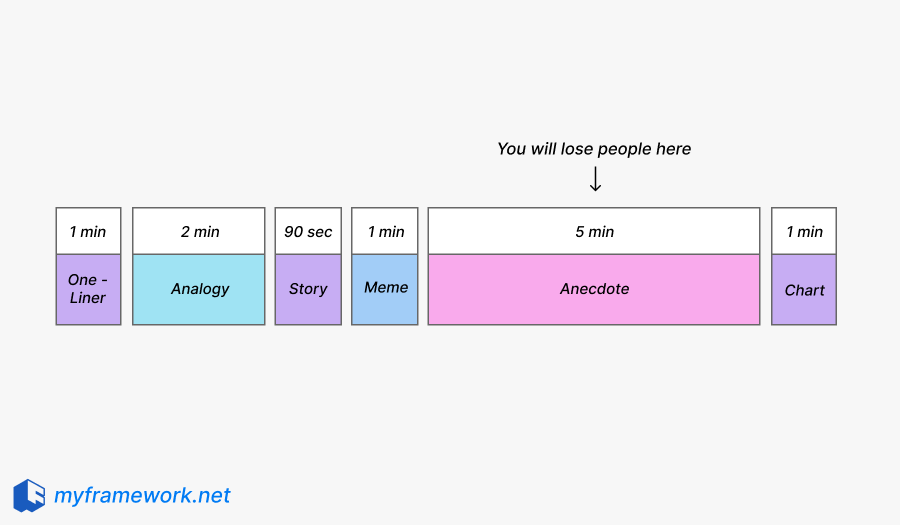
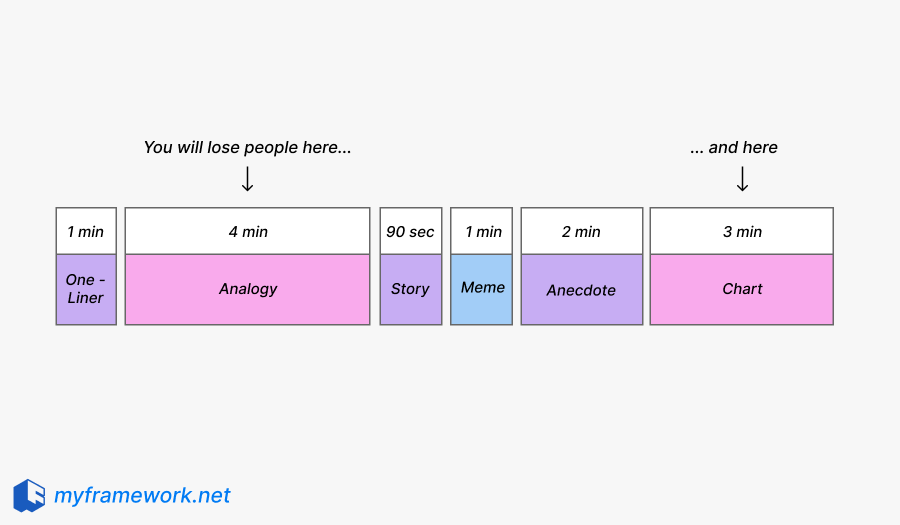
Research shows that adults can focus for about two minutes before their minds begin to wander if nothing changes. If your slides or speech keep the same tone for too long, even your best data will fade into background noise.
Why This Framework Works
The 2-Minute Rule is a communication strategy designed to keep audiences engaged by refreshing their attention every two minutes.
It stems from both cognitive science and practical presentation experience. Cognitive studies reveal that the human brain naturally craves novelty and contrast. This rule turns that insight into a simple, repeatable structure for meetings, speeches, and reports.
Detailed Explanation and Core Structure
The core idea is to change the format of your delivery at least once every two minutes so the audience’s brain gets a “fresh start.”
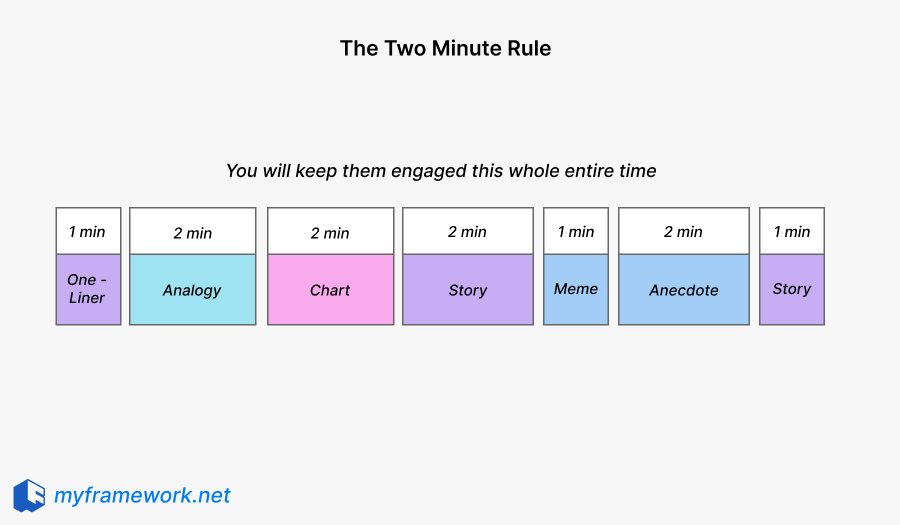
Each change is like flipping a page in a book—bringing new energy and focus.
Common switch methods include:
- One-liner (Punchline) – Start or transition with a short, memorable sentence. Example: “Data doesn’t lie, but storytellers can.”
- Analogy – Explain complex ideas with familiar comparisons. Example: “Upgrading our system is like replacing the engine of the entire supply chain.”
- Chart – Show data visually, not as a wall of numbers.
- Story – Share a real case that stirs emotion.
- Meme – Add a light, humorous image to reset attention.
- Anecdote – Insert a personal or relatable short story to make the content warm and human.
Arrange your slides to follow a pattern, for example: One-liner → Analogy → Chart → Story → Meme → Anecdote → Story.
Keep each segment under two minutes. Prepare transition cues like “This reminds me of…” or “Let’s go back to the data…” to signal a change.
When to Use
- Executive Status Updates: In data-heavy briefings, frequent format shifts prevent key insights from being lost as attention fades.
- Sales or Fundraising Pitches: In high-stakes decision settings, the rule helps sustain focus so core value propositions are fully absorbed.
- Training or Internal Knowledge Sharing: It keeps participants cognitively active during longer sessions and prevents passive listening.
- Large Meetings or Conference Talks: In environments with diverse audiences and scattered attention, it helps continuously “refresh” the room’s energy.
- Recurring Team or Weekly Meetings: It reduces fatigue caused by routine updates and increases engagement and willingness to participate.
Key Takeaway
Audience disengagement is rarely caused by bad content, but by static delivery.
The 2-Minute Rule works because it aligns with how the brain naturally resets attention.
By deliberately changing format, you give your audience repeated entry points back into your message.
Strong presentations do not speak faster; they refresh attention more often.
FAQ
What should a good 2 Minute Rule output look like?
A good result is a message that lands quickly because the main point is obvious, the supporting logic is grouped cleanly, and the audience can follow the argument without hunting for the conclusion. If the audience still has to reconstruct the point for themselves, the framework has not been used well.
When is 2 Minute Rule not the right tool?
It is a weak fit when the real problem is missing evidence, weak judgment, or disagreement about the decision itself. 2 Minute Rule improves how the message is expressed, but it cannot compensate for thin thinking underneath it.
Can 2 Minute Rule help with status reports?
2 Minute Rule is useful for status reports when the audience needs a message they can absorb quickly and act on. It adds the most value when you already know the point you want to make but need a stronger way to deliver it.