4Ps Problem-Solving Framework: Discover Problems Before Solving Them
Discover the real problem before solving it.
4Ps Problem-Solving Framework
Why We Often Fix the Wrong Problem
In many teams, people rush to find solutions. They brainstorm, plan, and execute quickly but still end up solving the wrong issue.
The real challenge is not about how fast you think but how deeply you observe. True problem-solving begins with discovering what the real problem is. That is the core idea behind the 4Ps Problem-Solving Framework.
The 4Ps Problem-solving Framework helps people redefine problems before jumping to solutions.
It was developed by Japanese scholar Yoshinori Saito in his book <Professional Problem Finding: Conceptual & Analytical Skills>.

Saito believes that smart thinking is not about speed but about perspective. The model offers four dimensions: Purpose, Perspective, Position, and Period, which help you uncover the true nature of a problem through system thinking.
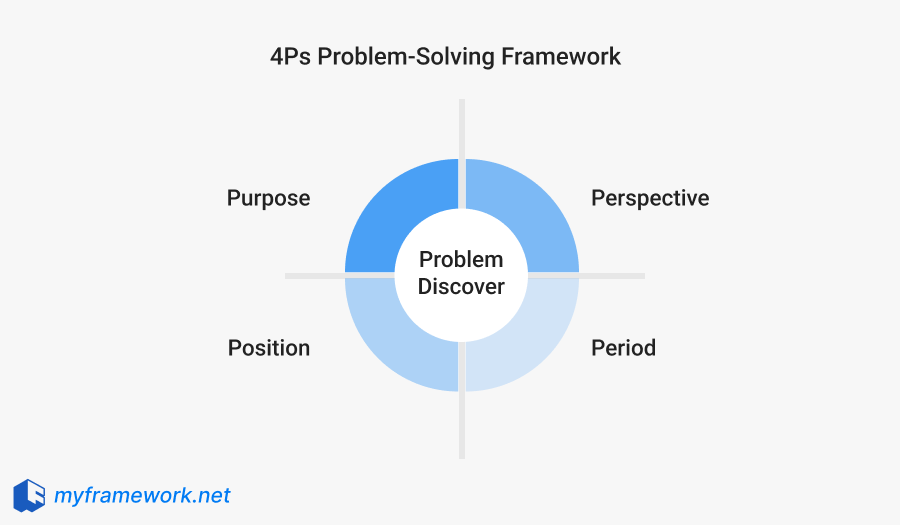
By examining a problem through these four lenses, you can avoid shallow assumptions, understand complex relationships, and make better decisions that create lasting results.
The Core Concept: Four Dimensions of 4Ps
Purpose – The Why Behind the Problem
This dimension focuses on the real intention behind an action. Often, we lose sight of why we started something in the first place.
To find the root cause, use the 5 Whys technique and keep asking “Why?” until you uncover the fundamental reason.
Example:
You go swimming to stay healthy, but soon focus only on daily check-ins for motivation. The original goal, which was health, gets replaced by habit. The issue is not the action but forgetting the purpose.
Perspective – The System View
Perspective expands your field of vision.
It reminds you that every issue exists within a larger system. By using system thinking, you can see how different elements interact and influence each other instead of treating each part as isolated.
This approach connects closely with the Zoom-In and Zoom-Out framework.
When you Zoom In, you focus on details to understand the structure of the problem. You observe patterns, causes, and hidden connections. It helps you gain deeper insight into what is really happening beneath the surface.
When you Zoom Out, you step back to view the entire picture. You see how the issue fits into a wider context — how policies, markets, people, or timing influence it. This shift prevents you from overemphasizing one part while missing how everything connects.
Example:
Housing price changes affect buyers, sellers, governments, and banks differently. Looking only from one angle hides the full structure of the issue. Broaden your perspective and you will find the real dynamics beneath the surface.
Position – The Stakeholder Lens
Every problem involves multiple sides. The Position dimension encourages you to analyze the issue from different stakeholders’ viewpoints.
Example:
Buyers want lower prices, sellers want higher ones, governments want stability, and banks want continuous lending. The conflict is not about who is right but about differing positions. Seeing all sides helps you find balance instead of blame.
By shifting positions and seeing through others’ perspectives, you can uncover hidden motivations and find solutions that work for everyone involved. Understanding the position behind each opinion helps you move from confrontation to collaboration.
Period – The Time Lens
The Period dimension reminds us to think across time horizons.
Use the 10–10–10 rule to consider the effect of your decision in 10 minutes, 10 months, and 10 years.
Example:
You want to quit your job. Ten minutes later, you feel relief. Ten months later, you may feel uncertain. Ten years later, you might see it as a turning point. When you stretch your time view, short-term emotions lose their power.
In summary, these four dimensions encourage a deeper and more structured way to analyze problems so that what you fix truly matters.
When to Use
- Misframed issues: When you have plenty of activity but results stay the same because the “problem” keeps shifting.
- Stakeholder conflicts: When different groups disagree on what matters, what success means, or what trade-offs are acceptable.
- Systemic complexity: When the issue has multiple interacting causes and fixing one part creates side effects elsewhere.
- Time horizon decisions: When short-term pressure is distorting judgment and you need to test decisions across timelines.
Example
Step back before solving
Ask which of the four dimensions you have overlooked.
Map your insights
Write down what the problem looks like from each “P” and notice the connections.
Reframe before acting
Once you see the issue clearly, your next step becomes obvious and effective.
Key Takeaway
The best problem solvers are not those who act fastest but those who see deepest.
The 4Ps troubleshooting framework helps you pause, observe, and understand before you fix. True improvement comes not from more effort but from a smarter perspective.
FAQ
What should a good 4Ps Problem-Solving Framework output look like?
A good result is a routine or working method that is easier to repeat and produces a visible practical benefit such as clearer notes, steadier focus, or better recall. If the user cannot feel or observe the difference in practice, the method has not been applied well.
When is 4Ps Problem-Solving Framework not the right tool?
It is a weak fit when the problem requires a deeper system change, not just a better routine or technique. 4Ps Problem-Solving Framework can improve how the work is done, but it will not solve structural constraints, motivation issues, or conflicting priorities on its own.