7-38-55 Rule: How Tone and Body Language Shape Communication
Your presence speaks louder than your words.
7-38-55 Rule
What's Causing Misunderstanding?
Have you ever sent a message that was misunderstood? Maybe you said something in a meeting, but people focused more on your tone than your words. This happens because communication is not just about words.
Albert Mehrabian, a psychology professor at UCLA, developed the 7-38-55 Rule to explain how people interpret messages.
His research in the 1960s found that when we express feelings and attitudes, only 7% of meaning comes from words, 38% from tone of voice, and 55% from body language.
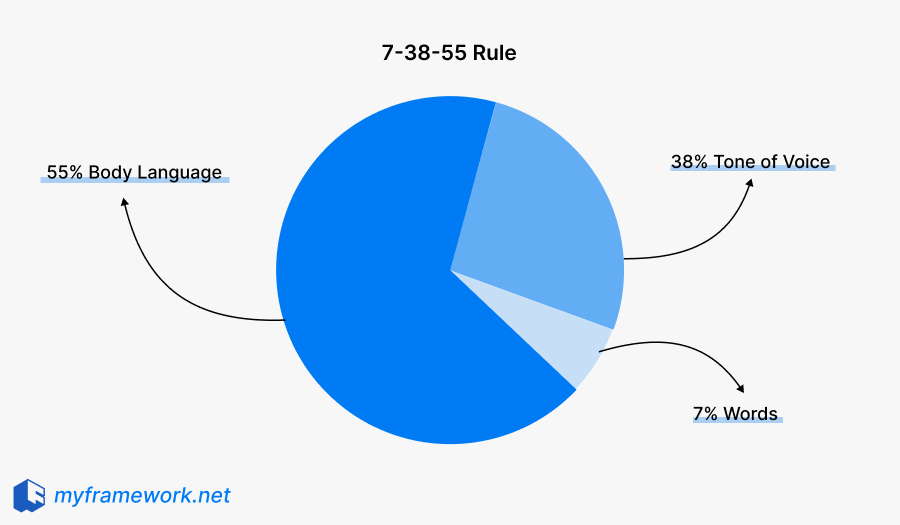
This rule helps us understand why tone and body language matter in communication. It is widely used in public speaking, leadership, and daily conversations.
Core Concept of the 7-38-55 Rule
7-38-55 Rule is about how people understand emotions in face-to-face communication. They will judge your communication based on:
- 7% – Words: The actual words we actually say
- 38% – Tone of Voice: How we say the words, including pitch, speed, and volume
- 55% – Body Language: Facial expressions, gestures, and posture
This means that when words and nonverbal signals do not match, people trust nonverbal cues more.
For example, if someone says, "I'm fine" but looks upset and speaks with a shaky voice, we believe their body language and tone, not just the words.
When to Use
- Workplace Feedback: When delivering praise or criticism, tone and body language often determine whether your message feels supportive or threatening. Even well-chosen words can fail if your delivery feels cold or tense.
- Public Speaking: Audiences respond more to how you show up than what you say. Eye contact, posture, and vocal energy shape credibility long before your content is evaluated.
- Negotiation: Trust is built through consistency. If your words signal cooperation but your tone or posture suggests resistance, counterparts will sense the mismatch immediately.
- Personal Conversations: In sensitive discussions, people listen for emotional safety. Calm tone and open body language often matter more than perfect phrasing.
Key Takeaway
Mastering the 7-38-55 rule isn't just about watching your body language; it is about achieving total alignment.
To be a persuasive communicator, you must ensure that your physical presence (posture, eye contact) and your vocal delivery (confidence, pacing) actively support and reinforce your spoken words.
When these three elements are completely congruent, your message transforms from mere information into a powerful, trustworthy signal that truly connects with your audience.
FAQ
What should a good 7-38-55 Rule output look like?
A good result is a message that lands quickly because the main point is obvious, the supporting logic is grouped cleanly, and the audience can follow the argument without hunting for the conclusion. If the audience still has to reconstruct the point for themselves, the framework has not been used well.
When is 7-38-55 Rule not the right tool?
It is a weak fit when the real problem is missing evidence, weak judgment, or disagreement about the decision itself. 7-38-55 Rule improves how the message is expressed, but it cannot compensate for thin thinking underneath it.
Can 7-38-55 Rule help with public speaking?
7-38-55 Rule is useful for public speaking when the audience needs a message they can absorb quickly and act on. It adds the most value when you already know the point you want to make but need a stronger way to deliver it.