7C Pyramid Communication Framework: A Checklist for Clarity
Aim to eliminate confusion and miscommunication in both verbal and written forms
7C Pyramid Communication Framework
We Need Clear Messages
Effective communication is the cornerstone of success, whether you’re navigating the boardroom, delivering a presentation, or simply having a conversation. But how can you ensure your message is clear, precise, and impactful?
Here comes the 7C Pyramid communication framework, a powerful model designed to optimize how we convey information in any setting.
Whether you're a businessman making crucial decisions or a college student working on a group project, mastering these principles can significantly elevate the quality and effectiveness of your communication.
What is the 7C’s Model
The 7C Pyramid Communication Framework is a guideline for workplace communication, it provides a clear structure for building stronger communication skills, ensuring that every message is effective and easy to understand.
The model was developed by Scott M. Cutlip and Allen H. Center, renowned scholars in the field of public relations and communication. Their work in the mid-20th century sought to improve how businesses and organizations communicate with their audiences.
Initially targeted at public relations professionals, the model quickly gained traction across various communication disciplines for its practical and straightforward approach to effective messaging.
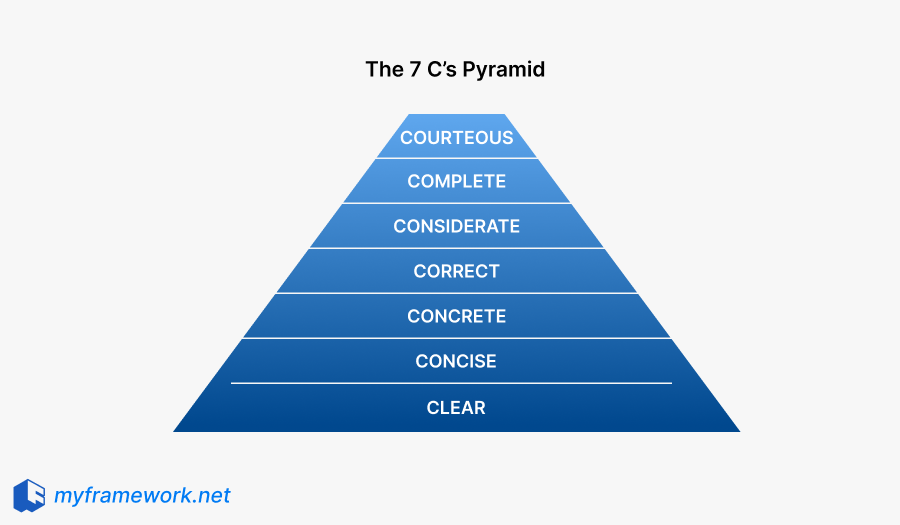
It defines seven essential qualities that make communication successful: Clarity, Conciseness, Concreteness, Correctness, Consideration, Completeness, and Courtesy: act as a checklist to ensure that messages are impactful, easy to understand, and tailored to the audience’s needs.
Core Concept of 7C's Pyramid
Clear
The foundation of effective communication is clarity.
The message should be clear and straightforward, avoiding ambiguity. Ensure that the purpose of your message is easily understood by the audience, and that language and terminology are simple and accessible.
Tips of Usage
- Use simple languages
- Avoid jargon unless necessary
- Provide context when needed
Concise
Be concise in your communication.
Avoid unnecessary details, and eliminate jargon or filler words. Deliver your message in as few words as necessary, without leaving out essential information. The goal is to convey your message efficiently without losing its meaning.
Tips of Usage
- Get to the point quickly
- Eliminate necessary words
- Use bullet points for easy digestion
Concrete
Ensure your message is specific, definite, and backed by facts. Concrete communication helps the audience grasp the message more easily and minimizes misunderstandings.
For example, use statistics, examples, and clear language that describe facts rather than vague statements.
Tips of Usage
- Use tangible facts and figures
- Provide real-world examples
- Avoid vague generalizations
Correct
Use the correct language, grammar, and spelling in your communication.
Correctness also involves ensuring that your message is suitable for the audience in terms of language, tone, and formality. It reflects professionalism and attention to detail.
Tips of Usage
- Double-check facts and figures
- Use proper grammar and spelling
- Cite source when appropriate
Considerate
Always consider the audience’s perspective, needs, and expectations. Tailor your message in a way that resonates with them, taking into account their background, emotions, and level of understanding.
Empathy in communication leads to stronger connections and better reception.
Tips of Usage
- Organzie thoughts sequencely
- Use transition words effectively
- Maintain a consistent tone
Complete
Ensure that your message includes all necessary information for the recipient to understand and act upon.
A complete message answers any potential questions the audience may have and provides sufficient context, ensuring nothing important is left out.
Tips of Usage
- Using 5W1H model
- Anticipate and address potential questions
- Offer next steps or calls to action
Courteous
Be polite, respectful, and considerate.
Courtesy is about being tactful and showing respect for the audience’s values, feelings, and perspectives. A courteous approach helps to foster goodwill and trust in communication.
Tips of Usage
- Use polite language
- Show empathy and understanding
- Be inclusive and mindful of diverse perspectives
When to Use
- Email Writing: To reduce long email chains.
- Marketing Copy: To ensure the value proposition is concrete.
- Crisis Management: When every word must be correct and considerate.
Key Takeaway
Clear communication is not about style, talent, or intention. If a message fails, the failure is rarely on the reader.
The 7C Pyramid makes quality communication a deliberate choice, not a guessing game.
FAQ
What should a good 7C Pyramid Communication Framework output look like?
A good result is a message that lands quickly because the main point is obvious, the supporting logic is grouped cleanly, and the audience can follow the argument without hunting for the conclusion. If the audience still has to reconstruct the point for themselves, the framework has not been used well.
When is 7C Pyramid Communication Framework not the right tool?
It is a weak fit when the real problem is missing evidence, weak judgment, or disagreement about the decision itself. 7C Pyramid Communication Framework improves how the message is expressed, but it cannot compensate for thin thinking underneath it.
Can 7C Pyramid Communication Framework help with business emails?
7C Pyramid Communication Framework is useful for business emails when the audience needs a message they can absorb quickly and act on. It adds the most value when you already know the point you want to make but need a stronger way to deliver it.