Active Listening Spiral: The Cycle of Deep Understanding
A framework enhances understanding, empathy, and responsiveness.
Active Listening Spiral
Where Misunderstanding Comes
Are you often left wondering if you've completely misunderstood key information during a conversation? Maybe the details you thought you understood turn out to be entirely off base.
Misinterpretation happens to everyone, but the solution lies in refining how we listen. The Active Listening Spiral framework could be one of the solutions.
It's a comprehensive, step-by-step guide that helps you capture, understand, and respond to information accurately and thoughtfully.
Why Practice the Active Listening Spiral?
The Active Listening Spiral goes beyond hearing words; it guides you through each layer of listening, from paying attention to responding thoughtfully.
This framework is especially valuable in scenarios where understanding, empathy, and accuracy are critical, like counseling, negotiations, and leadership.
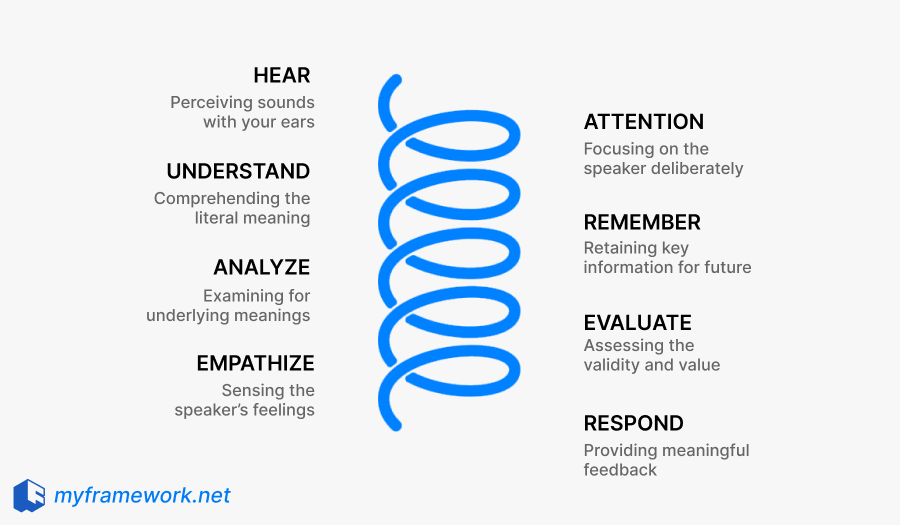
Each stage deepens your listening skills, enabling you to respond in ways that reflect a genuine understanding of the speaker’s message. So, where can this powerful tool be put into action?
How to Use the Active Listening Spiral
The Active Listening Spiral is broken down into clear stages to guide you through each interaction.
- Hear: Start by focusing on the speaker’s words, absorbing each detail.
- Attention: Give undivided attention, setting aside distractions.
- Understand: Decode the message’s meaning to grasp the speaker’s intent.
- Remember: Store key points to refer back to them later.
- Analyze: Break down the information, looking for underlying messages.
- Evaluate: Assess the message’s relevance, credibility, and alignment with your knowledge.
- Empathize: Connect emotionally with the speaker’s perspective.
- Respond: Provide thoughtful feedback, showing that you’ve understood the message.
By following each stage, you can transform how you listen and engage, turning every conversation into a constructive, insightful exchange.
Example
Counseling and Therapy
Counselors must grasp clients' feelings and thoughts to offer meaningful support. Therapists use this framework to focus on the client, empathize with their emotions, and respond with tailored advice that builds trust and a safe space for sharing.
Leadership and Management
Managers and leaders often need to connect with their teams on a deeper level to motivate and support them. By attentively listening, empathizing, and responding effectively, leaders can foster trust and build a collaborative, understanding team environment.
Sales and Customer Service
Active listening is essential for meeting customer needs. Sales professionals and customer service agents use this framework to analyze customer concerns, respond with empathy, and build lasting relationships based on trust and satisfaction.
The next time you’re in a situation where clarity and empathy are essential, remember the Active Listening Spiral. Practicing this framework will improve your understanding and foster stronger, trust-based connections.
Key Takeaway
Listening breaks down not because people lack empathy, but because they stop processing too early.
Understanding words is not the same as understanding meaning. The real gap appears between analysis and empathy.
The spiral reminds us that response quality is determined long before we speak.
FAQ
What should a good Active Listening Spiral output look like?
A good result is a message that lands quickly because the main point is obvious, the supporting logic is grouped cleanly, and the audience can follow the argument without hunting for the conclusion. If the audience still has to reconstruct the point for themselves, the framework has not been used well.
When is Active Listening Spiral not the right tool?
It is a weak fit when the real problem is missing evidence, weak judgment, or disagreement about the decision itself. Active Listening Spiral improves how the message is expressed, but it cannot compensate for thin thinking underneath it.
Can Active Listening Spiral help with counseling?
Active Listening Spiral is useful for counseling when the audience needs a message they can absorb quickly and act on. It adds the most value when you already know the point you want to make but need a stronger way to deliver it.