CBT Framework: Mastering Your Mind’s Operating System
It’s not the situation that causes your emotions — it’s how you think about it.
CBT Framework
Why Do We Struggle with Negative Emotions?
Have you ever had moments like these?
- You try your best, but still wonder: “Am I just not good enough?”
- One small mistake makes you feel like a total failure.
- You want to change, but you keep delaying, and days go by.
These feelings are more than just mood swings. Often, they come from the way we think.
The CBT Framework, also known as Cognitive Behavioural Therapy (ABC Model also belongs to this), is a simple and practical framework that helps you understand the link between your thoughts, emotions, and behaviors.
It was developed in the 1960s by psychiatrist Aaron T. Beck, and it’s widely used today in therapy, coaching, and self-help.
Instead of forcing yourself to “stay positive,” CBT teaches you how to notice and shift the thoughts that shape your emotions. It’s not about ignoring reality — it’s about understanding how your thinking patterns affect how you feel and act.
Thoughts, Emotions, Behaviors – All Connected
At the heart of CBT is one simple idea:
It’s not the situation that causes your emotions — it’s how you think about it.
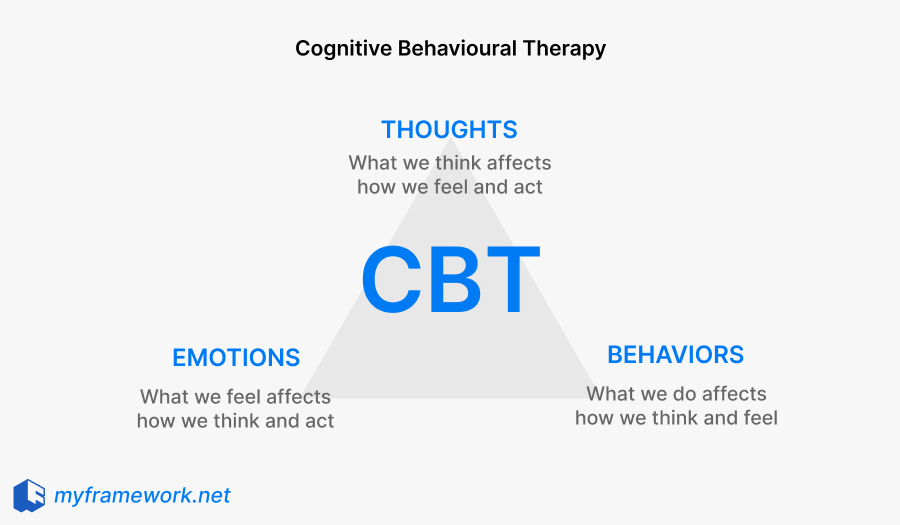
CBT focuses on the triangle of:
- Thoughts (what you tell yourself)
- Emotions (how you feel)
- Behaviors (what you do)
These three parts influence each other. Let’s take a closer look:
Thoughts
These are the messages you say to yourself, often automatically.
Negative thoughts can become patterns, especially when repeated.
Emotions
Your feelings are shaped by how you interpret events. Harsh thoughts can lead to anxiety, shame, or sadness.
Behaviors
How you act is often a result of how you feel. If you think you can’t do anything right, you might avoid challenges or give up easily.
By learning to recognize and question unhelpful thoughts, you can change how you feel and respond.
When to Use
- Imposter Syndrome: When you discount evidence of competence and interpret normal difficulty as personal failure.
- Cognitive Procrastination: When perfectionism or all-or-nothing thinking stops you from starting.
- Emotional Overreaction: When a single thought triggers anxiety, shame, or frustration disproportionate to the situation.
- Interpersonal Misinterpretation: When you assume you know what others think and react to imagined judgments.
Steps
1. Identify Your Thought
When a strong emotion hits, pause and ask: “What was I just thinking?”
Example: “I keep procrastinating. I’m useless.”
2. Explore the Reason Behind It
Where does this thought come from? Maybe you believe: “Successful people are always productive.” But in reality, everyone has off days. Slowing down doesn’t mean you’re a failure.
3. Challenge the Thought
Talk back to your inner critic using facts:
- “I didn’t finish everything today, but I did organize my ideas.”
- “I’ve handled tough tasks before. I’m not useless. I’m just overwhelmed.”
4. Take Small Action
Instead of staying stuck, take one helpful step.
Example: “I’ll draft a simple outline tonight. Tomorrow, I’ll build on it.”
When you act, even a little, your emotions begin to shift too.
Key Takeaway
CBT is not about ignoring problems or pretending to be happy. It’s about understanding your mind, breaking free from negative cycles, and making small changes that lead to big growth.
You don’t have to be trapped by your thoughts. You can learn to think differently — and live more clearly, more kindly, and more confidently.
If you or someone close to you feels stuck in emotional struggles, CBT might be worth a try.
FAQ
What should a good CBT Framework output look like?
A good result is a realistic diagnosis of the team’s current stage together with a clear view of what leadership should focus on next. The output should help explain what is happening in the team now, not just list the stages in theory.
When is CBT Framework not the right tool?
It becomes less useful when people start treating the stages as a prediction tool or as a label to excuse poor performance. CBT Framework helps interpret team dynamics, but it should not replace direct observation of what the team actually needs next.
Can CBT Framework help with imposter syndrome root causes?
CBT Framework can help with imposter syndrome root causes when the real question is whether the tension reflects a normal stage-of-development issue or a deeper team problem. It helps you read the conflict in context and choose a leadership response that fits the team’s current stage.