Four Quarters Method: Reset Your Day, Not Tomorrow
Helps you stay productive, maintain focus, and manage your energy across the entire day.
Four Quarters Method
Why This Matters
Life and work have become harder nowadays.
We all have days like this: it started well but went off track halfway through. A stressful morning meeting, a missed deadline, or a small mistake can make the rest of the day feel wasted.
Don't blame yourself; the problem is not losing focus. We can control it better via a method called the Four Quarters Method.
Created by author Gretchen Rubin, this method offers a simple yet powerful way to regain control of your day in real time.
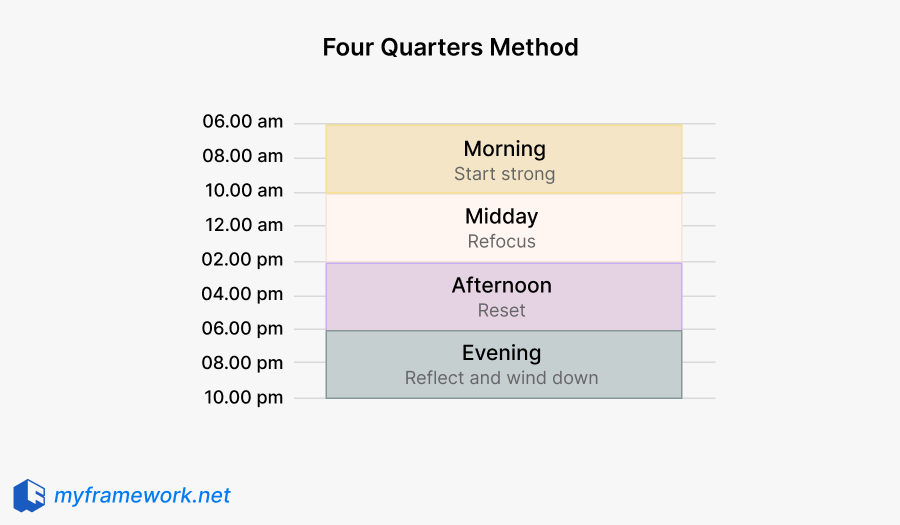
The Four Quarters Method divides a day (especially a typical working day) into 4 segments, each with its own goal and mindset.
Morning (6 AM – 12 PM): Start Strong
Focus on the most important and creative tasks. This is your high-energy zone where deep work matters most.
Midday (12 PM – 2 PM): Refocus
Take a short break, eat well, and reorganize your plan. Use this time to reset your priorities for the second half of the day.
Afternoon (2 PM – 6 PM): Reset
Shift to secondary or collaborative tasks. It’s a good time for meetings, teamwork, or follow-ups that need moderate energy.
Evening (After 6 PM): Reflect and Wind Down
Review what went well, note what can improve, and prepare for tomorrow. This reflection prevents burnout and helps you close the day with clarity.
When to Use
- Recovering from a bad start: When an early setback makes the rest of the day feel lost.
- Managing uneven energy: When your focus and energy fluctuate across the day.
- Resetting daily focus: When you need a mental reset without waiting for tomorrow.
Key Takeaway
The Four Quarters Method reframes productivity as recovery, not perfection.
By dividing the day into resettable segments, you stop letting one bad moment define the whole day and build a habit of restarting with intention.
FAQ
What should a good Four Quarters Method output look like?
A good result is a day that can recover from a bad start because each phase has its own role and reset point. It should help the person regain momentum inside the same day, not write the day off after one poor block.
When is Four Quarters Method not the right tool?
It is a weak fit when the day is driven by external demands you cannot re-segment meaningfully. Four Quarters Method works best when you have enough control to reset priorities between phases of the day.
Can Four Quarters Method help with recovering from a bad start?
Four Quarters Method can help with recovering from a bad start because it treats the day as recoverable in stages rather than as a single block ruined by one bad period. That makes it easier to reset priorities before tomorrow.