Freytag’s Pyramid: Structure Compelling Business Narratives
Helps communicators control emotional rhythm and attention over time.
Freytag’s Pyramid
Why This Matters
Many stories fail not because the idea is weak, but because the structure is flat.
In business communication, presentations often start too slow, peak too late, or end without resolution. As a result, audiences lose attention, miss the key point, or forget what mattered most.
Freytag’s Pyramid solves this by giving you a clear narrative arc that builds tension, delivers impact, and lands with clarity.
Freytag’s Pyramid is a classic storytelling structure developed by German novelist and playwright Gustav Freytag.
It breaks a story into seven stages that move from setup to tension, reach a peak, and then resolve cleanly. While it originated in dramatic literature, it is widely used today in storytelling, presentations, speeches, and brand narratives.
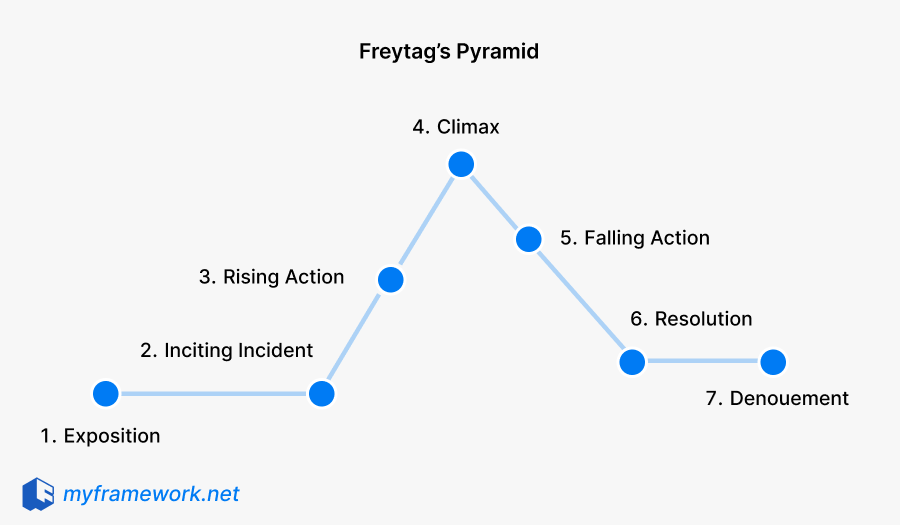
The model helps communicators control emotional rhythm and attention over time.
Core Concept of the Framework
Exposition
This is the introduction. You set the context, define the characters or stakeholders, and explain the situation.
In business, this could be the market context, the team, or the starting problem.
Inciting Incident
Something changes. A trigger appears that disrupts the status quo.
This could be a new challenge, a missed goal, a customer complaint, or a market shift.
Rising Action
Tension builds as actions are taken and obstacles appear. The audience starts to care because the outcome is uncertain.
In presentations, this is where complexity and stakes increase.
Climax
This is the turning point. The conflict reaches its peak.
A decision is made, a strategy is chosen, or a critical moment occurs. Everything before this leads here.
Falling Action
Tension begins to ease. The consequences of the decision unfold. You show what changed and how the situation starts to stabilize.
Resolution
The core conflict is resolved. The problem is addressed, the goal is reached, or a clear outcome is achieved.
Denouement
Loose ends are tied up.
You reflect, summarize lessons, and leave the audience with closure and meaning.
When to Use
- Project or crisis retrospectives: Explain what happened, why tension escalated, and how decisions led to resolution.
- Leadership or keynote speeches: Control emotional rhythm so the message builds toward a clear turning point.
- Change communication: Walk audiences through the before, during, and after of a transformation.
- Strategy or decision narratives: Highlight the moment where trade-offs were made and consequences followed.
- Internal storytelling or training: Help teams structure complex stories with a clear beginning, peak, and closure.
Example
Here is how a CTO might use Freytag’s Pyramid to explain a major crisis to the board of directors:
- Exposition: "Our e-commerce platform had 99.9% uptime for three years, serving 1M users daily." (Setting the stable context).
- Inciting Incident: "On Black Friday, at 9:00 AM, traffic spiked 500% above projections." (The disruption).
- Rising Action: "Servers began to fail. Customers couldn't checkout. The support team was overwhelmed. We tried auto-scaling, but the database locked up." (Tension builds, stakes get high).
- Climax: "At 10:30 AM, we had to make a tough call: take the entire site offline for 15 minutes to migrate to a larger cluster, risking $50k in lost sales per minute." (The peak point of no return).
- Falling Action: "We flipped the switch. The migration worked. Systems came back online at 10:45 AM, and orders started flowing smoothly." (Tension releases).
- Resolution: "We recovered 90% of the lost carts through email campaigns." (The immediate problem is solved).
- Denouement: "We have since implemented a new multi-region architecture to ensure this never happens again." (The lesson learned/New status quo).
Key Takeaway
Freytag’s Pyramid reminds us that attention follows structure.
By shaping tension deliberately, you guide the audience toward the moment that truly matters. The peak is not the end; meaning comes from how the story resolves.
When you control emotional flow, your message becomes easier to follow, accept, and remember.
FAQ
What should a good Freytag’s Pyramid output look like?
A good result is a message that lands quickly because the main point is obvious, the supporting logic is grouped cleanly, and the audience can follow the argument without hunting for the conclusion. If the audience still has to reconstruct the point for themselves, the framework has not been used well.
When is Freytag’s Pyramid not the right tool?
It is a weak fit when the real problem is missing evidence, weak judgment, or disagreement about the decision itself. Freytag’s Pyramid improves how the message is expressed, but it cannot compensate for thin thinking underneath it.
Can Freytag’s Pyramid help with project narratives?
Freytag’s Pyramid is useful for project narratives when the audience needs a message they can absorb quickly and act on. It adds the most value when you already know the point you want to make but need a stronger way to deliver it.