Ohmae’s 3C’s Model: The Strategic Triangle
Emphasizes the balanced integration of Company, Customer, and Competitor for strategic decisions, avoiding a singular focus.
Ohmae’s 3C’s Model
Introduction
Ohmae's 3C’s model is a well-known business framework. It focuses on three key elements that drive a business’s success: Customer, Competitor, and Company.
Japanese management consultant Kenichi Ohmae developed this model, and he introduced it as a way to assess and align these elements for competitive advantage.
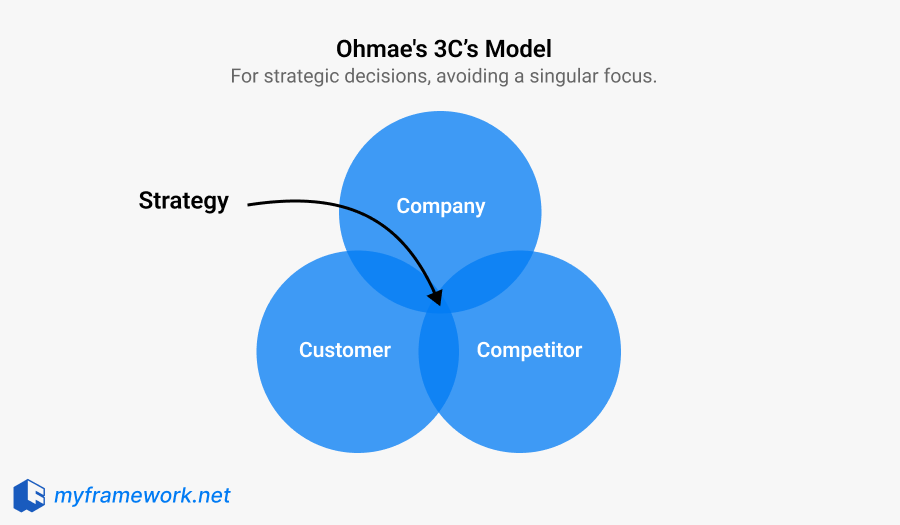
The model is a "Strategic Triangle" consisting of:
- The Customer (The market)
- The Competitor (The rival)
- The Company (The self)
Ohmae posits that the job of a strategist is to find the "Sweet Spot" where company strengths match customer needs better than the competition does.
Core Concept of Ohmae's 3C’s Model
At its core, the 3 C’s strategy emphasizes that businesses must consider three essential factors when making strategic decisions:
Customer
Understanding customer needs is the starting point.
Companies must know what their customers value and how they can meet or exceed those expectations. It's about identifying what the market truly wants, and not just what the business thinks they want.
Competitor
Knowing your competition is critical.
This part of the model stresses the need to analyze competitors’ strengths and weaknesses. By doing this, a business can find ways to differentiate itself, spot gaps in the market, or offer something unique that competitors do not.
Company
Finally, a business must assess its own capabilities.
It should ask, “What can we do best?” This involves analyzing internal strengths and weaknesses, resources, and skills to ensure the company can successfully deliver on its strategy and stand out in the market.
These three elements work together in harmony to create a strategy that is responsive to both the market and the internal capabilities of the company.
When to Use
- Market Entry: When launching a new product. You need to verify if there is a customer need and if you can beat the incumbents.
- Rebranding: When your company has lost its way. Go back to the basics. Are you still relevant to the customer?
- Differentiation Strategy: When you look exactly like your competitors. Use the model to find a new angle to stand out.
Steps
1. Customer Analysis
Start by gathering insights about your customers. Use market research, surveys, and feedback to understand their preferences and pain points. Create customer personas that reflect your target market and tailor your products or services accordingly.
The customer always comes first it is the key to this strategy as well as other business strategies. So do keep customer-centred thinking in your mindset. Stay focused on their needs and expectations, as this will guide your strategy in the right direction.
2. Competitor Analysis
Map out who your competitors are. Identify both direct and indirect competitors and examine their strengths and weaknesses. Look at their pricing, offerings, and customer service to find ways you can stand out.
Most importantly, be realistic about competition.
Don’t underestimate your competitors, but also don’t become too obsessed with them. Use competitor analysis to inform your strategy, but stay true to your unique value proposition.
3. Company Analysis
Take an honest look at your own company. Assess your resources, team capabilities, and unique strengths. Be aware of any limitations, and make sure your strategy leverages your company's strengths while addressing weaknesses.
Focus on what your company does best. By aligning your strengths with customer needs, you can gain a competitive advantage.
Some frameworks help the company identify its competitive advantage: SWOT Analysis, TOWS Analysis, and VRIO Framework.
Key Takeaway
The beauty of Ohmae's model is its ruthless simplicity. It exposes weak strategies immediately.
If you have a great product (Company) that customers love (Customer) but it is twice the price of an identical rival product (Competitor), you lose. You need all three legs of the stool.
The most successful businesses don't just "beat the competition" or "please the customer." They find the precise mathematical superiority where their unique strength solves a customer problem in a way the competitor cannot touch.
FAQ
What should a good Ohmae’s 3C’s Model output look like?
A good result is a realistic diagnosis of the team’s current stage together with a clear view of what leadership should focus on next. The output should help explain what is happening in the team now, not just list the stages in theory.
When is Ohmae’s 3C’s Model not the right tool?
It becomes less useful when people start treating the stages as a prediction tool or as a label to excuse poor performance. Ohmae’s 3C’s Model helps interpret team dynamics, but it should not replace direct observation of what the team actually needs next.
Can Ohmae’s 3C’s Model help with market entry?
Ohmae’s 3C’s Model can help with market entry when the real question is whether the tension reflects a normal stage-of-development issue or a deeper team problem. It helps you read the conflict in context and choose a leadership response that fits the team’s current stage.