Peak-End Rule: How We Really Remember Experiences
Explains how we remember experiences.
Peak-End Rule
The Psychology: Why the Peak-End Rule Works
The Peaks-Ends Rule is a great discovery because it reveals a cognitive bias in humans.
Our brain despite its sophisticated design, always processing information in a simplified way, attributes the most intense and final moments of an experience to our overall perception of it.
This bias can be used intentionally to create positive experiences by focusing on the peak and the end.
It also tells us that anyone can utilize this cognitive bias to design a good experience.
In 2002, Nobel Prize-winning economist Daniel Kahneman introduced the Peak-End Rule, a concept that explains how we remember experiences.
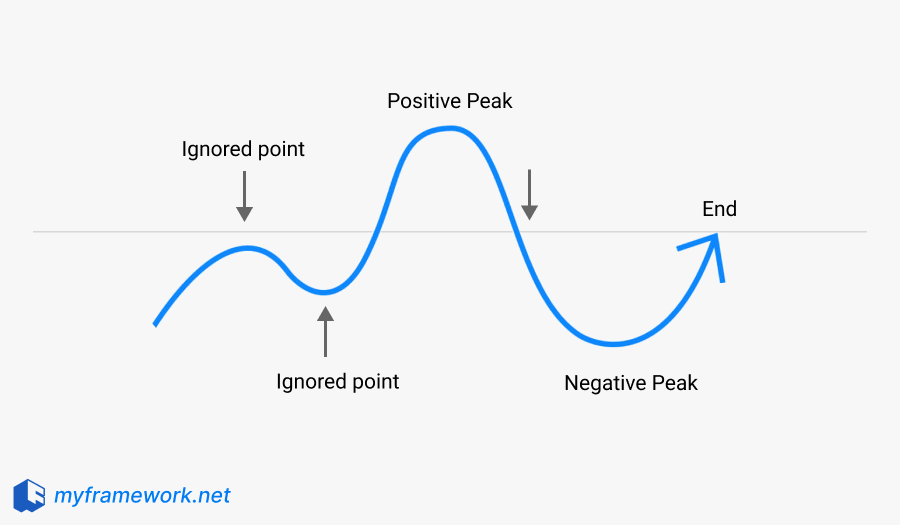
How to Apply the Peak-End Rule in Business & Life
According to this rule, people's memories of an event don't necessarily align with how they felt during the entire experience. Instead, their recollections are shaped by two key moments: the peak (the most intense part) and the end.
If both the peak and the end are pleasant, our brain convinces us that the entire experience was enjoyable—even if parts of it were less than ideal.
In other words, we evaluate experiences based on these two moments, rather than the finer details or the overall average.
When to Use
- Product and experience design: When mapping user journeys where onboarding, critical moments, and offboarding shape long-term perception.
- Public speaking and presentations: When structuring talks to create an emotional high point and a strong closing impression.
- Feedback and performance reviews: When delivering difficult feedback but ensuring the conversation ends with clarity and motivation.
- Event and service planning: When resources are limited and must be focused on the most memorable moments.
- Personal decision review: When reflecting on past experiences to avoid biased judgments driven by highlights alone.
Example
Take a team-building hike, for instance.
According to the Peak-End Rule, the experience might be remembered like this:
- Peak: The moment when the team reaches the summit and enjoys a stunning view, fostering a sense of achievement and camaraderie.
- End: The descent is filled with laughter and shared stories, leaving everyone with positive memories.
All the struggles—such as running out of water, feeling disoriented, or dealing with fatigue — are overshadowed by these two positive moments.
The same principle applies in other scenarios.
For example, in customer service, a diner might remember their meal as excellent if the food (the peak) was great and the service at the end was friendly—even if there were minor issues during the meal.
Key Takeaway
We do not remember experiences evenly.
Memory is shaped by intensity and endings, not consistency.
Designing a strong peak and a clear ending often matters more than fixing every detail.
Understanding this rule helps you both create better experiences and resist emotional manipulation.
FAQ
What should a good Peak-End Rule output look like?
A good result is a message that lands quickly because the main point is obvious, the supporting logic is grouped cleanly, and the audience can follow the argument without hunting for the conclusion. If the audience still has to reconstruct the point for themselves, the framework has not been used well.
When is Peak-End Rule not the right tool?
It is a weak fit when the real problem is missing evidence, weak judgment, or disagreement about the decision itself. Peak-End Rule improves how the message is expressed, but it cannot compensate for thin thinking underneath it.
Can Peak-End Rule help with product design?
Peak-End Rule is useful for product design when the audience needs a message they can absorb quickly and act on. It adds the most value when you already know the point you want to make but need a stronger way to deliver it.