Pixar Storytelling Formula: The 6-Step Narrative Structure
Turn complex ideas into clear cause-and-effect stories people remember.
Pixar Storytelling Formula
Quick Introcution
The Pixar Formula connects emotionally with audiences because it follows a logical and emotional progression. Each step builds upon the previous one, creating a cause-and-effect flow that deepens the audience’s engagement.
It moves beyond simply telling a story to make it memorable and impactful by showing growth, change, and relatable challenges.
The Pixar Storytelling Formula is a simple yet powerful storytelling framework that Pixar uses to create compelling stories with emotional depth and narrative flow.
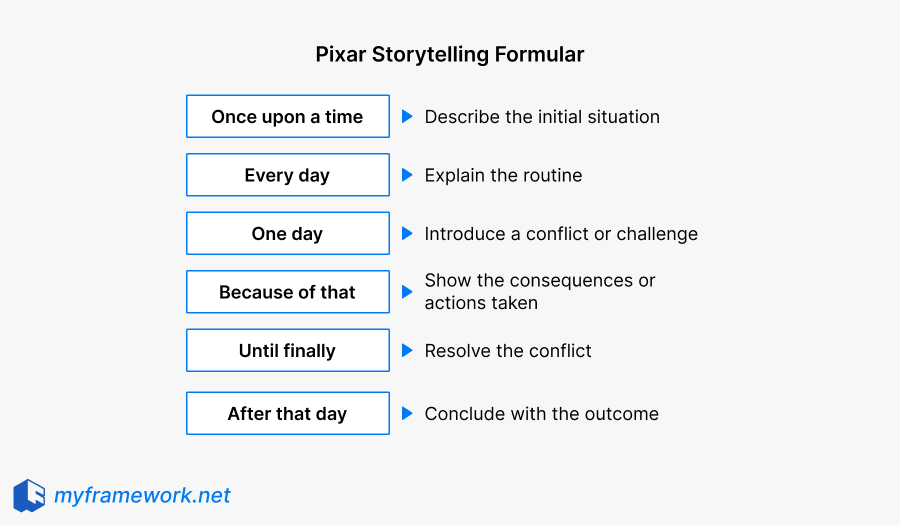
Known for captivating audiences across all ages, Pixar’s approach to storytelling can be broken down into a sequence often called the "Pixar Pitch," a structure that makes complex storytelling accessible and memorable.
The Structure of the Pixar Storytelling Formula
Once upon a time, there was…
Introduce the main character or setting to establish a baseline for the story.
Every day…
Describe the character's ordinary life, establishing their routine or normal world before any big changes.
Until one day…
Introduce a conflict or inciting incident that disrupts the character's normal life and propels the story forward.
Because of that…
Show the consequences of the inciting event, leading to a series of actions and reactions as the character faces new challenges.
Because of that…
Continue the chain of cause and effect, building momentum and emotional stakes as the character deals with increasing obstacles.
Until finally…
Reach the story’s climax, where the character faces their biggest challenge and resolves the main conflict.
And ever since that day…
Conclude the story by showing how the character or their world has changed, leaving the audience with a sense of resolution.
When to Use
- Explain a business strategy or change in a clear, logical, and memorable way.
- Turn complex ideas into simple cause and effect stories that are easy to follow.
- Share team success stories that highlight effort, learning, and results.
- Align stakeholders by showing how actions led to outcomes step by step.
- Communicate product decisions, pivots, or experiments with clarity and flow.
- Train teams on storytelling for presentations, demos, or internal updates.
- Make abstract topics feel human, concrete, and relatable.
Example
Explaining a New Business Strategy
Let’s say you’re introducing a new customer-centred business strategy to your team.
- Once upon a time, there was... A company dedicated to creating quality products, yet facing a high rate of customer complaints and low retention.
- Every day... The team worked hard to meet product standards but found themselves constantly addressing customer dissatisfaction.
- Until one day... Leadership proposed a new customer-centered strategy, shifting focus from purely product quality to customer experience at every touchpoint.
- Because of that…The team restructured their processes, incorporating feedback loops, hosting regular customer listening sessions, and redesigning the user experience.
- Because of the... Customer feedback improved dramatically, and the retention rates rose, and satisfaction scores reached an all-time high, proving the new strategy’s effectiveness.
- And ever since that day... The company continued focusing on the customer journey, refining products and interactions to enhance loyalty and satisfaction.
Example: Sharing a Team Success Story
Imagine you want to share a success story to recognize a team’s efforts.
- Once upon a time, there was…A project team tasked with launching a complex software update, facing a tight deadline and significant technical challenges.
- Every day…The team worked overtime to troubleshoot, collaborate across departments, and keep the project on track, although setbacks were frequent.
- Until one day…A major issue arose that threatened the launch date, requiring innovative solutions and a stronger commitment from everyone involved.
- Because of that…The team held brainstorming sessions, invited feedback from users, and worked tirelessly to overcome this roadblock.
- Because of that…Their creativity and collaboration paid off, resulting in a seamless, successful software launch that exceeded client expectations.
- Until finally…The project was delivered on time, and clients were thrilled with the update’s improvements and new features.
- And ever since that day…The team’s approach to collaboration and resilience set a new standard, inspiring others and leading to further successful projects.
Key Takeaway
Stories do not persuade because they are emotional.
They persuade because they make change feel inevitable.
The Pixar Formula works because it turns decisions into consequences, not opinions.
FAQ
What should a good Pixar Storytelling Formula output look like?
A good result is a message that lands quickly because the main point is obvious, the supporting logic is grouped cleanly, and the audience can follow the argument without hunting for the conclusion. If the audience still has to reconstruct the point for themselves, the framework has not been used well.
When is Pixar Storytelling Formula not the right tool?
It is a weak fit when the real problem is missing evidence, weak judgment, or disagreement about the decision itself. Pixar Storytelling Formula improves how the message is expressed, but it cannot compensate for thin thinking underneath it.
Can Pixar Storytelling Formula help with explaining business strategy?
Pixar Storytelling Formula is useful for explaining business strategy when the audience needs a message they can absorb quickly and act on. It adds the most value when you already know the point you want to make but need a stronger way to deliver it.