Pyramid Principle: Unlock Clear System Thinking
Structured communication framework which is supporting your point with logically organized details and effective information delivery.
Pyramid Principle
Why This Matters
Many people struggle to present ideas in a clear and convincing way. Long explanations or unstructured arguments often confuse the audience. This makes decision-making harder and weakens the impact of good ideas.
If so, the Pyramid Principle can transform your communication and thinking process.
What Is the Pyramid Principle
The Pyramid Principle was developed by Barbara Minto at McKinsey & Company. It is a system thinking approach that helps organize communication in a logical and structured way.
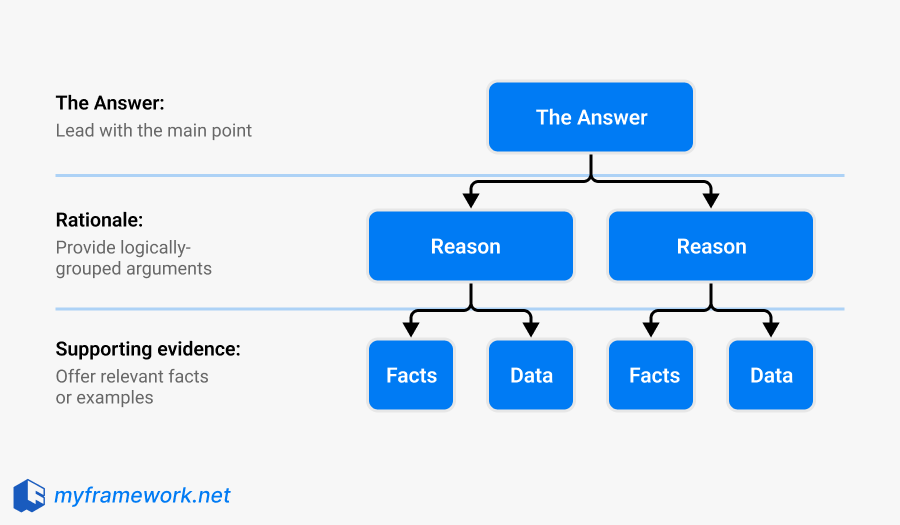
The method uses a pyramid shape to arrange ideas: start with the main point at the top, then support it with key arguments, and finally provide detailed evidence at the base.
Minto used the metaphor of a pyramid to emphasize the importance of starting with the most important point or conclusion (the apex of the pyramid) and then building upon it with supporting layers of information (the descending layers of the pyramid).
This principle is used in business communication initially, and now it has become one of the famous system thinking models to help people structure and present ideas in a logical and persuasive manner.
Visualization of Pyramid Principle
How Does Pyramid Principle Work
The Pyramid Principle is based on three key rules:
- Start with the answer first – Communicate the main message before details. It could be a conclusion, even an assumption.
- Group related ideas – Organize supporting points into clear categories.
- Follow a logical order – Present ideas in a sequence that builds understanding. It's like explanations to support your statement.
When to Use
- Structured communication: When messages feel long but still fail to land clearly.
- Logical problem framing: When complex issues lack a clear top-level conclusion.
- Executive thinking: When decisions require concise reasoning under time pressure.
Example
Here's how the Pyramid Principle can help in daily work and life.
Clear Communication
By starting with the main point or conclusion, the Pyramid Principle ensures that your message is clear and concise.
This is particularly useful in presentations, reports, and meetings where you need to convey complex ideas to others.
Example: In a business presentation about a new product launch, you would start with the main point (e.g., "Our new product will revolutionize the industry") and then provide supporting details such as features, benefits, market analysis, and financial projections.
Logical Structure
The hierarchical structure of the Pyramid Principle helps organize information in a logical and easy-to-follow manner.
This makes it easier for your audience to understand and retain the key points of your message.
Example: When writing a research paper, you would structure your argument using the Pyramid Principle, starting with your thesis statement (the main point) and then supporting it with evidence, analysis, and references in a logical sequence.
Persuasive Communication
By presenting your main point upfront and supporting it with strong arguments and evidence, you can make a more persuasive case for your ideas or recommendations.
Example: In a sales pitch to a potential client, you would lead with the main benefit or value proposition of your product or service, and then provide supporting details such as customer testimonials, case studies, and pricing options to reinforce your message.
Time-Saving
The Pyramid Principle helps you prioritize and focus on the most important information, saving time for both you and your audience.
Example: In a meeting with your team to discuss project updates, you would use the Pyramid Principle to highlight the key milestones, challenges, and action items upfront, and then delve into the details as needed.
Key Takeaway
The Pyramid Principle forces clarity by making you decide the answer first, then justify it logically.
By structuring ideas from the top down, it reduces confusion, shortens communication, and strengthens reasoning.
Clear thinking becomes visible thinking, which is why this model remains a cornerstone of system-level communication.
FAQ
How is Pyramid Principle different from SCQA Framework: Structure Your Story?
Pyramid Principle is mainly about how to structure the final message, while SCQA Framework: Structure Your Story is about how to frame the story or setup that leads to that message. Use Pyramid Principle when your conclusion is known and needs to be communicated clearly; use SCQA Framework: Structure Your Story when the audience first needs context, tension, or narrative progression.
What should a good Pyramid Principle output look like?
A good result is a message that lands quickly because the main point is obvious, the supporting logic is grouped cleanly, and the audience can follow the argument without hunting for the conclusion. If the audience still has to reconstruct the point for themselves, the framework has not been used well.
When is Pyramid Principle not the right tool?
It is a weak fit when the real problem is missing evidence, weak judgment, or disagreement about the decision itself. Pyramid Principle improves how the message is expressed, but it cannot compensate for thin thinking underneath it.
Can Pyramid Principle help with logical problem framing?
Pyramid Principle is useful for logical problem framing when the audience needs a message they can absorb quickly and act on. It adds the most value when you already know the point you want to make but need a stronger way to deliver it.