Radical Candor: Give Feedback Without Losing Humanity
Being a great manager without losing your humanity.
Radical Candor
Quick Introduction
Have you ever struggled to give feedback without hurting someone’s feelings? Or have you held back honest thoughts, worrying it might damage relationships?
If so, the Radical Candor model can help.
Developed by Kim Scott, a former leader at Google and Apple, this model teaches us how to give feedback in a way that is both honest and caring. It is widely recognized as a powerful communication and management tool, showing leaders how to balance candor with empathy.
The goal is to help people improve while maintaining strong relationships and strengthening team culture.
Radical Candor is not a communication technique. It is a diagnostic framework.
Overall, Radical Candor is about balancing two things:
- Caring personally – Showing that you respect and value the other person.
- Challenging directly – Giving clear and honest feedback, even when it is tough.
Kim Scott explains this idea using a 2x2 framework. Each quadrant represents a predictable failure mode.
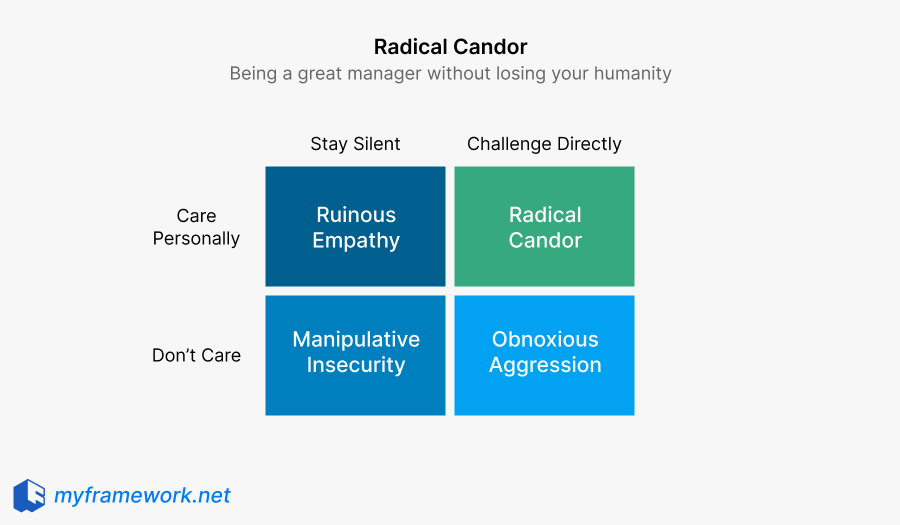
Radical Candor
Direct feedback delivered with genuine care for the person's growth.
This is the ideal way to give feedback. You tell the truth, but in a way that shows you care.
How to improve:
- Build real relationships. Take time to know your team and understand their motivations.
- Give specific feedback instead of vague comments. Instead of saying, “You need to improve,” say, “Your report was missing key data. Adding it next time will make it stronger.”
- Keep a neutral and helpful tone. Feedback should never feel like an attack.
- Encourage open conversations. Ask, “Did my feedback help?” to ensure the message was received well.
Ruinous Empathy
This happens when you care about someone but avoid telling them the truth because you don’t want to hurt their feelings.
While this seems kind, it actually holds them back from improving.
How to improve:
- Recognize that avoiding feedback does more harm than good. If someone keeps making the same mistake because you never corrected them, you are not helping.
- Start small. If you are afraid to give tough feedback, begin with gentle corrections and build confidence.
- Use questions. Instead of saying, “You did this wrong,” ask, “Have you considered trying this another way?”
Obnoxious Aggression
Harsh, critical feedback given without regard to the person's feelings.
This happens when you challenge people directly but do not show that you care and when you speak out, it makes others defensive or demotivated.
How to improve:
- Control your tone and emotions. Even if you are frustrated, take a moment to cool down before speaking.
- Show empathy: Balance your directness with genuine concern for the person's feelings.
- Listen actively: Make an effort to understand the other person's perspective before responding.
Manipulative Insincerity
This is the worst approach because it happens when you don’t care personally and don’t challenge directly. It includes fake praise, silent disapproval, or avoiding real conversations.
How to improve:
- Be honest, even if it’s uncomfortable. If someone did something wrong, don’t pretend it was okay.
- Avoid gossip: Address issues directly with the person involved, not behind their back.
- Give feedback in private when necessary. If a tough conversation is needed, doing it one-on-one builds trust.
When to Use
- Feedback Diagnosis: When performance issues persist but no one is saying the real problem out loud.
- Performance Reviews: When reviews feel polite but fail to drive behavior change.
- Culture Breakdown: When people talk about each other instead of to each other.
- Difficult Conversations: When managers avoid clarity to protect short-term harmony.
Key Takeaway
Feedback failure is rarely about kindness or cruelty.
It is about avoidance.
Radical Candor reminds leaders that clarity is a responsibility, not a personality trait.
If you care about someone’s growth, you owe them the truth.
FAQ
What should a good Radical Candor output look like?
A good result is a message that lands quickly because the main point is obvious, the supporting logic is grouped cleanly, and the audience can follow the argument without hunting for the conclusion. If the audience still has to reconstruct the point for themselves, the framework has not been used well.
When is Radical Candor not the right tool?
It is a weak fit when the real problem is missing evidence, weak judgment, or disagreement about the decision itself. Radical Candor improves how the message is expressed, but it cannot compensate for thin thinking underneath it.
Can Radical Candor help with performance reviews?
Radical Candor is useful for performance reviews when the audience needs a message they can absorb quickly and act on. It adds the most value when you already know the point you want to make but need a stronger way to deliver it.