SCR Framework: The Tool for Concise Updates
Resolve complications with concise, executive-ready solutions.
SCR Framework
Why Messages Often Get Lost
In some discussions, people often jump straight into details without giving context. This leaves listeners confused and weakens the impact of the message.
To communicate clearly, you need structure.
The SCR Framework provides a simple way to build strong communication skills and keep workplace communication sharp and effective.
The SCR framework is a simplified version of the well-known SCQA communication framework, both designed to structure messages for clarity and engagement.
SCQA, developed by Barbara Minto, is widely used to convey complex ideas by guiding the audience through a narrative that flows logically from a situation to a final answer.
SCR framework is more direct, focusing on presenting a solution to the complication without explicitly framing it as a question.
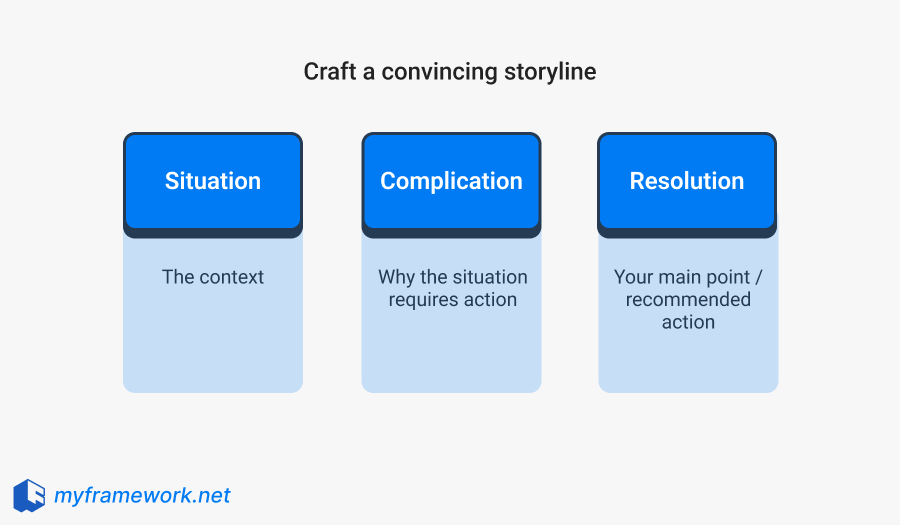
Situation: Introduces the current state or background.
Complication: Explains the problem or challenge arising from the situation.
Resolution: Offers a solution or resolution to the problem.
While both SCQA and SCR share similarities, their key differences lie in their approach to resolving complications and guiding the audience through the content.
When to Use
- Email Subject Lines: "Project X (S) - Delayed (C) - New Timeline (R)"
- Daily Standups: A 30-second update on what you did, what blocked you, and how you fixed it.
- Client Management: Handling complaints by acknowledging the issue (C) and immediately pivoting to the solution (R).
Example
Team Meeting Update
- Situation: The team is working on a project with a tight deadline.
- Complication: The project is behind schedule due to technical issues.
- Resolution: Additional resources have been brought in to get back on track.
Customer Service Response
- Situation: A customer reported an issue with a product.
- Complication: The issue is due to a manufacturing defect.
- Resolution: The product will be replaced at no cost, and steps are being taken to prevent future defects.
Key Takeaway
SCR works because it respects the reader’s time and attention.
By stating the situation, naming the complication, and closing with a resolution, you reduce cognitive load and remove ambiguity.
When messages are short, decisions become easier.
FAQ
What should a good SCR Framework output look like?
A good result is a message that lands quickly because the main point is obvious, the supporting logic is grouped cleanly, and the audience can follow the argument without hunting for the conclusion. If the audience still has to reconstruct the point for themselves, the framework has not been used well.
When is SCR Framework not the right tool?
It is a weak fit when the real problem is missing evidence, weak judgment, or disagreement about the decision itself. SCR Framework improves how the message is expressed, but it cannot compensate for thin thinking underneath it.
Can SCR Framework help with status updates?
SCR Framework is useful for status updates when the audience needs a message they can absorb quickly and act on. It adds the most value when you already know the point you want to make but need a stronger way to deliver it.