TAM-SAM-SOM Analysis: A Guide to Effective Market Segmentation
Enhance your market segmentation and marketing strategy
TAM-SAM-SOM Analysis
Introduction
Have you ever wondered how businesses identify the potential of a market and segment it effectively? The TAM-SAM-SOM model helps companies do just that.
Developed by marketing and business strategists, this framework allows organizations to better understand and measure the opportunity within a market.
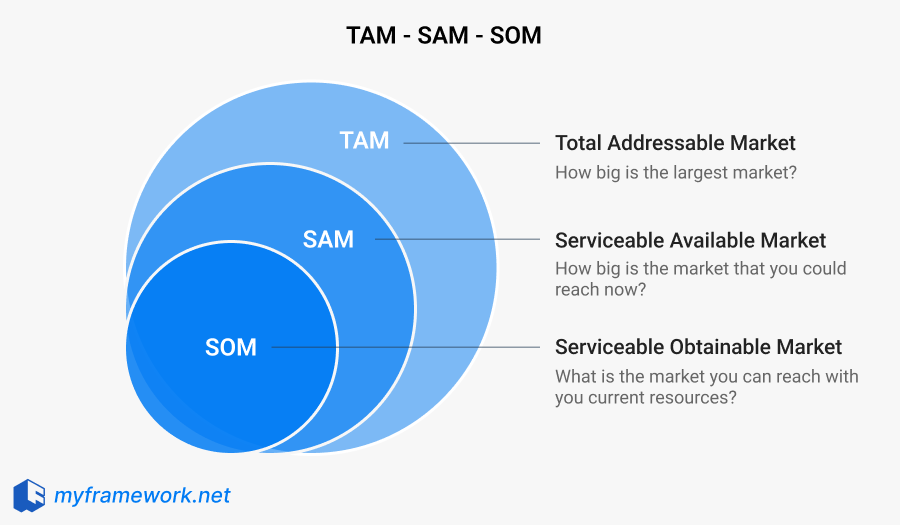
The model divides the market into three categories:
- Total Addressable Market (TAM)
- Serviceable Available Market (SAM)
- Serviceable Obtainable Market (SOM)
Each with a different level of market potential.
TAM (Total Addressable Market)
This is the broadest category and represents the total demand for a product or service within a market. It is the ideal scenario where a company has 100% market share and is serving every possible customer.
Key Questions for Defining TAM
What is the total size of the market globally or regionally?
What is the overall demand for this product or service?
How many potential customers exist, regardless of product availability?
What are the long-term trends driving the market’s growth?
SAM (Serviceable Available Market)
SAM is a more realistic view of the market. It narrows down the TAM to only those customers who are reachable based on geography, regulations, capabilities or resources.
Key Questions for Defining SAM:
Which geographic areas can I serve with my product or service?
What specific customer groups can I realistically target based on current capabilities?
What are the legal, regulatory, or cultural barriers preventing access to certain customers?
How does my offering meet the needs of this specific market?
SOM (Serviceable Obtainable Market)
SOM is the most specific category. It represents the portion of the SAM that your business can realistically capture, given your resources, competition, and market position.
Key Questions for Defining SOM:
What is the current competition in this segment, and what is their market share?
What portion of the market can I realistically reach in the next 6 to 12 months?
What resources (financial, human, or technological) do I have to capture this market?
How can I differentiate my offering to stand out in this specific segment?
When to Use
- Market evaluation: When you need to estimate market opportunity and avoid arguing over one inflated “big number.”
- Strategic planning: When you must choose a realistic target segment based on where you can actually compete and win.
- Execution targeting: When you need a defensible near-term goal to align budgets, headcount, and go-to-market priorities.
Example
Example 1: Smartphone Company
- TAM: The total global smartphone market size, which might be in the billions, represents every single person who might consider purchasing a smartphone, whether they already own one or not.
- SAM: If your smartphone is only available in North America, your SAM would focus on the population within North America, including factors like age, income, and technological adoption.
- SOM: As a new smartphone brand, your SOM would focus on a smaller group within your SAM, say 10% of the North American market, accounting for your brand's competitive position, marketing reach, and consumer preferences.
Example 2: SaaS Business Solution
- TAM: The entire global market for cloud-based SaaS solutions, including businesses of all sizes across different industries.
- SAM: Your software may only be suited for small-to-medium businesses in the financial sector, so your SAM would include this group within a certain region (e.g., North America or Europe).
- SOM: Your SOM, given the competitive landscape, may be limited to small businesses in the U.S. that have a budget for cloud services and are looking for affordable financial software solutions, which would be a smaller portion of your SAM.
Key Takeaway
TAM-SAM-SOM is not about producing an impressive big number. It is about narrowing possibility into focus.
Use TAM to understand the ceiling, SAM to choose the battlefield, and SOM to set realistic, near-term execution targets.
When your assumptions are explicit and consistent, TAM-SAM-SOM becomes a shared language for strategy, investment, and prioritization.
FAQ
What should a good TAM-SAM-SOM Analysis output look like?
A good result is a market-sizing view that clearly separates the total market, the reachable market, and the portion you can realistically capture. It should narrow ambition into an actionable scope instead of leaving market size as one oversized number.
When is TAM-SAM-SOM Analysis not the right tool?
It is useful for sizing the opportunity, but it will not tell you whether the market is attractive, defensible, or operationally reachable. Market size alone is not the same as a viable strategy.
Can TAM-SAM-SOM Analysis help with go-to-market planning?
TAM-SAM-SOM Analysis can help with go-to-market planning by narrowing a broad market story into a reachable segment and a plausible capture target. That makes planning more realistic than relying on a single oversized TAM number.