The Rule of Suspense: How to Keep Your Audience Engaged
Reveal your points step by step.
The Rule of Suspense
Why Attention Fades So Easily
Great communicators know how to keep people curious. They build anticipation instead of revealing everything at once.
This is what we call the Rule of Suspense in communication.
The Rule of Suspense is a simple but powerful communication method that helps you keep your audience engaged by sharing your points one at a time. The core concept of this technique is simple and straight:
Instead of listing all your ideas upfront, you reveal them step by step. Each point becomes a small discovery, giving your audience a reason to stay focused.
When someone says, “I have three ideas to share. They are A, B, and C,” the listener’s curiosity disappears instantly because they already know what’s coming.
But when the speaker says, “I have three ideas to share. The first is…,” the audience starts to anticipate what the next one will be.
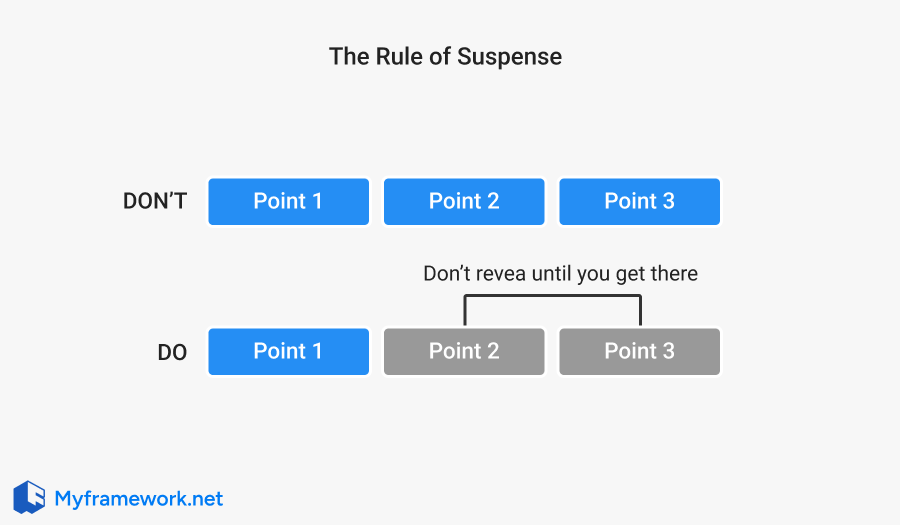
This creates momentum and keeps the listener invested.
Core Concept of the Rule
At its heart, the Rule of Suspense is about sequencing and curiosity.
- Sequence matters. Presenting points one at a time allows each idea to stand on its own. The listener can absorb, react, and reflect before moving to the next part.
- Curiosity drives attention. When people do not know what’s next, their brains stay alert. It’s the same principle that keeps us watching movies or reading stories until the end.
- Emotional engagement builds memory. Suspense creates a small emotional gap between what we know and what we want to know. Filling that gap makes information more memorable and persuasive.
This method is widely used in storytelling, sales, and presentations because it mirrors how human attention naturally works.
When to Use
- Executive presentations: Keep senior stakeholders engaged by revealing insights progressively instead of front-loading conclusions.
- Team meetings: Walk colleagues through your reasoning step by step so they follow your logic rather than jumping ahead.
- Storytelling and keynote talks: Maintain narrative momentum by letting each idea feel like a discovery.
- Teaching and training sessions: Increase retention by allowing learners to uncover concepts gradually instead of overwhelming them upfront.
Example
A presenter might say:
- Less effective: “I’ll share three lessons from this project: planning, teamwork, and feedback.”
- More effective: “I learned three key lessons from this project. The first is about planning…”
By holding back the rest, you keep attention alive. When the audience knows there’s more to come, they follow closely, waiting for the next insight.
Key Takeaway
Suspense is not about hiding information, but about revealing it at the right moment.
By sequencing ideas instead of listing them, you align your message with how human attention naturally works.
Curiosity keeps people mentally present, while anticipation makes ideas more memorable.
When you stop telling everything at once, your audience stops tuning out and starts leaning in.
FAQ
What should a good The Rule of Suspense output look like?
A good result is a message that lands quickly because the main point is obvious, the supporting logic is grouped cleanly, and the audience can follow the argument without hunting for the conclusion. If the audience still has to reconstruct the point for themselves, the framework has not been used well.
When is The Rule of Suspense not the right tool?
It is a weak fit when the real problem is missing evidence, weak judgment, or disagreement about the decision itself. The Rule of Suspense improves how the message is expressed, but it cannot compensate for thin thinking underneath it.
Can The Rule of Suspense help with meetings?
The Rule of Suspense is useful for meetings when the audience needs a message they can absorb quickly and act on. It adds the most value when you already know the point you want to make but need a stronger way to deliver it.