Three Zones of Learning: How to Grow Beyond Your Comfort Zone
Helps you study and improve by giving you a clear way to plan your effort.
Three Zones of Learning
Why This Matters
Many people want to improve, yet they feel stuck in routines that no longer help them grow. They stick to the same habits, repeat the same tasks, and wonder why their productivity doesn't change.
Noel Tichy, a professor at the University of Michigan, studied this problem and proposed a simple idea. Growth occurs when we understand our current position and then take one step beyond it. That is the heart of the Three Zones of Learning.
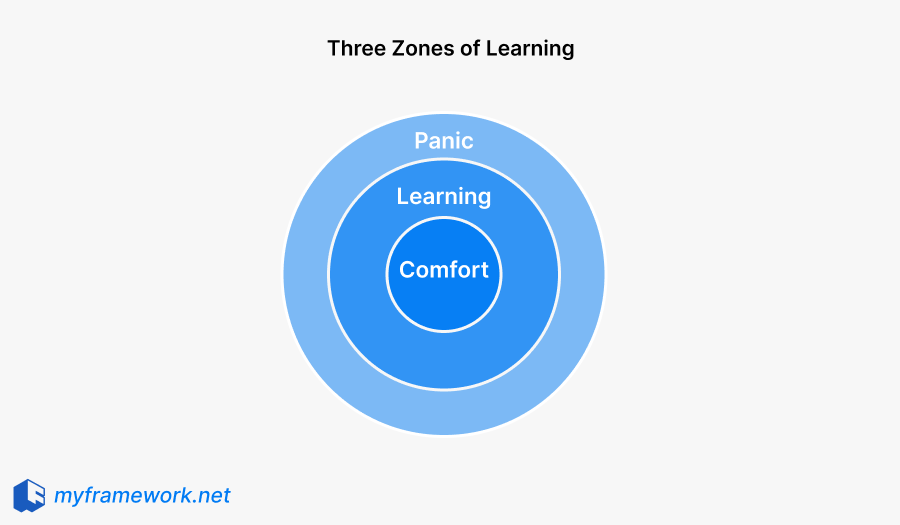
The Three Zones of Learning model describes three mental spaces that shape how we learn:
- Comfort zone
- Learning zone
- Panic zone
Each zone produces different emotions, different reactions, and different results. The key is to know when to stay, when to stretch, and when to pull back.
Comfort Zone
This is the space where everything feels familiar. Tasks are easy, skills are stable, and pressure is low.
People feel safe here, but the cost is slow improvement and productivity stays flat.
The comfort zone can become a trap when we stop noticing how the world changes around us. It feels warm, but it also limits how far we can go.
Learning Zone
This is where growth happens.
The learning zone creates enough challenge to activate curiosity without overwhelming the mind.
Research suggests that the ideal learning ratio is about 85 percent familiar and 15 percent unfamiliar. This mix keeps us engaged, stretches our thinking, and helps us learn faster. As we repeat these new skills, the unfamiliar becomes familiar, and the learning zone slowly transitions to the comfort zone.
Panic Zone
This is the space people usually won't want to touch. Tasks feel impossible, stress rises quickly, and focus disappears.
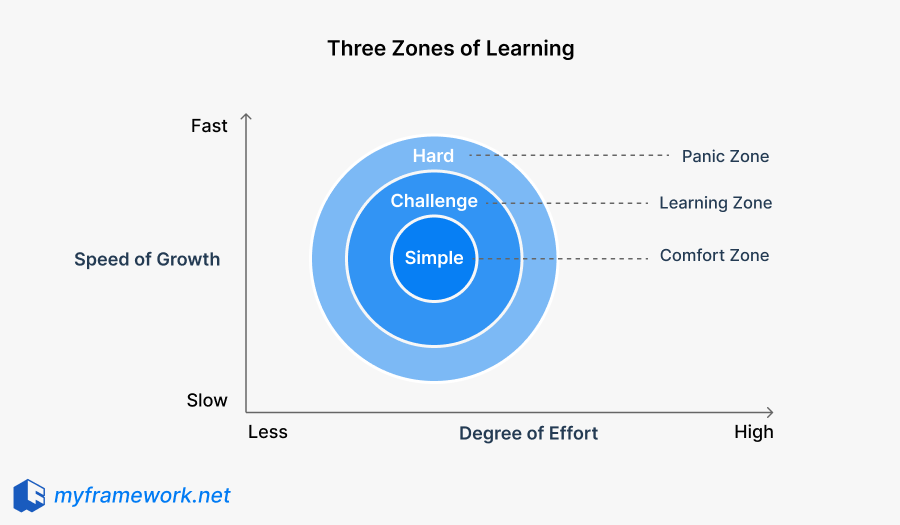
People sometimes quit because they believe they cannot succeed. In the panic zone, emotional overload replaces real learning. The goal is not to avoid this zone forever, but to move out of it fast and rebuild confidence inside the learning zone.
When to Use
- Curriculum Design: When learners disengage because content feels either too easy (Comfort) or overwhelming (Panic), use this model to rebalance difficulty and pacing.
- Employee Onboarding: Apply this framework when new hires feel either bored after initial training or anxious due to unclear expectations and excessive pressure.
- Personal Development Planning: Use this model when self-improvement efforts stall, either because routines feel too safe or goals feel intimidating and unsustainable.
Key Takeaway
Growth is not random. It is a rhythm. You learn when you stretch, and you stop when you freeze.
Your comfort zone expands only when you step out of it with intention. If you want to improve, ask yourself one simple question every day: which zone am I in right now? Then move one step further.
FAQ
What should a good Three Zones of Learning output look like?
A good result is a realistic sense of whether the learner is under-challenged, appropriately stretched, or overwhelmed, plus a clear adjustment to difficulty. It should improve the learning conditions, not just label the experience.
When is Three Zones of Learning not the right tool?
It becomes less useful when people use the zones as labels without changing the learning design itself. Three Zones of Learning helps calibrate challenge, but it does not replace good coaching, sequencing, or feedback.
Can Three Zones of Learning help with curriculum design?
Three Zones of Learning can help with curriculum design by showing whether the challenge level is too safe, productively stretching, or overwhelming. That makes it easier to adjust pacing and difficulty before motivation drops.
Related Frameworks
- Simon Learning Method: Master New Knowledge Quickly- Effective strategies for rapid learning.
- Feynman Technique: How to Learn by Teaching- Learning and understanding complex concepts by teaching them to someone else
- Deliberate Practice: Become an Expert at Anything- Understand how to study with purpose, without wasted effort.