TOWS Model: Create Actionable Strategies from SWOT Analysis
Turn SWOT insights into concrete strategic options and actions.
TOWS Model
The Problem with SWOT
We all know the SWOT analysis. It is the bread and butter of every business school student. But here is the uncomfortable truth. Most SWOT analyses end up in a drawer.
Why? Because listing your problems is not the same as solving them.
The TOWS Matrix forces you to stop listing bullet points and start connecting them. It asks a crucial question. How can specific strengths handle specific threats? It turns a static snapshot into a dynamic generator of ideas.
The TOWS Model, developed by Heinz Weihrich in 1982, is an extension of the well-known business frameworkSWOT Analysis (Strengths, Weaknesses, Opportunities, and Threats).
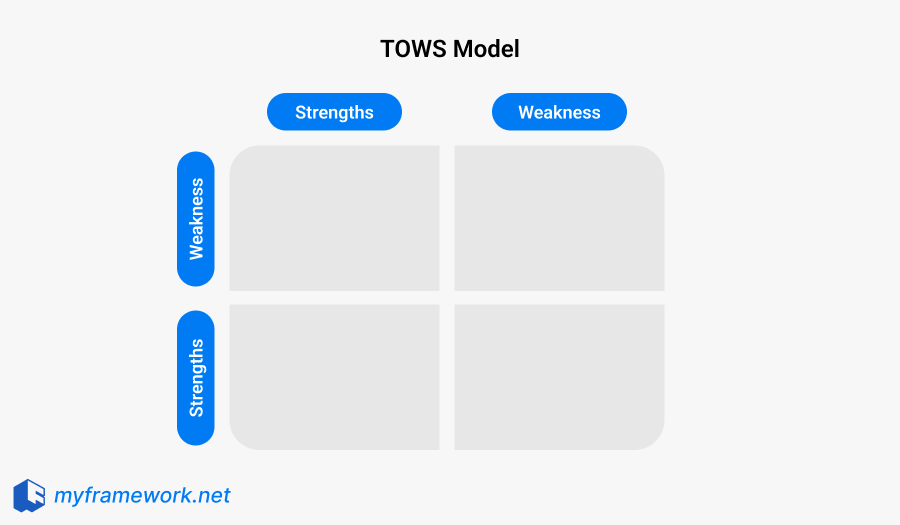
While SWOT is used to identify a company’s internal strengths and weaknesses along with external opportunities and threats, TOWS goes a step further by focusing on developing strategies based on those findings.
You can think of SWOT as the foundation and TOWS as the blueprint for action. With the former inputs, the TOWS Model helps businesses translate their SWOT analysis into real-world strategies.
Deep Dive into TOWS
The TOWS Model helps businesses take the insights from a SWOT analysis and create actionable strategies. It does this by matching internal strengths and weaknesses with external opportunities and threats.
The TOWS matrix is divided into four quadrants:
SO (Strengths-Opportunities): Use strengths to take advantage of opportunities.
WO (Weaknesses-Opportunities): Overcome weaknesses to pursue opportunities.
ST (Strengths-Threats): Use strengths to defend against external threats.
WT (Weaknesses-Threats): Minimize weaknesses to avoid threats.
The purpose is to identify strategies that will help a company grow, defend itself, or adapt to changing conditions by aligning internal capabilities with the external environment.
When to Use
- Post-SWOT Paralysis: Use TOWS when your team has identified many strengths and threats but cannot decide what to do next.
- Strategic Planning Offsites: Apply it to convert annual SWOT discussions into concrete, defensible strategic options.
- Turnaround Situations: Use the WT quadrant to identify survival moves when weaknesses and threats dominate the landscape.
Steps
1. Conduct a SWOT Analysis
Identify your company’s strengths, weaknesses, opportunities, and threats.
2. Fill Out the TOWS Matrix
Place the findings from your SWOT analysis into the four quadrants of the TOWS matrix.
3. Develop Strategies
Create strategies based on each quadrant.
4. Prioritize Action
Select the most feasible and impactful strategies to implement first.
Key Takeaway
TOWS forbids isolation.
You cannot list a threat without asking which strength can block it, or which weakness makes it dangerous. By forcing these connections, TOWS turns abstract analysis into concrete strategic choices. It ensures strategy is grounded in reality, not wishful thinking.
FAQ
How is TOWS Model different from SWOT Analysis: From List-Making to Strategy?
TOWS Model is for diagnosis: it helps you identify the important internal and external factors. SWOT Analysis: From List-Making to Strategy is for strategy formulation: it takes those factors and turns them into strategic options. Use TOWS Model when you need to understand the landscape first; use SWOT Analysis: From List-Making to Strategy when you are ready to convert that diagnosis into action choices.
What should a good TOWS Model output look like?
A good result is a prioritized view of the few internal and external factors that matter most, plus a clear implication for strategic choice. It should do more than collect observations; it should show what deserves attention and why.
When is TOWS Model not the right tool?
It is less useful when the team is already aligned on the diagnosis and the real challenge is choosing, sequencing, and executing actions. TOWS Model is better for clarifying the situation than for finishing the strategic decision on its own.
Can TOWS Model help with post-swot paralysis?
TOWS Model can help with post-swot paralysis when the real question is whether the tension reflects a normal stage-of-development issue or a deeper team problem. It helps you read the conflict in context and choose a leadership response that fits the team’s current stage.