ZOPA: How to Find the Deal
A practical negotiation concept that defines where a deal is actually possible.
ZOPA
The Negotiation Fog
In any negotiation, you know your own acceptable price. But you are guessing theirs.
You offer 100.Theyaskfor80. You meet at $90.
Sometimes this works. Sometimes, you walk away from a deal that could have happened because neither side realized they were close.
There are always gaps between buyers and sellers, that's why we need negotiations.
The Zone of Possible Agreement (ZOPA) is a key concept in negotiation and conflict management. It represents the overlapping area of acceptable conditions where both negotiating parties can find a common area.
You may not be familiar with the term ZOPA, but you’ve likely heard of similar phrases like “bargaining range” or “negotiation zone.” These terms describe the same idea.
Visualizing the ZOPA Framework
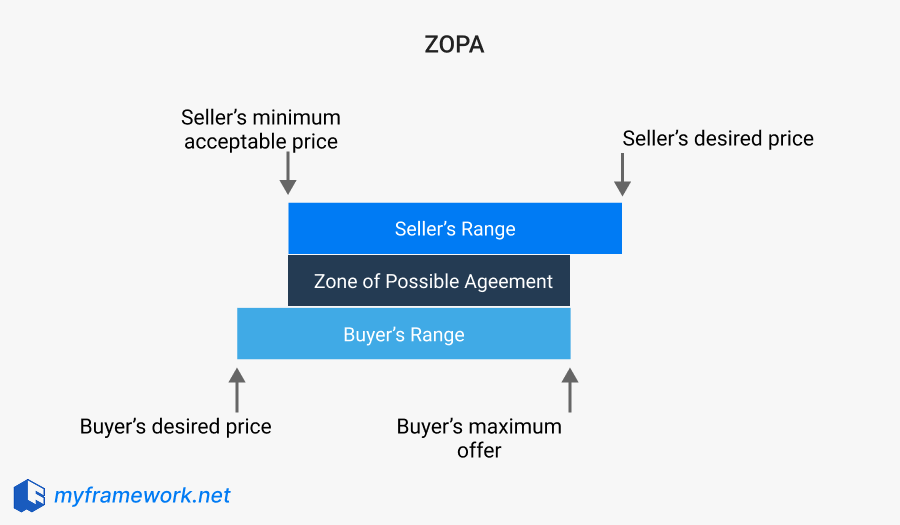
The larger this common area, the more the interests of both parties are satisfied, which typically leads to compromise and a final agreement.
On the other hand, if there is no overlap, no matter how much negotiation takes place, an agreement is unlikely to be reached under normal circumstances.
Therefore, both parties must understand each other's needs, values, and interests, to get into this zone as much as possible to make the deal.
How to Move Towards ZOPA?
To successfully move toward a ZOPA during negotiations, both parties must focus on key strategies that help align their expectations:
Clarify Interests and Objectives
ZOPA helps both sides identify their acceptable range of terms. By clarifying each other’s bottom lines, negotiations become more efficient, avoiding wasted time on non-negotiable terms.
Set Up BATNA (Best Alternative to a Negotiated Agreement)
BATNA is the fallback option if negotiations fail. Knowing your Best Alternative to a Negotiated Agreement provides leverage and helps assess whether continuing negotiations is worth it.
Explore Mutual Gains
Rather than focusing only on dividing the existing value, look for ways to create value for both sides. This could involve offering non-monetary benefits or trading issues that are more important to one party than the other.
By expanding the range of options, both parties can move toward a more satisfying outcome.
Stay Focused on the Deal
Don’t let personal conflicts or past issues sidetrack the negotiation. Keep your focus on reaching a mutually beneficial agreement within the current context.
Some many other approaches and strategies (for instance: Harvard Negotiation Principle) can help you with the negotiation.
By following these strategies, negotiating parties can move toward a ZOPA, where common ground is found, and a mutually acceptable deal becomes possible.
When to Use
- Real Estate: Determining if a bid gap is bridgeable.
- Procurement: when negotiating supplier contracts.
- Salary Talks: The gap between the budget cap and the candidate's minimum requirement.
Example
Imagine Tom is willing to sell his car for a minimum of $5,000, while John is willing to pay up to $5,500.
In this case, their bargaining range overlaps, and a ZOPA exists, with both parties likely able to agree on a price between $5,000 and $5,500.
The ZOPA is defined by the seller's minimum acceptable price and the buyer’s maximum offer. Any number within this range can lead to a deal that satisfies both parties.
Key Takeaway
A deal can only happen in the ZOPA.
Your goal in the early stages of negotiation is not to argue, but to explore. You must gather information to estimate the other side's Reservation Price.
Once you know the zone, you can stop fighting for survival and start fighting for value.
FAQ
What should a good ZOPA output look like?
A good result is a routine or working method that is easier to repeat and produces a visible practical benefit such as clearer notes, steadier focus, or better recall. If the user cannot feel or observe the difference in practice, the method has not been applied well.
When is ZOPA not the right tool?
It is a weak fit when the problem requires a deeper system change, not just a better routine or technique. ZOPA can improve how the work is done, but it will not solve structural constraints, motivation issues, or conflicting priorities on its own.