ABC Model: How to Take Charge of Your Emotions
A simple and practical way to break free from negative emotions.
ABC Model
Why We Often Feel Stuck In Negative Emotions
Many people struggle with sudden frustration, anxiety, or even sadness that seems to appear out of nowhere.
We blame the event itself, like a harsh comment from a boss or a friend not replying to a message. But in reality, the root of our emotions is not the event. It is how we interpret it. If we can manage these interpretations, we can better manage our emotions and actions.
The ABC Model is part of Rational Emotive Behavior Therapy (REBT), created by psychologist Albert Ellis in the 1950s.
Ellis believed that people are not disturbed by events themselves, but by their beliefs about those events. He called this process the ABC Theory of Emotion.
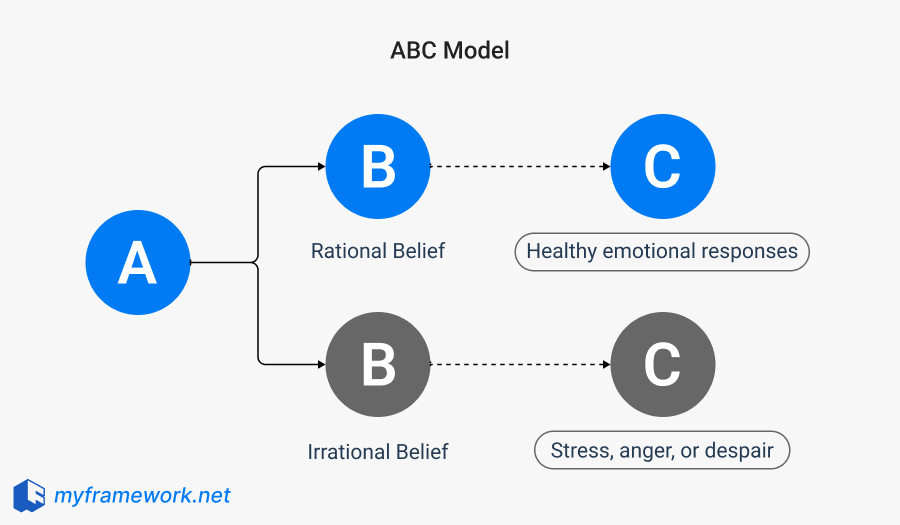
This model is now widely used in psychology, coaching, and personal improvement because it gives a practical tool to identify and change unhelpful thinking.
A - Activating Event
The situation that happens. It's only the trigger and it can be neutral or even random. Whatever the result is, one thing is obvious: it can not be changed.
B- Belief
The thoughts or assumptions we hold about the event.
It's the critical factor, because this is the only thing we can control.
A rational belief leads to healthy emotional responses, while an irrational belief creates stress, anger, or despair.
| Type | Definition | Example |
| Absolutism | Demanding that things must go our way | "I must win" or "Everyone must like me" |
| Overgeneralization | Judging yourself or others based on one event | "I failed once, so I am useless" |
| Catastrophizing | Assuming the worst possible outcome | "If I get criticized, I cannot survive it" |
C - Consequence
The consequenceis how we feel and act. Change the belief, and the consequence changes too.
By recognizing these patterns, we see that our emotions are not fixed. They are shaped by how we think.
So far, you can see that the ABC Model is a simple and practical way to break free from negative emotions. Still, I know it’s hard to follow any method when you feel really low.
If there’s only one thing to remember from this post, let it be this:
The real task is not managing emotions, but managing the irrational beliefs that drive them.
When to Use
- Conflict Resolution: When you feel disproportionate anger and realize it is driven by rigid "should" beliefs.
- Rejection: When a single failure or refusal turns into global self-judgment or hopelessness.
- Stress Overload: When you interpret normal pressure as catastrophic or unbearable.
Example
Imagine you ask a colleague for help and they say no.
If your belief is “People should always help me,” the result might be anger.
If your belief is “Everyone has the right to refuse,” the result is calm acceptance.
Another case: you hear that all your friends are getting married while you are still single.
If your belief is “Not being married means I am a failure,” you feel lonely and unworthy.
If your belief is “Marriage is not equal to value, I just need to love myself,” you feel confident.
In both examples, the event is the same, but the beliefs create very different outcomes.
Key Takeaway
The ABC Model shows that emotions are not caused by events, but by the beliefs attached to them.
When beliefs are rigid or irrational, emotional suffering becomes inevitable. By identifying and replacing these beliefs, emotional reactions naturally soften.
Emotional control begins with cognitive clarity, not emotional suppression.
FAQ
What should a good ABC Model output look like?
A good result is a realistic diagnosis of the team’s current stage together with a clear view of what leadership should focus on next. The output should help explain what is happening in the team now, not just list the stages in theory.
When is ABC Model not the right tool?
It becomes less useful when people start treating the stages as a prediction tool or as a label to excuse poor performance. ABC Model helps interpret team dynamics, but it should not replace direct observation of what the team actually needs next.
Can ABC Model help with irrational thinking loops?
ABC Model can help with irrational thinking loops when the real question is whether the tension reflects a normal stage-of-development issue or a deeper team problem. It helps you read the conflict in context and choose a leadership response that fits the team’s current stage.
Related Frameworks
- CBT Framework: Mastering Your Mind’s Operating System- It’s not the situation that causes your emotions — it’s how you think about it.