AARRR Model
Amodel redefines digital marketing by focusing on measurable growth and customer retention.
TAM-SAM-SOM Analysis
Enhance your market segmentation and marketing strategy
Product Lifecycle Model
Describe the natural path most products follow.
FASTR Framework
Filter AI use cases by risk, readiness, and measurable business value before committing real resources.
Philip Kotler's 5 Product Levels
Analyze where your product creates value and identify the layers where real differentiation happens.
TOWS Model: Create Actionable Strategies from SWOT Analysis
Turn SWOT insights into concrete strategic options and actions.
TOWS Model
The Problem with SWOT
We all know the SWOT analysis. It is the bread and butter of every business school student. But here is the uncomfortable truth. Most SWOT analyses end up in a drawer.
Why? Because listing your problems is not the same as solving them.
The TOWS Matrix forces you to stop listing bullet points and start connecting them. It asks a crucial question. How can specific strengths handle specific threats? It turns a static snapshot into a dynamic generator of ideas.
The TOWS Model, developed by Heinz Weihrich in 1982, is an extension of the well-known business frameworkSWOT Analysis (Strengths, Weaknesses, Opportunities, and Threats).
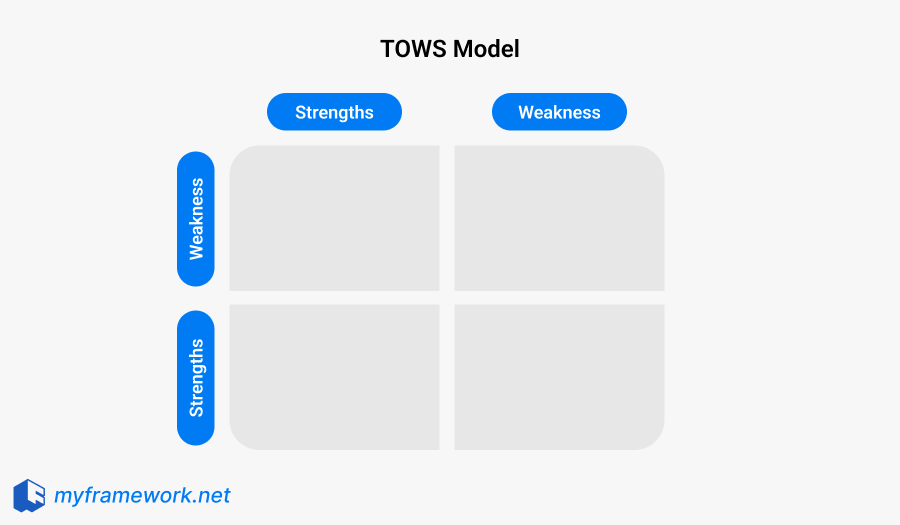
While SWOT is used to identify a company’s internal strengths and weaknesses along with external opportunities and threats, TOWS goes a step further by focusing on developing strategies based on those findings.
You can think of SWOT as the foundation and TOWS as the blueprint for action. With the former inputs, the TOWS Model helps businesses translate their SWOT analysis into real-world strategies.
Deep Dive into TOWS
The TOWS Model helps businesses take the insights from a SWOT analysis and create actionable strategies. It does this by matching internal strengths and weaknesses with external opportunities and threats.
The TOWS matrix is divided into four quadrants:
SO (Strengths-Opportunities): Use strengths to take advantage of opportunities.
WO (Weaknesses-Opportunities): Overcome weaknesses to pursue opportunities.
ST (Strengths-Threats): Use strengths to defend against external threats.
WT (Weaknesses-Threats): Minimize weaknesses to avoid threats.
The purpose is to identify strategies that will help a company grow, defend itself, or adapt to changing conditions by aligning internal capabilities with the external environment.