Porter’s Five Forces
Analyze industry competition beyond direct rivals to uncover structural profit drivers.
VRIO Framework
Evaluate whether your resources create real, defensible competitive advantage.
Ohmae’s 3C’s Model
Emphasizes the balanced integration of Company, Customer, and Competitor for strategic decisions, avoiding a singular focus.
TOWS Model
Turn SWOT insights into concrete strategic options and actions.
Value Stick Model
Helps businesses balance willingness to pay and willingness to sell
CAGE Model
Provides a framework for comparing markets beyond surface-level metrics.
Value Stick Model: The Economics of Competitive Advantage
Helps businesses balance willingness to pay and willingness to sell
Value Stick Model
What is the Value Stick Model
Have you ever wondered why people are willing to pay more for one product over another, even when both seem similar?
Many companies struggle to set the right price, understand customer value, or figure out how much profit they should make.
The Value Stick model helps answer these questions. Developed by Professor Felix Oberholzer-Gee from Harvard Business School, this model focuses on what customers are willing to pay and what suppliers or employees are willing to accept.
Visualize the Value Stick Model
The Value Stick can be visualized in a top-to-bottom view: a customer is willing to pay at the top, the cost to the company at the bottom, and the resulting profit margin as the space between the two.
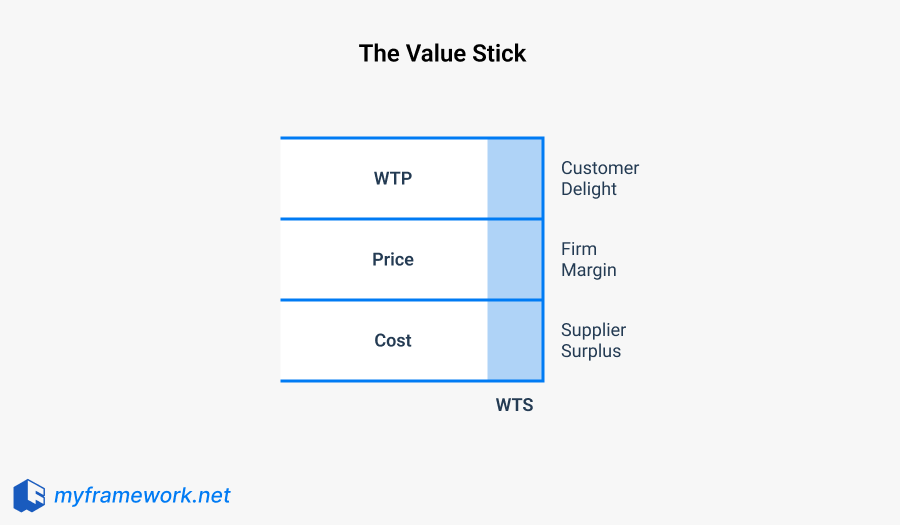
Willingness to Pay (WTP)
The highest or maximum price a customer is willing to pay for your product or service. If your product is valuable or unique, WTP goes up since it's delighting the customer.
Price
What the customer actually pays. This also defines the firm margin.
Cost
What it costs the company to produce the product or service.
Willingness to Sell (WTS)
The minimum price at which the company is willing to accept.
If working conditions or supplier relationships improve, WTS can go down, it means the company would like to accept a lower price since the overall cost goes down.
How to Use the Value Stick Model
These four parts create three important value zones:
Customer Delight = WTP – Price
- This is the extra value the customer feels they are getting. The bigger this gap, the more satisfied the customer is.
- To enhance WTP, please identify what increases customer willingness to pay, such as improving features, customer services, etc.
Firm Margin = Price – Cost
- This is the company’s profit. A bigger margin means more money for the business.
Supplier or Employee Surplus = Cost – WTS
- This is the value given to the people or suppliers who help make the product. If treated fairly, their surplus grows.
- To lower WTS, analyze your cost structure to find ways to reduce costs.
The goal is to stretch the Value Stick – raise WTP, lower WTS, and grow the total value created. Companies can then decide how to share this value among customers, themselves, and suppliers.