STAR Method
Answer behavioral interview questions clearly.
Current–Past–Future Interview Framework
An easy framework to answer "Tell Me About Yourself" in a job interview.
151515 Career Planning Model
Guiding you through three 15-year stages for your 45-year career.
PART Framework
Structure your answers and emphasize takeaways to show real growth.
Three Zones of Learning: How to Grow Beyond Your Comfort Zone
Helps you study and improve by giving you a clear way to plan your effort.
Three Zones of Learning
Why This Matters
Many people want to improve, yet they feel stuck in routines that no longer help them grow. They stick to the same habits, repeat the same tasks, and wonder why their productivity doesn't change.
Noel Tichy, a professor at the University of Michigan, studied this problem and proposed a simple idea. Growth occurs when we understand our current position and then take one step beyond it. That is the heart of the Three Zones of Learning.
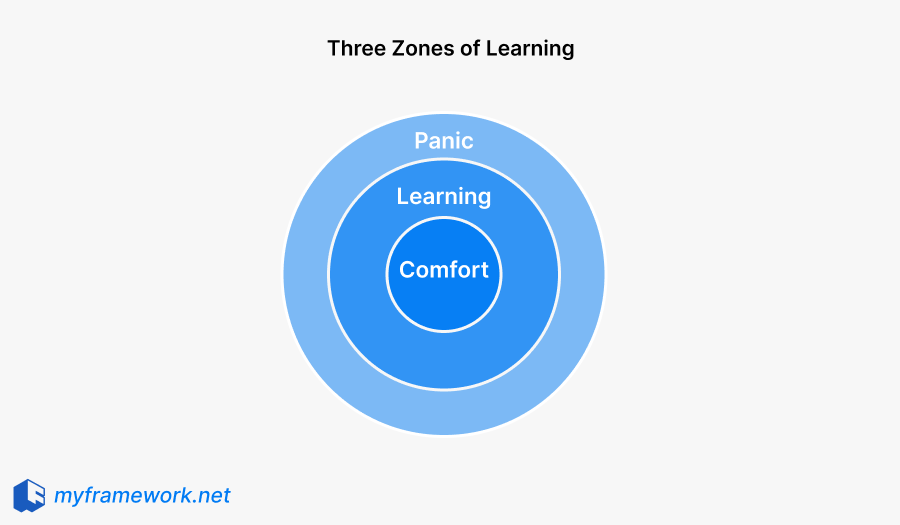
The Three Zones of Learning model describes three mental spaces that shape how we learn:
- Comfort zone
- Learning zone
- Panic zone
Each zone produces different emotions, different reactions, and different results. The key is to know when to stay, when to stretch, and when to pull back.
Comfort Zone
This is the space where everything feels familiar. Tasks are easy, skills are stable, and pressure is low.
People feel safe here, but the cost is slow improvement and productivity stays flat.
The comfort zone can become a trap when we stop noticing how the world changes around us. It feels warm, but it also limits how far we can go.
Learning Zone
This is where growth happens.
The learning zone creates enough challenge to activate curiosity without overwhelming the mind.
Research suggests that the ideal learning ratio is about 85 percent familiar and 15 percent unfamiliar. This mix keeps us engaged, stretches our thinking, and helps us learn faster. As we repeat these new skills, the unfamiliar becomes familiar, and the learning zone slowly transitions to the comfort zone.
Panic Zone
This is the space people usually won't want to touch. Tasks feel impossible, stress rises quickly, and focus disappears.
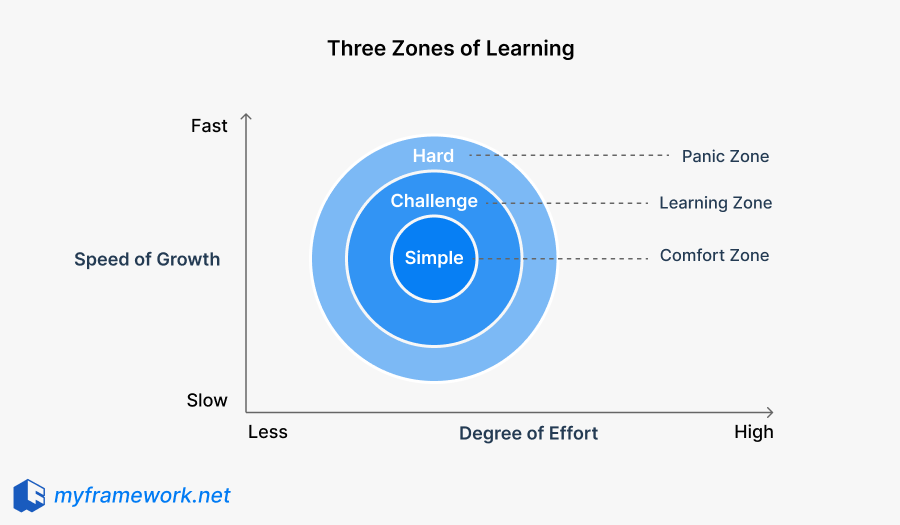
People sometimes quit because they believe they cannot succeed. In the panic zone, emotional overload replaces real learning. The goal is not to avoid this zone forever, but to move out of it fast and rebuild confidence inside the learning zone.