FFC Technique
Give feedback that is clear, specific, and actionable by combining Feeling, Fact, and Comparison.
4 Patterns of Team Conflicts
Summary of typical conflicts in the workplace, discover proven strategies
Active Listening Spiral
A framework enhances understanding, empathy, and responsiveness.
Thomas-Kilmann Conflict Mode Instrument (TKI)
Using dual concern theory to understand and resolve conflicts.
10-10-10 Meeting Model
Structure 30-minute meetings into focused parts for better feedback.
ORID Focus Conversation
Help groups move from information gathering to action in a structured and inclusive way.
Harvard Negotiation Principle
Six negotiation principles help both sides get more of what they want.
ZOPA
A practical negotiation concept that defines where a deal is actually possible.
VSNC Framework
Persuade and inform with clarity by structuring your message.
COIN Model
Deliver clear, non-judgmental feedback by separating facts, impact, and next actions.
Radical Candor
Being a great manager without losing your humanity.
CLEAR 1
Strengthen alignment between your priorities and your manager’s expectations.
VSNC Framework: Speak and Write to Persuade and Inform
Persuade and inform with clarity by structuring your message.
VSNC Framework
The Professor's Secret
How do you make complex ideas stick?
Patrick Henry Winston, the legendary MIT computer science professor, taught a famous lecture explicitly on this topic for over 40 years. His core philosophy was simple:
Your success in life will be determined largely by your ability to speak, your ability to write, and the quality of your ideas, in that order.
He developed the VSNC Framework in his book, Make It Clear: Speak and Write to Persuade and Inform, a guide designed to help readers enhance their speaking and writing skills. He wants to ensure his students could command a room. It moves beyond "storytelling" into "structured persuasion."
The book emphasizes the importance of clear and structured communication, essential for persuading and informing audiences effectively.
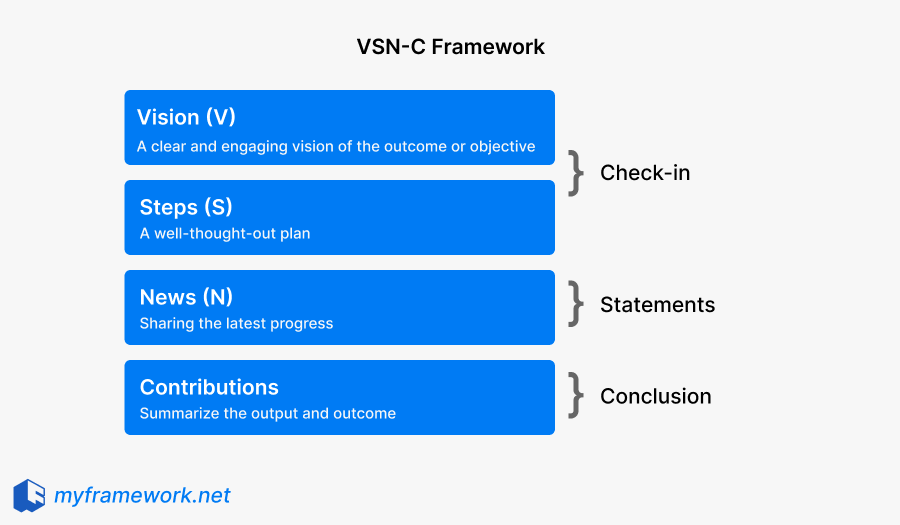
The VSNC Framework focuses on four key elements:
- V - Vision
- S - Steps
- N - News
- C - Contributions
Core Content
Vision
Begin with a clear and engaging vision of the outcome or objective. This gives your audience a sense of purpose and direction.
Your vision goals should include the problems people care about. Remember, you are not the only one who is passionate about the issue, you should also get your audience interested.
Hints:
- Propose different visions and goals for different groups.
- Determine the title of the speech according to a specific group. It does not have to be framed as a “goal.” A challenge, an opportunity, or a bold hypothesis can work just as well.
Steps
In order to convince your audience, you need to show that you have a well-thought-out plan, which will give credence to the idea that you are wise and capable enough to solve the problem.
Outline these steps with a structured roadmap (refer to Outcome-based Roadmap). The steps here could be the actions you've taken or the plan you are going to carry out.
Hints:
- It is not necessary to list all the details
- The process of creating the plan is more important than the plan itself
News
The latest progress regarding the Steps you defined.
Tell us about the work you have recently accomplished. Provide accomplishments (preferably with data) and then explain how you achieved them.
Hints:
- Don't just rehash previous work, but also get your audience excited about what you plan to do in the future.
Contributions
Summarize the output and outcome of your work. Emphasizing how they make a meaningful impact.
The VSNC Framework isn’t just about improving your communication skills, it’s about creating meaningful connections with your audience. Whether you’re a student, professional, or speaker, applying these principles can make your ideas truly shine.