The Hook Model
A four-step process that encourages user engagement and promotes habit formation.
The AIDMA Model
Classic framework in marketing, helping business understand and influence each stage of the customer journey.
AISAS Model
Adapts traditional marketing concept to the digital landscape.
AARRR Model
Amodel redefines digital marketing by focusing on measurable growth and customer retention.
AIPL Model
Optimize each stage of the customer journey, from brand awareness to loyalty.
5A Marketing Model
focusing on how brands can guide prospects from awareness to advocacy.
4P Marketing Mix
A classic framework that provides a clear, structured approach to marketing.
4C Marketing Model
For building customer-focused marketing strategies.
9 Key Forces of Mobile Technology Reshape Customer Behavior
Understand how context, location, and environment shape mobile customer decisions.
Marketing Funnel 5 Stages To Boost Email Marketing
Align your marketing email with the proven customer journey strategy.
FABE Model
Highlight product value, connect with customer needs, and build long-term trust
SPIN Model
Uncover real customer pain through thoughtful, guided questioning.
6 Essential Marketing Campaigns Every Brand Needs
Better fomulate your brand’s marketing strategy.
Straight Line System
Gives sales people a clear roadmap to follow.
4P Model in Content Marketing
Build a clear system to improve content, ensuring long-term marketing impact.
ChatGPT5 P.R.O.M.P.T. Framework For Business Planning
Help you stay focused, filter noise, and improve output, which is deeply aligned with your intent.
4P Model in Content Marketing: Improve Content Strategy
Build a clear system to improve content, ensuring long-term marketing impact.
4P Model in Content Marketing
Feel Harder in Content Marketing
Many teams work hard on content, yet results are uneven.
Sometimes content gets attention, but it rarely converts. Other times, the effort to produce articles, videos, or posts feels wasted because there is no clear plan behind it.
The truth is that content marketing without a system is like building a house without a blueprint. It may stand for a while, but it will not last.
What is the 4P Model
The 4P Model of Content Marketing was introduced by Pam Didner, a well-known strategist and author of Global Content Marketing. She designed it to help business bring structure to their digital marketing efforts.
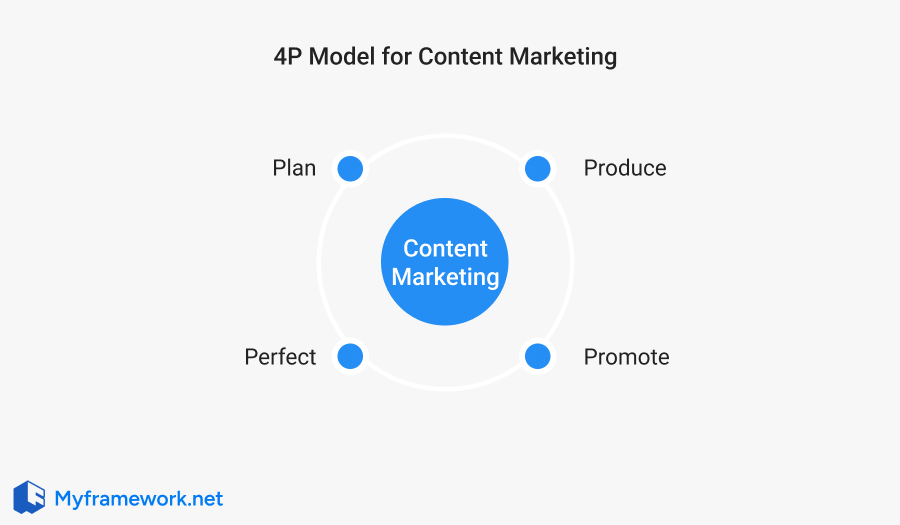
The model covers four connected steps: Plan, Produce, Promote, and Perfect. Together, they work like gears in a machine, keeping content aligned with business goals while driving long-term value.
Core Concept of Content 4Ps
The 4P Model forms a closed loop that makes content marketing both structured and sustainable. Each “P” has its own focus, yet together they drive long-term business growth.
Plan
The starting point is not writing or designing, but planning like an architect builds a blueprint.
A clear plan defines the objectives of content marketing, the role of each piece, and how success will be measured. Planning ensures content is tied to real user needs, pain points, and challenges.
Themes should be wide enough to inspire ongoing creation and close enough to the brand to build strong customer connections.
Produce
Production is about more than output. It is about creating content that builds a value bridge between brand and user.
The process includes auditing current assets, brainstorming ideas, organizing resources, and publishing.
The ideal outcome is producing both enough content and the right quality. If you must choose, choose quality. Because when audiences sense real value and depth, marketing messages resonate more.
Follow these steps to produce valuable content:
- Step 1: Define goals. Clarify the target audience, understand how to help them, and provide valuable and inspiring information.
- Step 2: Audit existing content.
- Step 3:Brainstorm and record a series of creative ideas.
- Step 4: Match content with the timeline. Note that not all content can align with products, but most content should strongly match the target audience.
- Step 5: Identify content creators. They can be internal brand teams, outsourced partners, or even invited users.
- Step 6: Manage and evaluate the results of content production.
- Step 7: Upload and synchronize content.
- Step 8: Create content packages and share them with regional and across-functional teams. When content becomes too much, use “editorial themes” or “target audiences” as categories, so each region knows which content is available.
Promote
Content only creates impact if it reaches people. Promotion ensures the right message is delivered to the right audience at the right time.
This step includes setting clear goals, confirming budgets, identifying channels, and creating a promotion calendar. Let's break it down into practical steps:
- Step 1
- Establish promotion goals and evaluation methods.
- Define promotion objectives, strategies, and evaluation standards, then align them with content marketing goals.
- Combine with sales promotions or events to drive consumer action.
- Step 2
- Discuss new promotion ideas and set the corresponding budget.
- Confirm budget support, and use brainstorming to decide on attractive campaign themes.
- Step 3
- Clarify the priority of promotion strategies.
- Understand what types of content are available.
- Determine which channels they can be used for, forming a complete promotion plan.
- Step 4
- Create a content promotion calendar. A well-designed calendar can extend the long-tail effect of content, ensuring assets continue to generate awareness, engagement, and leads well beyond the launch moment.
Perfect
The final step is about renewal and continuous improvement.
Perfecting means using data and feedback to evaluate how well content performs. Common measures include views, clicks, downloads, shares, and conversions.
At a strategic level, companies must also ask:
Does our content improve customer acquisition?
Does it build reputation and trust?
By reviewing and refining, teams ensure every cycle becomes smarter, and content marketing keeps driving growth.