The Hook Model
A four-step process that encourages user engagement and promotes habit formation.
The AIDMA Model
Classic framework in marketing, helping business understand and influence each stage of the customer journey.
AISAS Model
Adapts traditional marketing concept to the digital landscape.
AARRR Model
Amodel redefines digital marketing by focusing on measurable growth and customer retention.
AIPL Model
Optimize each stage of the customer journey, from brand awareness to loyalty.
5A Marketing Model
focusing on how brands can guide prospects from awareness to advocacy.
4P Marketing Mix
A classic framework that provides a clear, structured approach to marketing.
4C Marketing Model
For building customer-focused marketing strategies.
9 Key Forces of Mobile Technology Reshape Customer Behavior
Understand how context, location, and environment shape mobile customer decisions.
Marketing Funnel 5 Stages To Boost Email Marketing
Align your marketing email with the proven customer journey strategy.
FABE Model
Highlight product value, connect with customer needs, and build long-term trust
SPIN Model
Uncover real customer pain through thoughtful, guided questioning.
6 Essential Marketing Campaigns Every Brand Needs
Better fomulate your brand’s marketing strategy.
Straight Line System
Gives sales people a clear roadmap to follow.
4P Model in Content Marketing
Build a clear system to improve content, ensuring long-term marketing impact.
ChatGPT5 P.R.O.M.P.T. Framework For Business Planning
Help you stay focused, filter noise, and improve output, which is deeply aligned with your intent.
Straight Line System: The "Wolf of Wall Street" Sales Method
Gives sales people a clear roadmap to follow.
Straight Line System
Common Sales Struggles
Many people struggle with sales, they often lose during a sales conversation. They don’t know how to start a conversation, losing control during a pitch, these make us feel unpredictable and uncomfortable.
Among these people, Jordan Belfort is the special one. While his personal story is controversial, the sales method he developed, called Straight Line Selling really helps.
Introduced in his book The Wolf of Wall Street, this method helps salespeople control the flow of conversation and guide it smoothly toward a successful close.
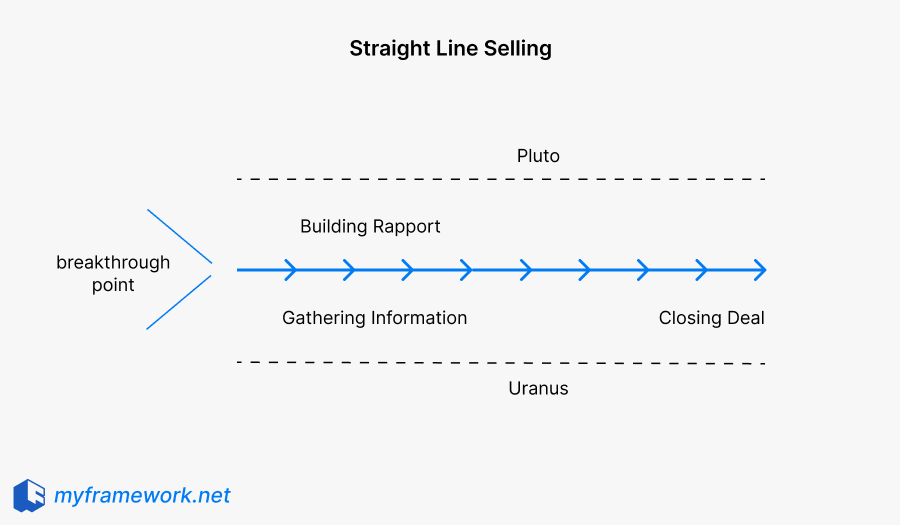
The beauty of this model is that it gives people a clear roadmap to follow.
Instead of wandering through a conversation and hoping for the best, you can guide it confidently from the first hello to the final “yes.”
Core Structure of Straight Line System
The diagram perfectly captures the system’s logic:
- The straight horizontal arrow represents the entire sales process — from the breakthrough point (starting the conversation, using FORM technique) to closing the deal. Remember, always move the conversation forward.
- On this line, the middle point is where trust is built and needs are identified.
- The path is guided by two forces:
- Above the line: Building Rapport – creating emotional connection.
- Below the line: Gathering Information – asking questions to understand the customer, this happens simultaneously when you start building the relationship with your customer.
The key of this system is to keep the customer within this "zone" and control the direction by using confidence and structure, not pressure.
In order to achieve this, you must stay on this straight line all the time. Straying too far up makes you overly friendly and unfocused (Pluto). Going too far down makes you cold and disconnected (Uranus).
Key Elements of the System
Control the Conversation
The salesperson must guide the flow of the conversation. This doesn’t mean being pushy. It means asking the right questions and using active listening to keep things moving in the right direction.
Build Rapport Quickly
People buy from those they trust. So, you must build a connection fast. This is done through tone of voice, body language, and matching the energy of the other person.
Identify Needs Through Questions
Instead of guessing what the customer wants, ask smart questions to understand their real needs. This builds trust and helps you present the right solution.
Present with Certainty
According to Belfort, people buy when they feel three things with certainty:
- They trust the product.
- They trust the salesperson.
- They trust the company.
You must transfer that certainty through your words, tone, and body language.
Handle Objections Smoothly
Objections are part of every sale. This system teaches that objections often come from uncertainty. Instead of fighting them, you gently guide the person back onto the straight line by addressing concerns without losing control.
Close with Confidence
A sale should feel like the natural end of the conversation. By staying on the straight line, building trust, and addressing objections, the close becomes much easier.