The Golden Circle
For understanding how great leaders and orgs inspire action by starting with a clear sense of purpose.
StoryBrand Framework
Focuses on the seven elements necessary for helping your customer.
The Hook Model
A four-step process that encourages user engagement and promotes habit formation.
Self-Us-Now Framework
Help individuals and groups connect personal stories to collective action.
Pixar Storytelling Formula
Turn complex ideas into clear cause-and-effect stories people remember.
5A Marketing Model
focusing on how brands can guide prospects from awareness to advocacy.
Hero's Journey Storytelling Framework
A storytelling framework that makes your message relatable, memorable, and impactful in any context.
The Innovation Story Framework
Narrate how an idea was born, built, and scaled to demonstrate its real-world impact.
ICARE Model
Build a service culture that turns everyday interactions into lasting customer loyalty.
4C Marketing Model
For building customer-focused marketing strategies.
4P Model in Content Marketing
Build a clear system to improve content, ensuring long-term marketing impact.
5E Experience Model
Map user journeys from first attraction to lasting memory by structuring experiences across five critical stages.
CARE Framework
Design consistent customer service experiences through connection, support, resolution, and continuous improvement.
Freytag’s Pyramid
Helps communicators control emotional rhythm and attention over time.
Philip Kotler's 5 Product Levels
Analyze where your product creates value and identify the layers where real differentiation happens.
CARE Framework: 4 Steps to Better Customer Service
Design consistent customer service experiences through connection, support, resolution, and continuous improvement.
CARE Framework
Why do Customers Leave
Customer experience is important, but many teams still struggle with that.
Scattered touchpoints, inconsistent communication, and slow problem resolution all constantly jeopardize the customer experience. This is why a clear and simple experience model matters.
The CARE Customer Experience Framework organizes the journey into four moves that any business can practice. It brings structure to communication, service quality, and customer satisfaction.
What is CARE Customer Experience Framework
The CARE Framework is a practical model that helps teams design and deliver a stronger customer experience.
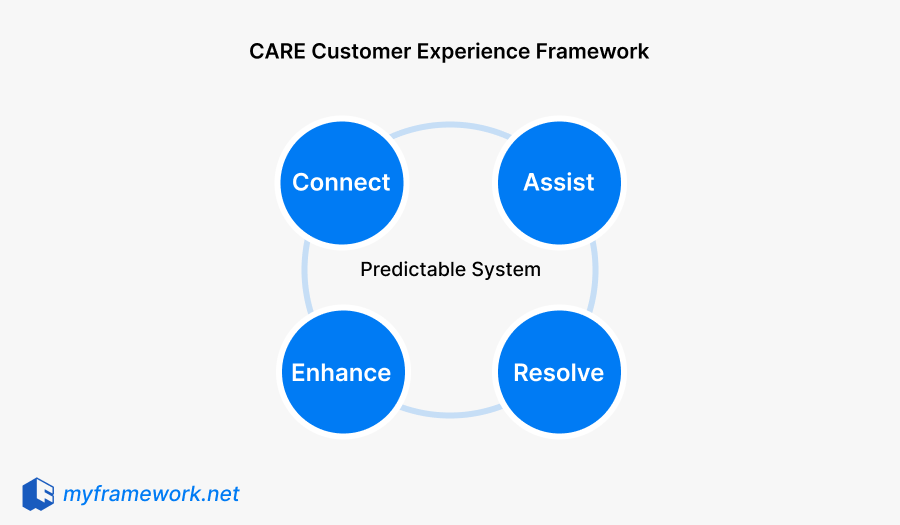
It covers four essential stages:
- Connect - Build emotional connection
- Assist - Support and help
- Resolve - Resolve the problem
- Enhance - Improve experience
Each stage shapes how customers feel, how they communicate, and how satisfied they are with the service.
The Four Elements of the CARE Framework
Connect
Connection begins long before a ticket is created. It happens the moment a customer interacts with your brand. When people feel seen, they listen more. They share more. And they stay longer.
Common moves include using personal names, acknowledging context, and adding small emotional signals that show real attention.
Example: Don't just say 'Hello'. Say 'Hello [Name], I see you've been with us for 2 years, thanks for that!'
Assist
Customers rarely state their needs clearly. Many do not ask for help until they are already frustrated. A strong experience anticipates questions before they surface.
Teams use intelligent FAQ systems, onboarding tips, scenario prompts, and usage guides that reduce friction.
Tactic: Implement 'Proactive Chat' triggers on error pages to assist before the customer complains.
Output: Faster progress and fewer blockers.
Resolve
Delay is the enemy, not the problems. A team that responds quickly and takes ownership builds immediate credibility. A team that passes customers around destroys it.
Clear rules of engagement matter. A 24-hour response target (if not possible, don't over-commit). Authority for frontline staff to solve issues. Simple escalation paths.
Rule of Thumb: If a problem cannot be solved in 2 interactions, escalate immediately to voice/video call.
Output: Higher customer satisfaction and stronger referral intent.
Enhance
Experience work never ends. When markets shift, expectations change as well. What impressed a customer today may feel basic tomorrow.
Teams need a steady practice of reviewing customer journeys, identifying bottlenecks, and improving the service with real data from retention and repurchase behavior.
Loop: Send a 'Did we solve it?' survey 24 hours later, not immediately.
Output: A living experience loop that improves over time.