8+8+8 Rule
Make a good balance sheet of your life.
2 Minute Rule
Change up the content every two minutes to keep people engaged.
Four Quarters Method
Helps you stay productive, maintain focus, and manage your energy across the entire day.
Mental Flow
A state of complete immersion and focused enjoyment in an activity.
5 Second Rule
A Simple Trick to overcome procrastination and anxiety.
Pomodoro Technique
An easy time management method that boost your focus and productivity.
VITALS Method
Just take one small, meaningful step instead of a giant leap.
Ivy Lee Method
Replace scattered planning with deliberate action.
Peak–Trough–Recovery Model
Knowing where you are helps you choose what to do next with intention instead of habit.
2 Minute Rule: Keep People Engaged During Your Presentation
Change up the content every two minutes to keep people engaged.
2 Minute Rule
The Common Problem
While doing a presentation or public speaking, you may have seen many people losing the audience's attention, not due to unimportant content, but because the delivery is monotonous.
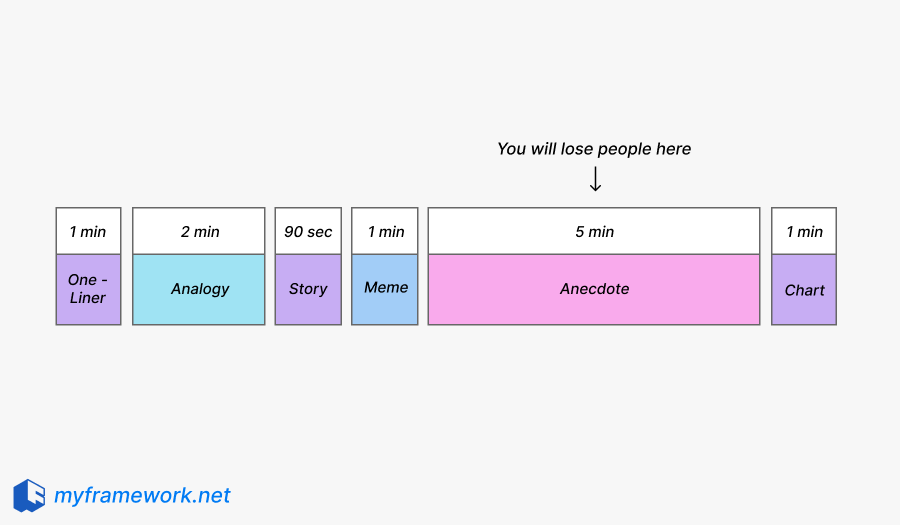
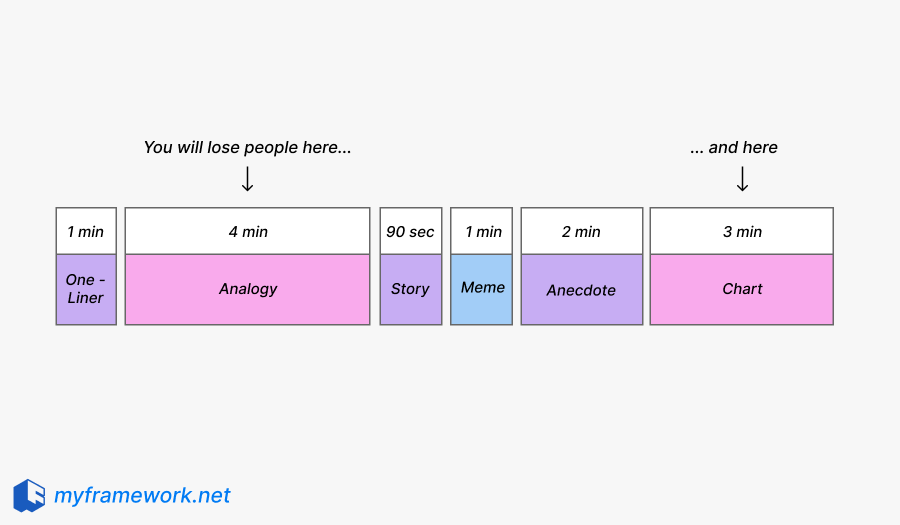
Research shows that adults can focus for about two minutes before their minds begin to wander if nothing changes. If your slides or speech keep the same tone for too long, even your best data will fade into background noise.
Why This Framework Works
The 2-Minute Rule is a communication strategy designed to keep audiences engaged by refreshing their attention every two minutes.
It stems from both cognitive science and practical presentation experience. Cognitive studies reveal that the human brain naturally craves novelty and contrast. This rule turns that insight into a simple, repeatable structure for meetings, speeches, and reports.
Detailed Explanation and Core Structure
The core idea is to change the format of your delivery at least once every two minutes so the audience’s brain gets a “fresh start.”
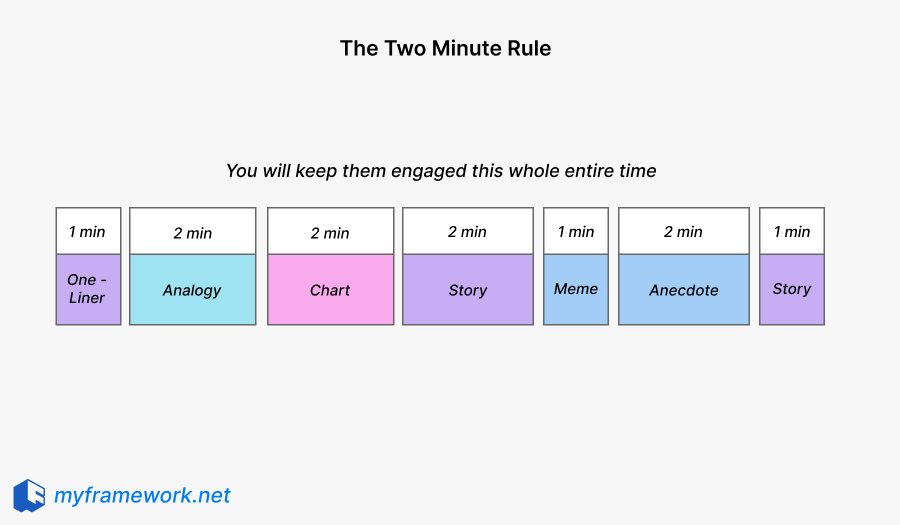
Each change is like flipping a page in a book—bringing new energy and focus.
Common switch methods include:
- One-liner (Punchline) – Start or transition with a short, memorable sentence. Example: “Data doesn’t lie, but storytellers can.”
- Analogy – Explain complex ideas with familiar comparisons. Example: “Upgrading our system is like replacing the engine of the entire supply chain.”
- Chart – Show data visually, not as a wall of numbers.
- Story – Share a real case that stirs emotion.
- Meme – Add a light, humorous image to reset attention.
- Anecdote – Insert a personal or relatable short story to make the content warm and human.
Arrange your slides to follow a pattern, for example: One-liner → Analogy → Chart → Story → Meme → Anecdote → Story.
Keep each segment under two minutes. Prepare transition cues like “This reminds me of…” or “Let’s go back to the data…” to signal a change.