KISS Review Framework
An action-orientated review model to convert past experience into practice.
FFC Technique
Give feedback that is clear, specific, and actionable by combining Feeling, Fact, and Comparison.
5 Whys Technique
Get to the root cause of an issue by asking "why" repeatedly.
The Golden Circle
For understanding how great leaders and orgs inspire action by starting with a clear sense of purpose.
First Principles
Start from the basics and find a new, more logical way of doing things.
Fiedler's Contingency Model
Leadership effectiveness isn’t just about the leader’s style but about how well that style fits the situation.
4 Patterns of Team Conflicts
Summary of typical conflicts in the workplace, discover proven strategies
Maslow's Hierarchy of Needs
Famous model in psychology and helps us understand what motivates people.
Active Listening Spiral
A framework enhances understanding, empathy, and responsiveness.
5Ps Leadership Framework
Simple models enhance your leadership skills.
Finance Transformation Priority Matrix
Prioritize finance transformation work without burning out your team.
Thomas-Kilmann Conflict Mode Instrument (TKI)
Using dual concern theory to understand and resolve conflicts.
FMEA Methodology
Identify failure modes and prioritize risks.
DEEP Technique
Protect your emotional boundaries.
AVP Model
A simple practice to accept the anxiety, anger or sadness and start embracing them.
SBI Model
Deliver objective feedback by separating situation, behavior, and impact.
7-38-55 Rule
Your presence speaks louder than your words.
FORM Technique
A simple way to start conversations.
The Relationship Map
A simple way to evaluate your relationships.
Work Breakdown Structure (WBS)
For better project planning, helps you simplify, organize, and get things done.
8+8+8 Rule
Make a good balance sheet of your life.
TOPS Framework
Make your pitch or message clear, logical, and action-oriented.
Stakeholder Saliency Model
Sharpen your stakeholder management skills via finding who matters most.
Winston’s Star
Apply five communication elements to make ideas memorable and repeatable.
7% Rule for Organizational Change
Start with 7%, Spark the Rest.
3A Trust Model
Gives you a simple and clear structure to build trust fast.
Research Funnel Model
Understand users with clarity, even when resources are tight.
2 Minute Rule
Change up the content every two minutes to keep people engaged.
10-10-10 Meeting Model
Structure 30-minute meetings into focused parts for better feedback.
5 Sos Technique for Problem Solving and Strategic Thinking
Continuously asking “So what might happen next?” to project how one event could trigger another.
The Rule of Suspense
Reveal your points step by step.
Four Quarters Method
Helps you stay productive, maintain focus, and manage your energy across the entire day.
StoryBrand Framework
Focuses on the seven elements necessary for helping your customer.
5W1H
Gather comprehensive information and provide clarity in various situations.
SQRRR (SQ3R) Method
A systematic approach to studying and comprehending reading material effectively.
Feynman Technique
Learning and understanding complex concepts by teaching them to someone else
STAR Method
Answer behavioral interview questions clearly.
PREP Framework
Deliver clear, structured arguments by stating your point first, proving it, and closing with clarity.
Johari Window
Expand self-awareness, uncover blind spots, and strengthen trust through structured feedback.
Brainstorming
A creativity technique designed to generate a large number of ideas.
80/20 Rule
Highlights the imbalance between causes and effects
The Hook Model
A four-step process that encourages user engagement and promotes habit formation.
Fogg Behavior Model
Identifies 3 elements for behavior change: Motivation, Ability, and Prompt.
FIRE Model
Separate facts from interpretations to respond to feedback calmly and solve the real problem.
Simon Learning Method
Effective strategies for rapid learning.
Mental Flow
A state of complete immersion and focused enjoyment in an activity.
ORID Focus Conversation
Help groups move from information gathering to action in a structured and inclusive way.
Harvard Negotiation Principle
Six negotiation principles help both sides get more of what they want.
ZOPA
A practical negotiation concept that defines where a deal is actually possible.
Peak-End Rule
Explains how we remember experiences.
Zoom-In and Zoom-Out Model
Allows you to handle challenges with clarity, whether you need to see the big picture or focus on the details.
Self-Us-Now Framework
Help individuals and groups connect personal stories to collective action.
Tuckman Model
Help you better structure, understand, and develop the team.
Freud’s Iceberg Theory
Developed from human psychology, it help us understand how the conscious and unconscious mind interacts.
The AIDMA Model
Classic framework in marketing, helping business understand and influence each stage of the customer journey.
AISAS Model
Adapts traditional marketing concept to the digital landscape.
AARRR Model
Amodel redefines digital marketing by focusing on measurable growth and customer retention.
AIPL Model
Optimize each stage of the customer journey, from brand awareness to loyalty.
7C Pyramid Communication Framework
Aim to eliminate confusion and miscommunication in both verbal and written forms
Pixar Storytelling Formula
Turn complex ideas into clear cause-and-effect stories people remember.
Cornell Note-Taking System
Encourage active engagement with the material and reinforces memory with review.
COSTAR AI Prompt Framework
This AI prompt framework helps you receive higher-quality feedback, and it’s very simple and effective
CRISPE AI Prompt Framework
Define context, role, instruction, subject, preset, and exceptions to get high-quality AI feedback.
5A Marketing Model
focusing on how brands can guide prospects from awareness to advocacy.
Current–Past–Future Interview Framework
An easy framework to answer "Tell Me About Yourself" in a job interview.
Fishbone Diagram
A simple yet powerful tool that helps you analyze and solve problems in a structured way.
Hero's Journey Storytelling Framework
A storytelling framework that makes your message relatable, memorable, and impactful in any context.
Porter’s Five Forces
Analyze industry competition beyond direct rivals to uncover structural profit drivers.
Outcome-Based Roadmap
Align your team around the right goals, ensure that you’re always working toward meaningful outcomes that matter.
The Innovation Story Framework
Narrate how an idea was born, built, and scaled to demonstrate its real-world impact.
PEST Analysis
Scan political, economic, social, and technological forces to spot macro risks and opportunities early.
4P Marketing Mix
A classic framework that provides a clear, structured approach to marketing.
VSNC Framework
Persuade and inform with clarity by structuring your message.
PESTEL Analysis
Scan political, economic, social, technological, environmental, and legal forces to reduce strategic blind spots.
Business Model Canvas
Visualize how your business creates, delivers, and captures value on a single page.
ICARE Model
Build a service culture that turns everyday interactions into lasting customer loyalty.
4C Marketing Model
For building customer-focused marketing strategies.
COIN Model
Deliver clear, non-judgmental feedback by separating facts, impact, and next actions.
GREAT Coaching Model
Emphasis on timing, ensuring actions are strategically aligned with deadlines for effective goal setting.
SCAMPER Method
Generate new ideas by systematically remixing existing products, processes, and assumptions.
SOAR Self-Leadership Model
Built on four essential components that guide personal and professional development.
VRIO Framework
Evaluate whether your resources create real, defensible competitive advantage.
Leadership Success Model
Define the success of leadership via team engaged, personal satisfaction, and organizational success.
TAM-SAM-SOM Analysis
Enhance your market segmentation and marketing strategy
9 Key Forces of Mobile Technology Reshape Customer Behavior
Understand how context, location, and environment shape mobile customer decisions.
Ohmae’s 3C’s Model
Emphasizes the balanced integration of Company, Customer, and Competitor for strategic decisions, avoiding a singular focus.
TOWS Model
Turn SWOT insights into concrete strategic options and actions.
Three Circles of Influence
Grow your influence via focusing what you can control.
Radical Candor
Being a great manager without losing your humanity.
4-7-8 Breathing Technique
Simple approach to clam the nervous system.
Marketing Funnel 5 Stages To Boost Email Marketing
Align your marketing email with the proven customer journey strategy.
4A Model
A valuable model to manage stress effectively.
Bridges Transition Model
Focus on the emotional and psychological transitions individuals experience during change.
Outcome Discovery Canvas
Define measurable outcomes and success metrics before you commit to building features.
5 Second Rule
A Simple Trick to overcome procrastination and anxiety.
Internal Factor Evaluation (IFE) Matrix
Evaluate internal strengths and weaknesses in strategy.
Goleman Emotional Intelligence Model
Foundation for personal success and leadership.
External Factor Evaluation (EFE) Matrix
Evaluate external opportunities and threats in strategic decision-making.
COST Principle
Help people to deliver strong messages or express complex ideas.
Satir Change Model
Details the process of change through five stages.
Pomodoro Technique
An easy time management method that boost your focus and productivity.
Product Lifecycle Model
Describe the natural path most products follow.
Value Stick Model
Helps businesses balance willingness to pay and willingness to sell
BROKE AI Prompt Framework
Help you write better AI prompts.
ICIO AI Prompt Framework
A simple prompt that saves time and gets better result.
DIKW Model
Move beyond information overload and make truly wise decisions.
RACI Model
Bring clarity, reduce friction to the stakeholder communication.
VUCA Framework
A simple guide to describe the complex environment.
BANI Framework
Move away from confusion via recognizing emotional and chaotic forces.
VITALS Method
Just take one small, meaningful step instead of a giant leap.
CBT Framework
It’s not the situation that causes your emotions — it’s how you think about it.
Product GTM Canvas
Brings clarity, reduces risk, and gives your product the best chance of success.
Magic Loop Framework
Capture feedback, act on it, make changes stick, and report back with clarity.
FABE Model
Highlight product value, connect with customer needs, and build long-term trust
ABCD Trust Model
Increase engagement and commitment in the workplace.
SCARF Model
Uncovers the emotional drivers behind employee reactions.
SPIN Model
Uncover real customer pain through thoughtful, guided questioning.
6 Essential Marketing Campaigns Every Brand Needs
Better fomulate your brand’s marketing strategy.
Straight Line System
Gives sales people a clear roadmap to follow.
151515 Career Planning Model
Guiding you through three 15-year stages for your 45-year career.
Four-Step Innovation Model
Turn raw ideas into market-ready products through a disciplined, four-stage innovation pipeline.
ABC Model
A simple and practical way to break free from negative emotions.
4P Model in Content Marketing
Build a clear system to improve content, ensuring long-term marketing impact.
PART Framework
Structure your answers and emphasize takeaways to show real growth.
4Ps Problem-Solving Framework
Discover the real problem before solving it.
CLEAR 1
Strengthen alignment between your priorities and your manager’s expectations.
Ivy Lee Method
Replace scattered planning with deliberate action.
ChatGPT5 P.R.O.M.P.T. Framework For Business Planning
Help you stay focused, filter noise, and improve output, which is deeply aligned with your intent.
RIDE Communication Framework
Help you persuade effectively, build trust, and gain support in any professional setting.
Peak–Trough–Recovery Model
Knowing where you are helps you choose what to do next with intention instead of habit.
DISC Communication Styles Framework
Speak their language, not yours.
Three Zones of Learning
Helps you study and improve by giving you a clear way to plan your effort.
Deliberate Practice
Understand how to study with purpose, without wasted effort.
OODA Loop
To make effective decisions quickly in rapidly changing situations.
STEEP Analysis Framework
Scan external risks and opportunities early using five macro lenses to guide strategy, market entry, and innovation.
FASTR Framework
Filter AI use cases by risk, readiness, and measurable business value before committing real resources.
ISD Model
Creates a closed loop that ensures learning outcomes align with business objectives
POEMS Framework
Gives teams a clear way to observe, classify, and interpret user behavior.
5E Experience Model
Map user journeys from first attraction to lasting memory by structuring experiences across five critical stages.
CARE Framework
Design consistent customer service experiences through connection, support, resolution, and continuous improvement.
Freytag’s Pyramid
Helps communicators control emotional rhythm and attention over time.
Philip Kotler's 5 Product Levels
Analyze where your product creates value and identify the layers where real differentiation happens.
SCR Framework
Resolve complications with concise, executive-ready solutions.
CAGE Model
Provides a framework for comparing markets beyond surface-level metrics.
GROW Model
Helps people clarify goals, assess situation, explore options, and take actions.
SWOT Analysis
Evaluate internal strengths and weaknesses against external opportunities and threats to identify real strategic choices.
SCQA Framework
Structure complex messages into a clear narrative that leads the audience to your conclusion.
Pyramid Principle
Structured communication framework which is supporting your point with logically organized details and effective information delivery.
Peak-End Rule
The Psychology: Why the Peak-End Rule Works
The Peaks-Ends Rule is a great discovery because it reveals a cognitive bias in humans.
Our brain despite its sophisticated design, always processing information in a simplified way, attributes the most intense and final moments of an experience to our overall perception of it.
This bias can be used intentionally to create positive experiences by focusing on the peak and the end.
It also tells us that anyone can utilize this cognitive bias to design a good experience.
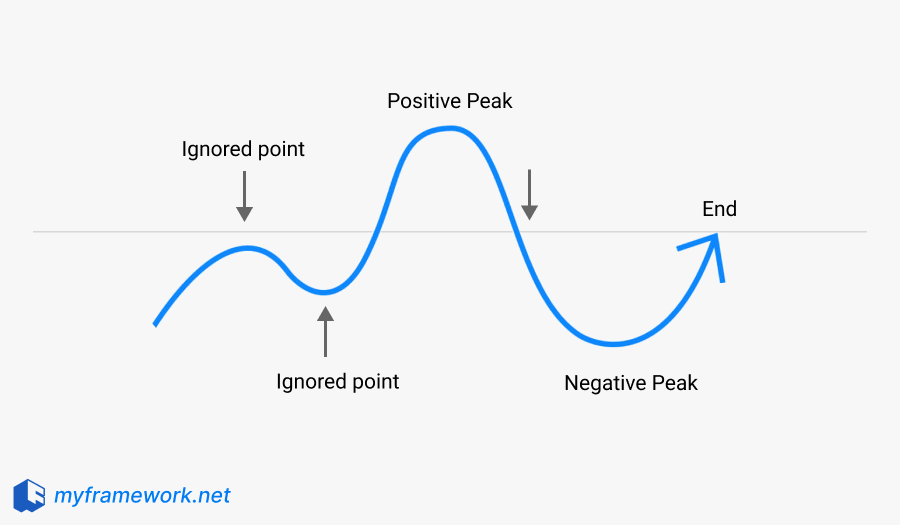
In 2002, Nobel Prize-winning economist Daniel Kahneman introduced the Peak-End Rule, a concept that explains how we remember experiences.
How to Apply the Peak-End Rule in Business & Life
According to this rule, people's memories of an event don't necessarily align with how they felt during the entire experience. Instead, their recollections are shaped by two key moments: the peak (the most intense part) and the end.
If both the peak and the end are pleasant, our brain convinces us that the entire experience was enjoyable—even if parts of it were less than ideal.
In other words, we evaluate experiences based on these two moments, rather than the finer details or the overall average.