Finance Transformation Priority Matrix
Prioritize finance transformation work without burning out your team.
Porter’s Five Forces
Analyze industry competition beyond direct rivals to uncover structural profit drivers.
PEST Analysis
Scan political, economic, social, and technological forces to spot macro risks and opportunities early.
PESTEL Analysis
Scan political, economic, social, technological, environmental, and legal forces to reduce strategic blind spots.
Business Model Canvas
Visualize how your business creates, delivers, and captures value on a single page.
SCAMPER Method
Generate new ideas by systematically remixing existing products, processes, and assumptions.
VRIO Framework
Evaluate whether your resources create real, defensible competitive advantage.
Ohmae’s 3C’s Model
Emphasizes the balanced integration of Company, Customer, and Competitor for strategic decisions, avoiding a singular focus.
TOWS Model
Turn SWOT insights into concrete strategic options and actions.
Outcome Discovery Canvas
Define measurable outcomes and success metrics before you commit to building features.
Internal Factor Evaluation (IFE) Matrix
Evaluate internal strengths and weaknesses in strategy.
External Factor Evaluation (EFE) Matrix
Evaluate external opportunities and threats in strategic decision-making.
VUCA Framework
A simple guide to describe the complex environment.
BANI Framework
Move away from confusion via recognizing emotional and chaotic forces.
Four-Step Innovation Model
Turn raw ideas into market-ready products through a disciplined, four-stage innovation pipeline.
STEEP Analysis Framework
Scan external risks and opportunities early using five macro lenses to guide strategy, market entry, and innovation.
FASTR Framework
Filter AI use cases by risk, readiness, and measurable business value before committing real resources.
SWOT Analysis
Evaluate internal strengths and weaknesses against external opportunities and threats to identify real strategic choices.
TOWS Model: Create Actionable Strategies from SWOT Analysis
Turn SWOT insights into concrete strategic options and actions.
TOWS Model
The Problem with SWOT
We all know the SWOT analysis. It is the bread and butter of every business school student. But here is the uncomfortable truth. Most SWOT analyses end up in a drawer.
Why? Because listing your problems is not the same as solving them.
The TOWS Matrix forces you to stop listing bullet points and start connecting them. It asks a crucial question. How can specific strengths handle specific threats? It turns a static snapshot into a dynamic generator of ideas.
The TOWS Model, developed by Heinz Weihrich in 1982, is an extension of the well-known business frameworkSWOT Analysis (Strengths, Weaknesses, Opportunities, and Threats).
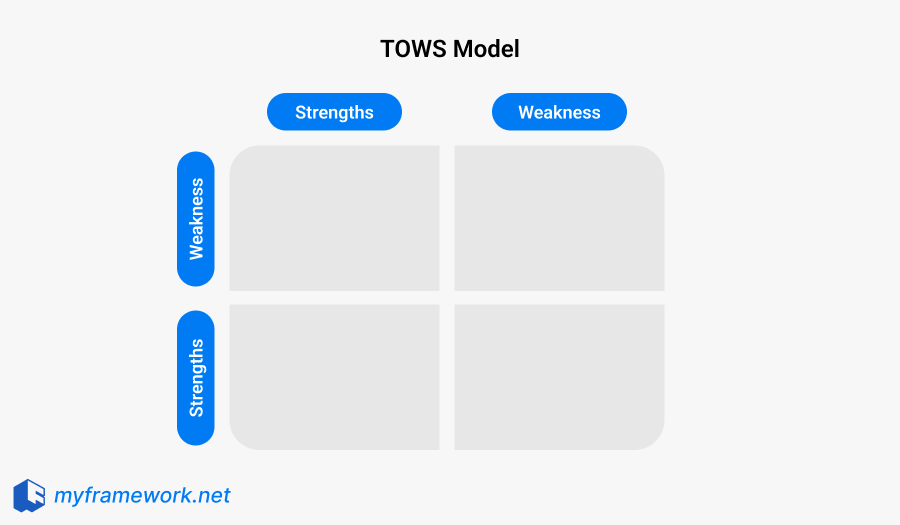
While SWOT is used to identify a company’s internal strengths and weaknesses along with external opportunities and threats, TOWS goes a step further by focusing on developing strategies based on those findings.
You can think of SWOT as the foundation and TOWS as the blueprint for action. With the former inputs, the TOWS Model helps businesses translate their SWOT analysis into real-world strategies.
Deep Dive into TOWS
The TOWS Model helps businesses take the insights from a SWOT analysis and create actionable strategies. It does this by matching internal strengths and weaknesses with external opportunities and threats.
The TOWS matrix is divided into four quadrants:
SO (Strengths-Opportunities): Use strengths to take advantage of opportunities.
WO (Weaknesses-Opportunities): Overcome weaknesses to pursue opportunities.
ST (Strengths-Threats): Use strengths to defend against external threats.
WT (Weaknesses-Threats): Minimize weaknesses to avoid threats.
The purpose is to identify strategies that will help a company grow, defend itself, or adapt to changing conditions by aligning internal capabilities with the external environment.