Finance Transformation Priority Matrix
Prioritize finance transformation work without burning out your team.
Porter’s Five Forces
Analyze industry competition beyond direct rivals to uncover structural profit drivers.
PEST Analysis
Scan political, economic, social, and technological forces to spot macro risks and opportunities early.
PESTEL Analysis
Scan political, economic, social, technological, environmental, and legal forces to reduce strategic blind spots.
Business Model Canvas
Visualize how your business creates, delivers, and captures value on a single page.
SCAMPER Method
Generate new ideas by systematically remixing existing products, processes, and assumptions.
VRIO Framework
Evaluate whether your resources create real, defensible competitive advantage.
Ohmae’s 3C’s Model
Emphasizes the balanced integration of Company, Customer, and Competitor for strategic decisions, avoiding a singular focus.
TOWS Model
Turn SWOT insights into concrete strategic options and actions.
Outcome Discovery Canvas
Define measurable outcomes and success metrics before you commit to building features.
Internal Factor Evaluation (IFE) Matrix
Evaluate internal strengths and weaknesses in strategy.
External Factor Evaluation (EFE) Matrix
Evaluate external opportunities and threats in strategic decision-making.
VUCA Framework
A simple guide to describe the complex environment.
BANI Framework
Move away from confusion via recognizing emotional and chaotic forces.
Four-Step Innovation Model
Turn raw ideas into market-ready products through a disciplined, four-stage innovation pipeline.
STEEP Analysis Framework
Scan external risks and opportunities early using five macro lenses to guide strategy, market entry, and innovation.
FASTR Framework
Filter AI use cases by risk, readiness, and measurable business value before committing real resources.
SWOT Analysis
Evaluate internal strengths and weaknesses against external opportunities and threats to identify real strategic choices.
VRIO Framework: The Litmus Test for Competitive Advantage
Evaluate whether your resources create real, defensible competitive advantage.
VRIO Framework
Quick Introduction
In today’s competitive business environment, companies constantly seek ways to stand out. But what truly sets a business apart?
Many struggle to identify which resources contribute to long-term success. This is why the VRIO Framework becomes essential.
Developed by Jay Barney in 1991, this framework provides a structured way to assess internal resources (it's also part of the Business Model Canvas, we could see how important it is.) and determine whether they can create a sustained competitive advantage.
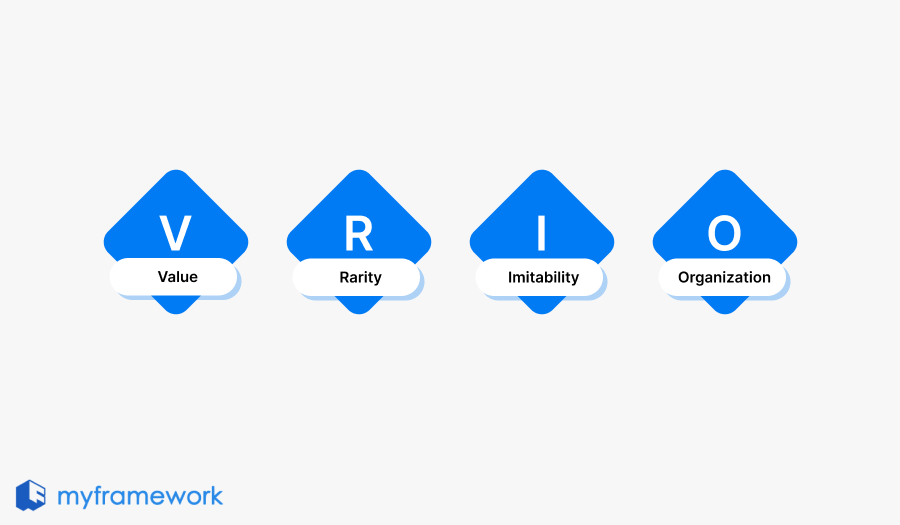
The VRIO Framework evaluates resources based on four key factors:
- Value
- Rarity
- Imitability
- Organization
Core Concept of the VRIO Model
Value
A resource must add value to the company; otherwise, it may not only fail to contribute to a competitive advantage but could even lead to a disadvantage.
Key questions to ask:
- Does this resource help the company respond to customer needs or market demands?
- Does it improve business performance, such as efficiency or profitability?
- Is this resource aligned with our business strategy and objectives?
- How does this resource contribute to solving current business challenges?
Rarity
A resource must be rare to provide an edge. If every competitor has access to it, it won’t create an advantage.
Key questions to ask:
- How many competitors possess this resource or capability?
- Is this resource difficult for others to acquire or replicate?
- How unique is this resource compared to what is available in the market?
- Would this resource provide a distinct advantage if it were not widely available?
Imitability
If a resource is easy to imitate, competitors can quickly catch up. The harder it is to copy, the stronger the advantage.
Key questions to ask:
- Can competitors easily imitate this resource or capability?
- What barriers exist that make it difficult for others to copy this resource (e.g., patents, unique skills, proprietary technology)?
- Are there factors (e.g., time, cost, complexity) that would make it challenging for others to replicate this resource?
- Is this resource tied to the company’s history, culture, or relationships, making it harder to imitate?
Organization
Even a valuable, rare, and hard-to-imitate resource won’t be useful if the company isn’t organized to exploit it fully.
Key questions to ask:
- Does the company have the right structure and systems in place to fully leverage this resource?
- Are there processes or policies that support the effective use of this resource?
- Does the company have the right skills, knowledge, and culture to maximize this resource’s potential?
- Is there a clear alignment between the resource and the organization’s strategic goals?