Fiedler's Contingency Model
Leadership effectiveness isn’t just about the leader’s style but about how well that style fits the situation.
4 Patterns of Team Conflicts
Summary of typical conflicts in the workplace, discover proven strategies
5Ps Leadership Framework
Simple models enhance your leadership skills.
Thomas-Kilmann Conflict Mode Instrument (TKI)
Using dual concern theory to understand and resolve conflicts.
3A Trust Model
Gives you a simple and clear structure to build trust fast.
10-10-10 Meeting Model
Structure 30-minute meetings into focused parts for better feedback.
Tuckman Model
Help you better structure, understand, and develop the team.
Leadership Success Model
Define the success of leadership via team engaged, personal satisfaction, and organizational success.
ABCD Trust Model
Increase engagement and commitment in the workplace.
SCARF Model
Uncovers the emotional drivers behind employee reactions.
CLEAR 1
Strengthen alignment between your priorities and your manager’s expectations.
ABCD Trust Model: Building the Foundation of Leadership
Increase engagement and commitment in the workplace.
ABCD Trust Model
Being Trusted Is Hard
Many teams struggle not because of a lack of skill or strategy, but because of a lack of trust.
When people lack trust in their leaders, they withhold ideas, avoid risks, and disengage. In contrast, high-performing teams are built on trust, not control.
To help leaders become truly trustworthy, leadership expert Ken Blanchard developed the ABCD Trust Model. This model breaks trust into four key behaviors that anyone can learn and apply.
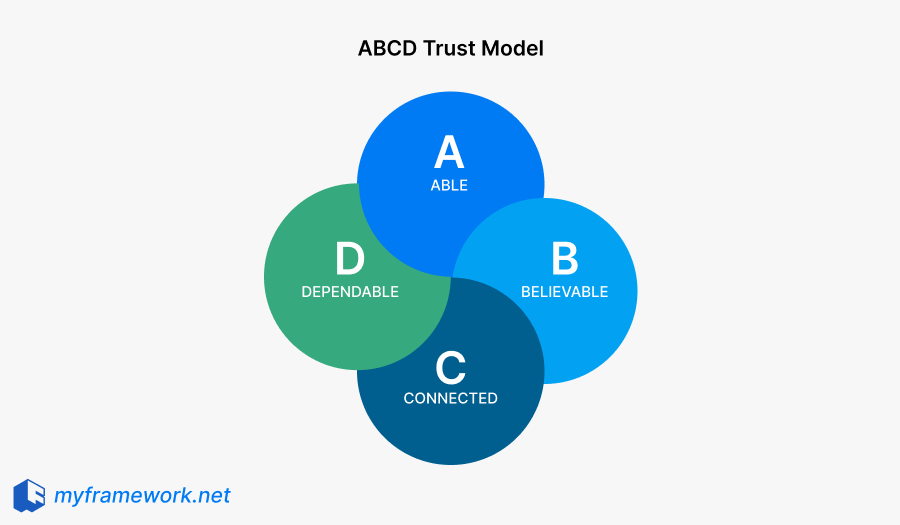
ABCD Trust Model contains 4 elements:
- A – Able
- B – Believable
- C – Connected
- D – Dependable
The Four Core Elements of the ABCD Trust Model
A – Able: Show You Know What You’re Doing
Being “able” means demonstrating competence.
You need to know how your team actually does the work. People trust leaders who clearly understand the work and can provide meaningful direction.
When common challenges arise, you’re ready to step in with support, but you don't take over, just show power.
B – Believable: Say What You Mean, Mean What You Say
Believability is rooted in integrity.
People watch what you do more than what you say. You build trust when you tell the truth, even when it’s hard. You follow through on promises, even when it’s inconvenient. Most importantly, you treat everyone fairly.
C – Connected: Show You Care About People
Leaders who connect with others build real relationships, so please remember, you lead with empathy, not ego.
When you give feedback, it’s to help someone grow, not to make them feel small.
D – Dependable: Follow Through Every Time
Being dependable means your team can count on you.
This includes a couple of points:
- You do what you said you would do, not just what’s urgent.
- You stay consistent when things get uncertain
- You don’t shift direction without reason.
- You respect other people’s time and energy like it’s your own.