Fiedler's Contingency Model
Leadership effectiveness isn’t just about the leader’s style but about how well that style fits the situation.
4 Patterns of Team Conflicts
Summary of typical conflicts in the workplace, discover proven strategies
5Ps Leadership Framework
Simple models enhance your leadership skills.
Thomas-Kilmann Conflict Mode Instrument (TKI)
Using dual concern theory to understand and resolve conflicts.
3A Trust Model
Gives you a simple and clear structure to build trust fast.
10-10-10 Meeting Model
Structure 30-minute meetings into focused parts for better feedback.
Tuckman Model
Help you better structure, understand, and develop the team.
Leadership Success Model
Define the success of leadership via team engaged, personal satisfaction, and organizational success.
ABCD Trust Model
Increase engagement and commitment in the workplace.
SCARF Model
Uncovers the emotional drivers behind employee reactions.
CLEAR 1
Strengthen alignment between your priorities and your manager’s expectations.
Thomas-Kilmann Conflict Mode Instrument (TKI): A Guide to Conflict Resolution
Using dual concern theory to understand and resolve conflicts.
Thomas-Kilmann Conflict Mode Instrument (TKI)
Introduction
Regardless which role you are in, being an effective communicator within the organization is always important. This inevitably includes resolving conflicts that naturally arise when individuals, teams, or departments compete for scare resources.
Conflict management is a crucial skill that helps professionals navigate disagreements and disputes effectively.
Various approaches to conflict management can be applied depending on the situation, the nature of the conflict, and the desired outcome. Now we introduce some conflict management approaches based on varying levels of assertiveness and cooperation.
The Thomas-Kilmann Conflict Mode Instrument (TKI) is a powerful tool for understanding and navigating conflict.
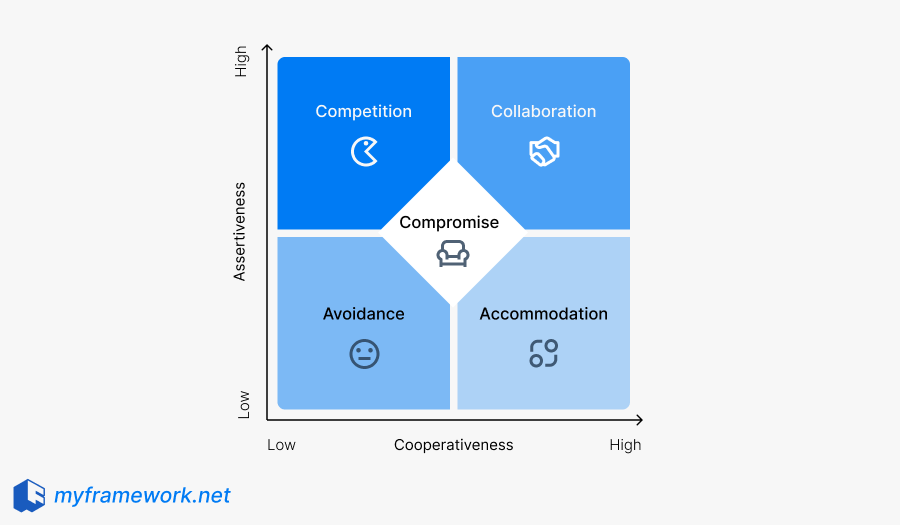
Developed by Kenneth Thomas and Ralph Kilmann, the TKI introduces five distinct conflict-handling styles based on two fundamental dimensions: assertiveness and cooperativeness.
By understanding these dimensions and styles, individuals can become more adaptable and strategic in addressing conflicts effectively.
Core Concept: The Assertiveness and Cooperativeness Framework
The TKI framework categorizes conflict management into five unique styles, which balance the dimensions of assertiveness (meeting one's own needs) and cooperativeness (considering others' needs):
Competition
This approach involves assertively pursuing one's own goals and needs, sometimes at the expense of others.
Individuals using this style prioritize winning the argument or conflict, which can be effective when a quick, decisive action is needed, such as in emergencies. However, overuse can strain relationships as others may feel unheard.
Accommodation
Here, individuals set aside their own concerns to satisfy the needs of others.
Accommodating is valuable in maintaining harmony or showing goodwill, especially when the issue is less important to the accommodating person. However, if relied on too heavily, it may lead to a sense of imbalance and unmet personal needs.
Avoidance
This style neither prioritizes one’s own needs nor those of others. Avoiding is useful for minor issues or when there’s a need to delay the conflict for a better time, but it risks allowing problems to escalate if used to avoid addressing meaningful conflicts.
Collaboration
Collaborating seeks a win-win solution, actively addressing the needs of both parties. Although this approach requires time and open communication, it often results in stronger, more sustainable solutions and positive relationships.
Compromise
A compromise seeks middle ground, with each party giving up something to reach a balanced solution. This style can be effective for time-sensitive situations and minor conflicts, though it may lead to only partially satisfying both parties.
By recognizing these styles, individuals can choose the most appropriate response to different conflicts, increasing the likelihood of positive outcomes.
The key insight of the TKI is not that one mode is better than another.
Each conflict mode is situationally useful. The real skill is not having a “preferred” style, but knowing when to switch modes deliberately instead of reacting on autopilot.