Fiedler's Contingency Model
Leadership effectiveness isn’t just about the leader’s style but about how well that style fits the situation.
4 Patterns of Team Conflicts
Summary of typical conflicts in the workplace, discover proven strategies
5Ps Leadership Framework
Simple models enhance your leadership skills.
Thomas-Kilmann Conflict Mode Instrument (TKI)
Using dual concern theory to understand and resolve conflicts.
3A Trust Model
Gives you a simple and clear structure to build trust fast.
10-10-10 Meeting Model
Structure 30-minute meetings into focused parts for better feedback.
Tuckman Model
Help you better structure, understand, and develop the team.
Leadership Success Model
Define the success of leadership via team engaged, personal satisfaction, and organizational success.
ABCD Trust Model
Increase engagement and commitment in the workplace.
SCARF Model
Uncovers the emotional drivers behind employee reactions.
CLEAR 1
Strengthen alignment between your priorities and your manager’s expectations.
Leadership Success Model: Balance Personal, Team and Organization
Define the success of leadership via team engaged, personal satisfaction, and organizational success.
Leadership Success Model
What Defines an Effective Leader
Leaders today face a range of challenges that can hinder their success. Often, the path to effective leadership feels unclear.
Paul Byrne developed the Leadership Success Model to provide a simple yet powerful framework to guide leaders. This model highlights the balance of three core elements: Competencies, Heart & Soul, and Environment. These elements work together to support leaders in achieving success.
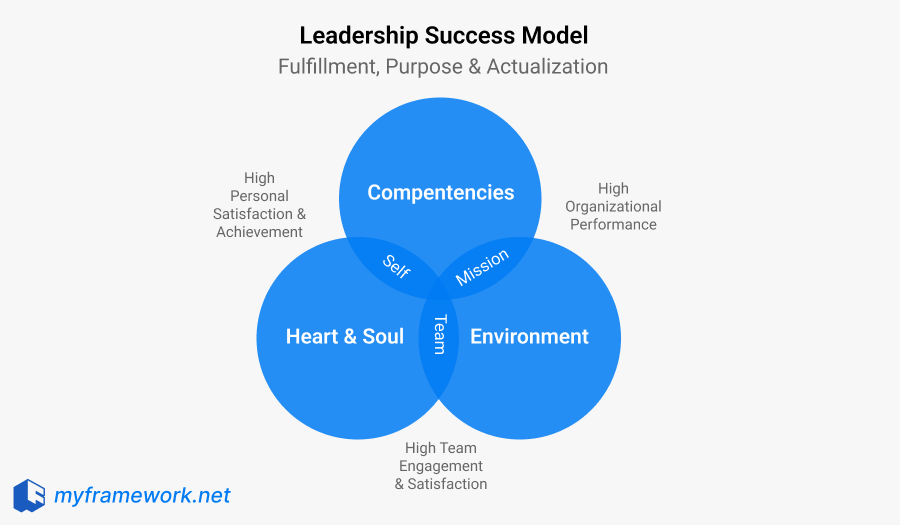
The model consists of three interconnected circles.
- Competencies
- Heart & Soul
- Environment
Core Concept of the Leadership Success Model
Competencies
The first circle refers to the skills and knowledge required to be an effective leader.
These include technical abilities, problem-solving skills, strategic thinking, and the ability to inspire and manage teams. Leaders must continuously improve their competencies to handle the demands of their roles.
Without strong competencies, a leader may struggle to gain respect and lead effectively.
Key capabilities:
- Creativity
- Innovation
- Risk & courage
- Decision making
- Conflict resolution
- Time management
- Resilience
- Communication
- Problem-solving
- Collaboration
- Adaptability
- Emotional intelligence
Heart & Soul
This encompasses a leader’s emotional intelligence, values, and character. With heart and soul in mind, a leader has the ability to empathize with others, act with integrity, and build trust.
This circle is about the inner qualities that drive a leader's behavior, such as passion, resilience, and authenticity, and these can create positive, inspiring environments that encourage loyalty and motivation among their teams.
Key capabilities:
- Emotional energy & kindness
- Gratitude & appreciation
- Healthy relationships
- Overcoming fears
- Connections
- Forgiveness
- Giving
Environment
Environment refers to the external factors that influence leadership success. This includes organizational culture, team dynamics, and the broader societal and economic context in which a leader operates.
A leader’s success is often shaped by how well they adapt to and leverage the environment. A positive environment can support and enhance a leader’s competencies and emotional connection with their team, while a challenging environment requires a leader to be more adaptable and resourceful.
Key capabilities:
- Providing opportunity
- Caring and supporting
- Delivering feedback
- Leading by example
- Providing for needs
- Recognizing efforts
- Promoting growth
- Fostering trust