Fiedler's Contingency Model
Leadership effectiveness isn’t just about the leader’s style but about how well that style fits the situation.
4 Patterns of Team Conflicts
Summary of typical conflicts in the workplace, discover proven strategies
5Ps Leadership Framework
Simple models enhance your leadership skills.
Thomas-Kilmann Conflict Mode Instrument (TKI)
Using dual concern theory to understand and resolve conflicts.
SBI Model
Deliver objective feedback by separating situation, behavior, and impact.
7% Rule for Organizational Change
Start with 7%, Spark the Rest.
3A Trust Model
Gives you a simple and clear structure to build trust fast.
10-10-10 Meeting Model
Structure 30-minute meetings into focused parts for better feedback.
Johari Window
Expand self-awareness, uncover blind spots, and strengthen trust through structured feedback.
Tuckman Model
Help you better structure, understand, and develop the team.
GREAT Coaching Model
Emphasis on timing, ensuring actions are strategically aligned with deadlines for effective goal setting.
SOAR Self-Leadership Model
Built on four essential components that guide personal and professional development.
Leadership Success Model
Define the success of leadership via team engaged, personal satisfaction, and organizational success.
Three Circles of Influence
Grow your influence via focusing what you can control.
Bridges Transition Model
Focus on the emotional and psychological transitions individuals experience during change.
Goleman Emotional Intelligence Model
Foundation for personal success and leadership.
Satir Change Model
Details the process of change through five stages.
ABCD Trust Model
Increase engagement and commitment in the workplace.
SCARF Model
Uncovers the emotional drivers behind employee reactions.
CLEAR 1
Strengthen alignment between your priorities and your manager’s expectations.
GROW Model
Helps people clarify goals, assess situation, explore options, and take actions.
Three Circles of Influence: Focus on What You Can Control
Grow your influence via focusing what you can control.
Three Circles of Influence
Feeling Overwhelmed Is Common
Have you ever felt overwhelmed by things outside your control? If so, you are not alone. Many people spend time worrying about problems they cannot change.
Stephen Covey, in his famous book The 7 Habits of Highly Effective People, introduced the Three Circles of Influence to help us focus on what truly matters.
This model teaches us how to direct our energy wisely to become more effective in life and work.
Understanding the Three Circles
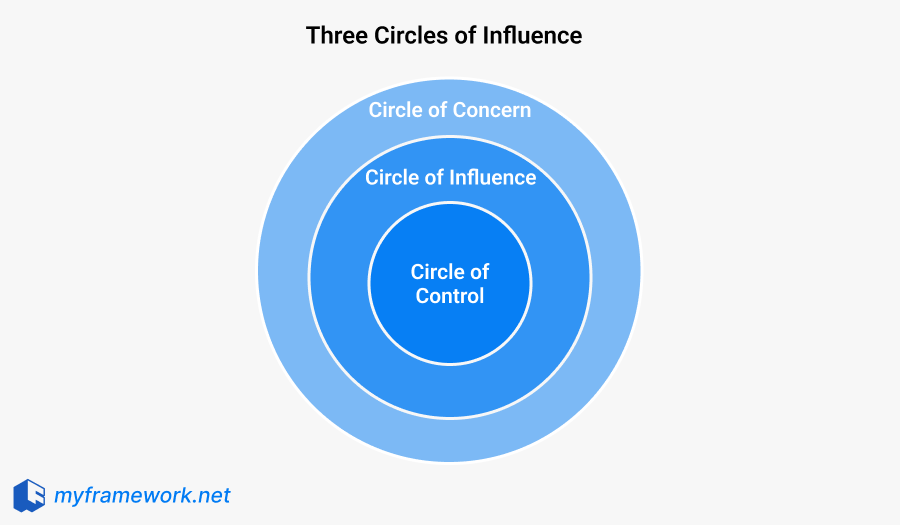
The model divides everything we care about into three circles:
- Circle of Concern
- Circle of Influence
- Circle of Control
Circle of Concern
This includes everything that affects us, such as the economy, global events, or other people's opinions. We may worry about these things, but we have little or no power to change them.
- The weather
- The past
- The economy
- The new/global events
Action: Let go of anything in this circle, it will not serve you.
Circle of Influence
This covers areas where we can make a difference, such as relationships, skills, and habits. We may not control everything here, but our actions can have an impact.
- Your friends
- Your family
- Your reputation
Action: Put your focus on the factors that you can influence the most.
Circle of Control
This is where we have full power. It includes our choices, mindset, and behaviors. By focusing on this circle, we can take meaningful action and influence the other circles over time.
- Your thoughts
- Your actions
- Your reactions
Action: Spend your energy and time improving what you can control.
The key insight from this model is that when we focus on what we can control, our influence grows. If we spend too much time on things we cannot change, we waste energy and feel frustrated.