Maslow's Hierarchy of Needs
Famous model in psychology and helps us understand what motivates people.
AVP Model
A simple practice to accept the anxiety, anger or sadness and start embracing them.
SQRRR (SQ3R) Method
A systematic approach to studying and comprehending reading material effectively.
Feynman Technique
Learning and understanding complex concepts by teaching them to someone else
Simon Learning Method
Effective strategies for rapid learning.
Freud’s Iceberg Theory
Developed from human psychology, it help us understand how the conscious and unconscious mind interacts.
Cornell Note-Taking System
Encourage active engagement with the material and reinforces memory with review.
COSTAR AI Prompt Framework
This AI prompt framework helps you receive higher-quality feedback, and it’s very simple and effective
CRISPE AI Prompt Framework
Define context, role, instruction, subject, preset, and exceptions to get high-quality AI feedback.
BROKE AI Prompt Framework
Help you write better AI prompts.
ICIO AI Prompt Framework
A simple prompt that saves time and gets better result.
DIKW Model
Move beyond information overload and make truly wise decisions.
CBT Framework
It’s not the situation that causes your emotions — it’s how you think about it.
ChatGPT5 P.R.O.M.P.T. Framework For Business Planning
Help you stay focused, filter noise, and improve output, which is deeply aligned with your intent.
Three Zones of Learning
Helps you study and improve by giving you a clear way to plan your effort.
Deliberate Practice
Understand how to study with purpose, without wasted effort.
ISD Model
Creates a closed loop that ensures learning outcomes align with business objectives
CBT Framework: Mastering Your Mind’s Operating System
It’s not the situation that causes your emotions — it’s how you think about it.
CBT Framework
Why Do We Struggle with Negative Emotions?
Have you ever had moments like these?
- You try your best, but still wonder: “Am I just not good enough?”
- One small mistake makes you feel like a total failure.
- You want to change, but you keep delaying, and days go by.
These feelings are more than just mood swings. Often, they come from the way we think.
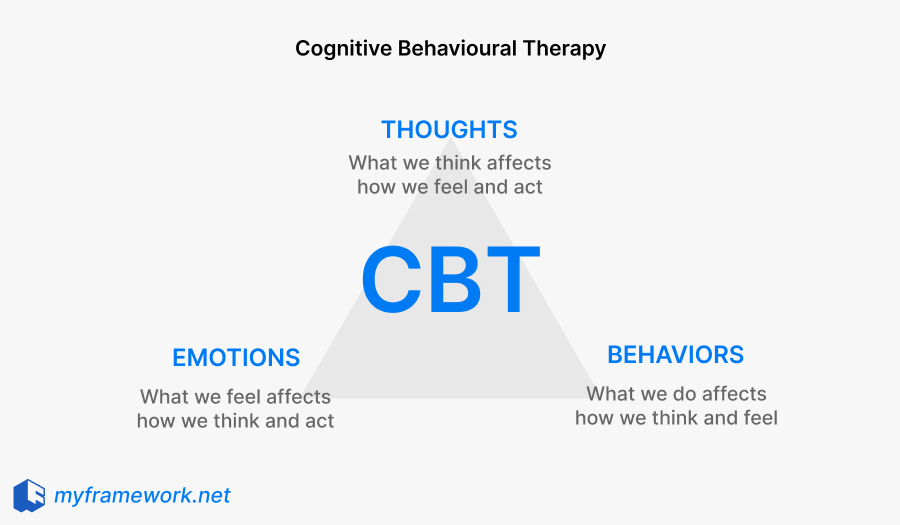
The CBT Framework, also known as Cognitive Behavioural Therapy (ABC Model also belongs to this), is a simple and practical framework that helps you understand the link between your thoughts, emotions, and behaviors.
It was developed in the 1960s by psychiatrist Aaron T. Beck, and it’s widely used today in therapy, coaching, and self-help.
Instead of forcing yourself to “stay positive,” CBT teaches you how to notice and shift the thoughts that shape your emotions. It’s not about ignoring reality — it’s about understanding how your thinking patterns affect how you feel and act.
Thoughts, Emotions, Behaviors – All Connected
At the heart of CBT is one simple idea:
It’s not the situation that causes your emotions — it’s how you think about it.
CBT focuses on the triangle of:
- Thoughts (what you tell yourself)
- Emotions (how you feel)
- Behaviors (what you do)
These three parts influence each other. Let’s take a closer look:
Thoughts
These are the messages you say to yourself, often automatically.
Negative thoughts can become patterns, especially when repeated.
Emotions
Your feelings are shaped by how you interpret events. Harsh thoughts can lead to anxiety, shame, or sadness.
Behaviors
How you act is often a result of how you feel. If you think you can’t do anything right, you might avoid challenges or give up easily.
By learning to recognize and question unhelpful thoughts, you can change how you feel and respond.