Work Breakdown Structure (WBS)
For better project planning, helps you simplify, organize, and get things done.
8+8+8 Rule
Make a good balance sheet of your life.
2 Minute Rule
Change up the content every two minutes to keep people engaged.
Four Quarters Method
Helps you stay productive, maintain focus, and manage your energy across the entire day.
80/20 Rule
Highlights the imbalance between causes and effects
Mental Flow
A state of complete immersion and focused enjoyment in an activity.
Outcome-Based Roadmap
Align your team around the right goals, ensure that you’re always working toward meaningful outcomes that matter.
5 Second Rule
A Simple Trick to overcome procrastination and anxiety.
Pomodoro Technique
An easy time management method that boost your focus and productivity.
RACI Model
Bring clarity, reduce friction to the stakeholder communication.
VITALS Method
Just take one small, meaningful step instead of a giant leap.
151515 Career Planning Model
Guiding you through three 15-year stages for your 45-year career.
Ivy Lee Method
Replace scattered planning with deliberate action.
Peak–Trough–Recovery Model
Knowing where you are helps you choose what to do next with intention instead of habit.
ISD Model
Creates a closed loop that ensures learning outcomes align with business objectives
Peak–Trough–Recovery Model: Mastering Your Energy, Not Just Your Time
Knowing where you are helps you choose what to do next with intention instead of habit.
Peak–Trough–Recovery Model
Introduction
Most professionals manage their schedules by the clock. They fill every hour with tasks and push through fatigue to stay productive. Yet what truly limits performance is not time, but energy.
Throughout the day, your energy naturally rises and falls. Some hours you feel sharp and creative, while others feel slow and draining.
Don't take this on yourself; it is more than the rhythm of a human being.
Ignoring this rhythm leads to wasted effort and lower focus.
The Peak Trough Recovery Model helps you understand and manage these natural energy cycles.
Developed from behavioral science research by Dan Pink, it shows how mental energy follows a daily pattern of highs, lows, and rebounds.
By aligning your most demanding work with your peak periods and saving lighter tasks for your lower-energy hours, you can work smarter, stay focused, and recover more effectively.
In this model, Dan Pink divided a day into 3 stages, and each day follows a predictable emotional and cognitive curve:
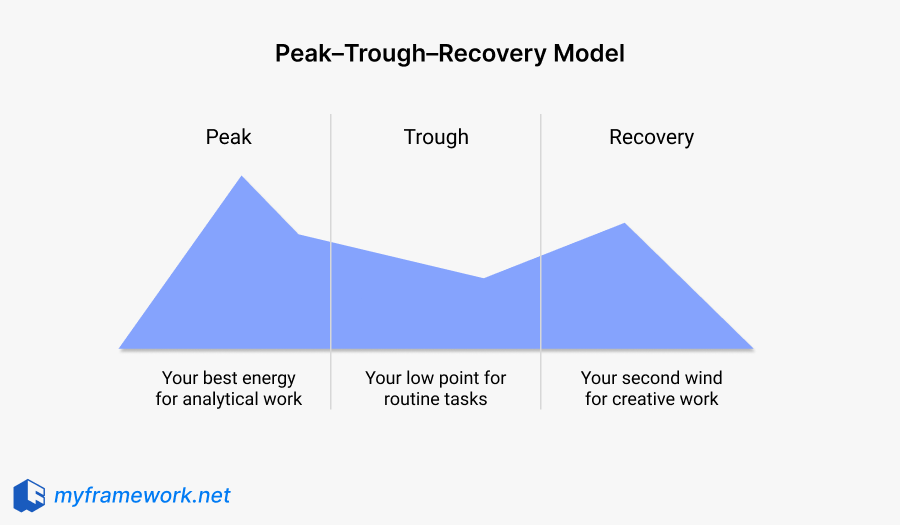
The model reveals that productivity is not a straight line.
Peak
Usually, you reach the peak of the day in the morning. This is your high-performance window. Focus, alertness, and analytical thinking are strongest.
It is ideal for deep work, problem-solving, and decision-making. For most people, this occurs in the morning hours after waking and stabilizing.
Trough
When it moves to the second stage, energy dips and attention declines. Mistakes are more likely, and motivation drops.
The trough is not the time for complex work but for routine tasks, checklists, or short breaks that help you reset.
Recovery
Later in the day, mood improves and creativity rebounds. Logic weakens slightly, but flexible thinking returns.
This phase suits brainstorming, collaboration, or planning sessions that need open-mindedness rather than precision.