AARRR Model
Amodel redefines digital marketing by focusing on measurable growth and customer retention.
Porter’s Five Forces
Analyze industry competition beyond direct rivals to uncover structural profit drivers.
Business Model Canvas
Visualize how your business creates, delivers, and captures value on a single page.
VRIO Framework
Evaluate whether your resources create real, defensible competitive advantage.
TAM-SAM-SOM Analysis
Enhance your market segmentation and marketing strategy
9 Key Forces of Mobile Technology Reshape Customer Behavior
Understand how context, location, and environment shape mobile customer decisions.
Ohmae’s 3C’s Model
Emphasizes the balanced integration of Company, Customer, and Competitor for strategic decisions, avoiding a singular focus.
TOWS Model
Turn SWOT insights into concrete strategic options and actions.
Outcome Discovery Canvas
Define measurable outcomes and success metrics before you commit to building features.
Product Lifecycle Model
Describe the natural path most products follow.
Value Stick Model
Helps businesses balance willingness to pay and willingness to sell
Product GTM Canvas
Brings clarity, reduces risk, and gives your product the best chance of success.
FASTR Framework
Filter AI use cases by risk, readiness, and measurable business value before committing real resources.
Philip Kotler's 5 Product Levels
Analyze where your product creates value and identify the layers where real differentiation happens.
CAGE Model
Provides a framework for comparing markets beyond surface-level metrics.
Ohmae’s 3C’s Model: The Strategic Triangle
Emphasizes the balanced integration of Company, Customer, and Competitor for strategic decisions, avoiding a singular focus.
Ohmae’s 3C’s Model
Introduction
Ohmae's 3C’s model is a well-known business framework. It focuses on three key elements that drive a business’s success: Customer, Competitor, and Company.
Japanese management consultant Kenichi Ohmae developed this model, and he introduced it as a way to assess and align these elements for competitive advantage.
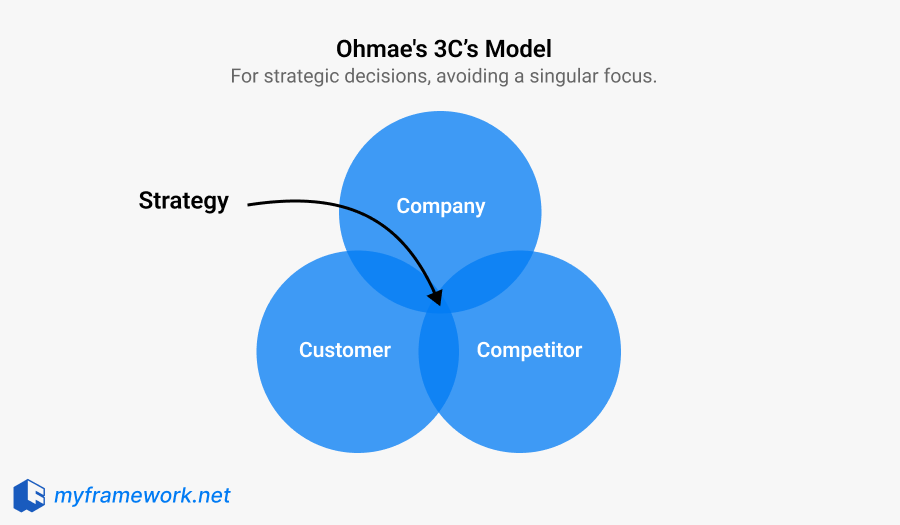
The model is a "Strategic Triangle" consisting of:
- The Customer (The market)
- The Competitor (The rival)
- The Company (The self)
Ohmae posits that the job of a strategist is to find the "Sweet Spot" where company strengths match customer needs better than the competition does.
Core Concept of Ohmae's 3C’s Model
At its core, the 3 C’s strategy emphasizes that businesses must consider three essential factors when making strategic decisions:
Customer
Understanding customer needs is the starting point.
Companies must know what their customers value and how they can meet or exceed those expectations. It's about identifying what the market truly wants, and not just what the business thinks they want.
Competitor
Knowing your competition is critical.
This part of the model stresses the need to analyze competitors’ strengths and weaknesses. By doing this, a business can find ways to differentiate itself, spot gaps in the market, or offer something unique that competitors do not.
Company
Finally, a business must assess its own capabilities.
It should ask, “What can we do best?” This involves analyzing internal strengths and weaknesses, resources, and skills to ensure the company can successfully deliver on its strategy and stand out in the market.
These three elements work together in harmony to create a strategy that is responsive to both the market and the internal capabilities of the company.