FORM Technique
A simple way to start conversations.
The Relationship Map
A simple way to evaluate your relationships.
Stakeholder Saliency Model
Sharpen your stakeholder management skills via finding who matters most.
3A Trust Model
Gives you a simple and clear structure to build trust fast.
PREP Framework
Deliver clear, structured arguments by stating your point first, proving it, and closing with clarity.
FIRE Model
Separate facts from interpretations to respond to feedback calmly and solve the real problem.
ORID Focus Conversation
Help groups move from information gathering to action in a structured and inclusive way.
Harvard Negotiation Principle
Six negotiation principles help both sides get more of what they want.
ZOPA
A practical negotiation concept that defines where a deal is actually possible.
Current–Past–Future Interview Framework
An easy framework to answer "Tell Me About Yourself" in a job interview.
VSNC Framework
Persuade and inform with clarity by structuring your message.
Three Circles of Influence
Grow your influence via focusing what you can control.
RACI Model
Bring clarity, reduce friction to the stakeholder communication.
ABCD Trust Model
Increase engagement and commitment in the workplace.
PART Framework
Structure your answers and emphasize takeaways to show real growth.
RIDE Communication Framework
Help you persuade effectively, build trust, and gain support in any professional setting.
DISC Communication Styles Framework
Speak their language, not yours.
ABCD Trust Model: Building the Foundation of Leadership
Increase engagement and commitment in the workplace.
ABCD Trust Model
Being Trusted Is Hard
Many teams struggle not because of a lack of skill or strategy, but because of a lack of trust.
When people lack trust in their leaders, they withhold ideas, avoid risks, and disengage. In contrast, high-performing teams are built on trust, not control.
To help leaders become truly trustworthy, leadership expert Ken Blanchard developed the ABCD Trust Model. This model breaks trust into four key behaviors that anyone can learn and apply.
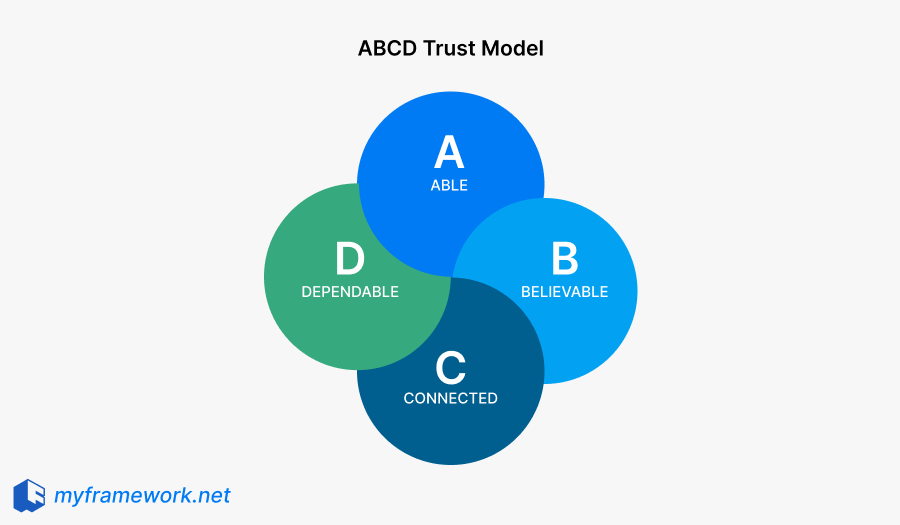
ABCD Trust Model contains 4 elements:
- A – Able
- B – Believable
- C – Connected
- D – Dependable
The Four Core Elements of the ABCD Trust Model
A – Able: Show You Know What You’re Doing
Being “able” means demonstrating competence.
You need to know how your team actually does the work. People trust leaders who clearly understand the work and can provide meaningful direction.
When common challenges arise, you’re ready to step in with support, but you don't take over, just show power.
B – Believable: Say What You Mean, Mean What You Say
Believability is rooted in integrity.
People watch what you do more than what you say. You build trust when you tell the truth, even when it’s hard. You follow through on promises, even when it’s inconvenient. Most importantly, you treat everyone fairly.
C – Connected: Show You Care About People
Leaders who connect with others build real relationships, so please remember, you lead with empathy, not ego.
When you give feedback, it’s to help someone grow, not to make them feel small.
D – Dependable: Follow Through Every Time
Being dependable means your team can count on you.
This includes a couple of points:
- You do what you said you would do, not just what’s urgent.
- You stay consistent when things get uncertain
- You don’t shift direction without reason.
- You respect other people’s time and energy like it’s your own.