FORM Technique
A simple way to start conversations.
The Relationship Map
A simple way to evaluate your relationships.
Stakeholder Saliency Model
Sharpen your stakeholder management skills via finding who matters most.
3A Trust Model
Gives you a simple and clear structure to build trust fast.
PREP Framework
Deliver clear, structured arguments by stating your point first, proving it, and closing with clarity.
FIRE Model
Separate facts from interpretations to respond to feedback calmly and solve the real problem.
ORID Focus Conversation
Help groups move from information gathering to action in a structured and inclusive way.
Harvard Negotiation Principle
Six negotiation principles help both sides get more of what they want.
ZOPA
A practical negotiation concept that defines where a deal is actually possible.
Current–Past–Future Interview Framework
An easy framework to answer "Tell Me About Yourself" in a job interview.
VSNC Framework
Persuade and inform with clarity by structuring your message.
Three Circles of Influence
Grow your influence via focusing what you can control.
RACI Model
Bring clarity, reduce friction to the stakeholder communication.
ABCD Trust Model
Increase engagement and commitment in the workplace.
PART Framework
Structure your answers and emphasize takeaways to show real growth.
RIDE Communication Framework
Help you persuade effectively, build trust, and gain support in any professional setting.
DISC Communication Styles Framework
Speak their language, not yours.
Three Circles of Influence: Focus on What You Can Control
Grow your influence via focusing what you can control.
Three Circles of Influence
Feeling Overwhelmed Is Common
Have you ever felt overwhelmed by things outside your control? If so, you are not alone. Many people spend time worrying about problems they cannot change.
Stephen Covey, in his famous book The 7 Habits of Highly Effective People, introduced the Three Circles of Influence to help us focus on what truly matters.
This model teaches us how to direct our energy wisely to become more effective in life and work.
Understanding the Three Circles
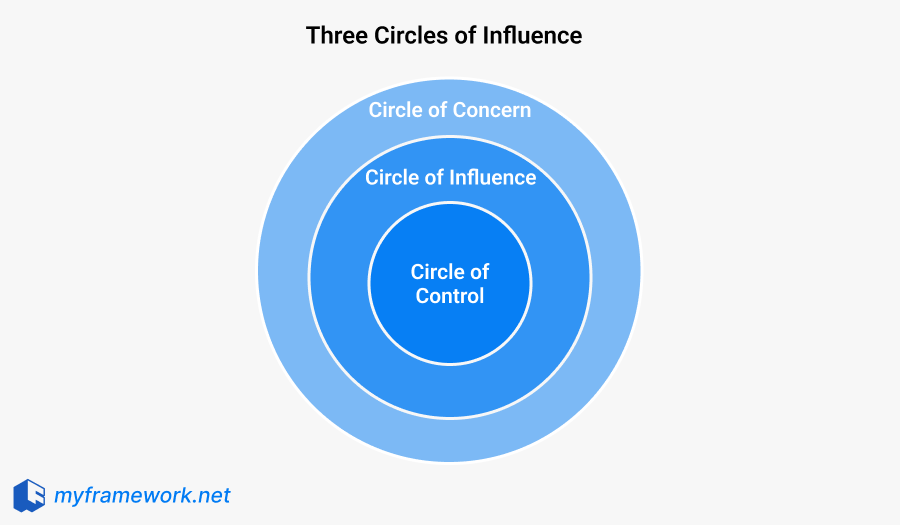
The model divides everything we care about into three circles:
- Circle of Concern
- Circle of Influence
- Circle of Control
Circle of Concern
This includes everything that affects us, such as the economy, global events, or other people's opinions. We may worry about these things, but we have little or no power to change them.
- The weather
- The past
- The economy
- The new/global events
Action: Let go of anything in this circle, it will not serve you.
Circle of Influence
This covers areas where we can make a difference, such as relationships, skills, and habits. We may not control everything here, but our actions can have an impact.
- Your friends
- Your family
- Your reputation
Action: Put your focus on the factors that you can influence the most.
Circle of Control
This is where we have full power. It includes our choices, mindset, and behaviors. By focusing on this circle, we can take meaningful action and influence the other circles over time.
- Your thoughts
- Your actions
- Your reactions
Action: Spend your energy and time improving what you can control.
The key insight from this model is that when we focus on what we can control, our influence grows. If we spend too much time on things we cannot change, we waste energy and feel frustrated.