KISS Review Framework
An action-orientated review model to convert past experience into practice.
FFC Technique
Give feedback that is clear, specific, and actionable by combining Feeling, Fact, and Comparison.
The Golden Circle
For understanding how great leaders and orgs inspire action by starting with a clear sense of purpose.
4 Patterns of Team Conflicts
Summary of typical conflicts in the workplace, discover proven strategies
Active Listening Spiral
A framework enhances understanding, empathy, and responsiveness.
Thomas-Kilmann Conflict Mode Instrument (TKI)
Using dual concern theory to understand and resolve conflicts.
AVP Model
A simple practice to accept the anxiety, anger or sadness and start embracing them.
SBI Model
Deliver objective feedback by separating situation, behavior, and impact.
7-38-55 Rule
Your presence speaks louder than your words.
FORM Technique
A simple way to start conversations.
The Relationship Map
A simple way to evaluate your relationships.
TOPS Framework
Make your pitch or message clear, logical, and action-oriented.
Stakeholder Saliency Model
Sharpen your stakeholder management skills via finding who matters most.
Winston’s Star
Apply five communication elements to make ideas memorable and repeatable.
3A Trust Model
Gives you a simple and clear structure to build trust fast.
2 Minute Rule
Change up the content every two minutes to keep people engaged.
10-10-10 Meeting Model
Structure 30-minute meetings into focused parts for better feedback.
The Rule of Suspense
Reveal your points step by step.
PREP Framework
Deliver clear, structured arguments by stating your point first, proving it, and closing with clarity.
Johari Window
Expand self-awareness, uncover blind spots, and strengthen trust through structured feedback.
FIRE Model
Separate facts from interpretations to respond to feedback calmly and solve the real problem.
ORID Focus Conversation
Help groups move from information gathering to action in a structured and inclusive way.
Harvard Negotiation Principle
Six negotiation principles help both sides get more of what they want.
ZOPA
A practical negotiation concept that defines where a deal is actually possible.
Zoom-In and Zoom-Out Model
Allows you to handle challenges with clarity, whether you need to see the big picture or focus on the details.
Self-Us-Now Framework
Help individuals and groups connect personal stories to collective action.
7C Pyramid Communication Framework
Aim to eliminate confusion and miscommunication in both verbal and written forms
Pixar Storytelling Formula
Turn complex ideas into clear cause-and-effect stories people remember.
Current–Past–Future Interview Framework
An easy framework to answer "Tell Me About Yourself" in a job interview.
Hero's Journey Storytelling Framework
A storytelling framework that makes your message relatable, memorable, and impactful in any context.
The Innovation Story Framework
Narrate how an idea was born, built, and scaled to demonstrate its real-world impact.
VSNC Framework
Persuade and inform with clarity by structuring your message.
COIN Model
Deliver clear, non-judgmental feedback by separating facts, impact, and next actions.
GREAT Coaching Model
Emphasis on timing, ensuring actions are strategically aligned with deadlines for effective goal setting.
Three Circles of Influence
Grow your influence via focusing what you can control.
Radical Candor
Being a great manager without losing your humanity.
COST Principle
Help people to deliver strong messages or express complex ideas.
RACI Model
Bring clarity, reduce friction to the stakeholder communication.
Magic Loop Framework
Capture feedback, act on it, make changes stick, and report back with clarity.
ABCD Trust Model
Increase engagement and commitment in the workplace.
PART Framework
Structure your answers and emphasize takeaways to show real growth.
CLEAR 1
Strengthen alignment between your priorities and your manager’s expectations.
RIDE Communication Framework
Help you persuade effectively, build trust, and gain support in any professional setting.
DISC Communication Styles Framework
Speak their language, not yours.
Freytag’s Pyramid
Helps communicators control emotional rhythm and attention over time.
SCR Framework
Resolve complications with concise, executive-ready solutions.
SCQA Framework
Structure complex messages into a clear narrative that leads the audience to your conclusion.
Pyramid Principle
Structured communication framework which is supporting your point with logically organized details and effective information delivery.
Thomas-Kilmann Conflict Mode Instrument (TKI): A Guide to Conflict Resolution
Using dual concern theory to understand and resolve conflicts.
Thomas-Kilmann Conflict Mode Instrument (TKI)
Introduction
Regardless which role you are in, being an effective communicator within the organization is always important. This inevitably includes resolving conflicts that naturally arise when individuals, teams, or departments compete for scare resources.
Conflict management is a crucial skill that helps professionals navigate disagreements and disputes effectively.
Various approaches to conflict management can be applied depending on the situation, the nature of the conflict, and the desired outcome. Now we introduce some conflict management approaches based on varying levels of assertiveness and cooperation.
The Thomas-Kilmann Conflict Mode Instrument (TKI) is a powerful tool for understanding and navigating conflict.
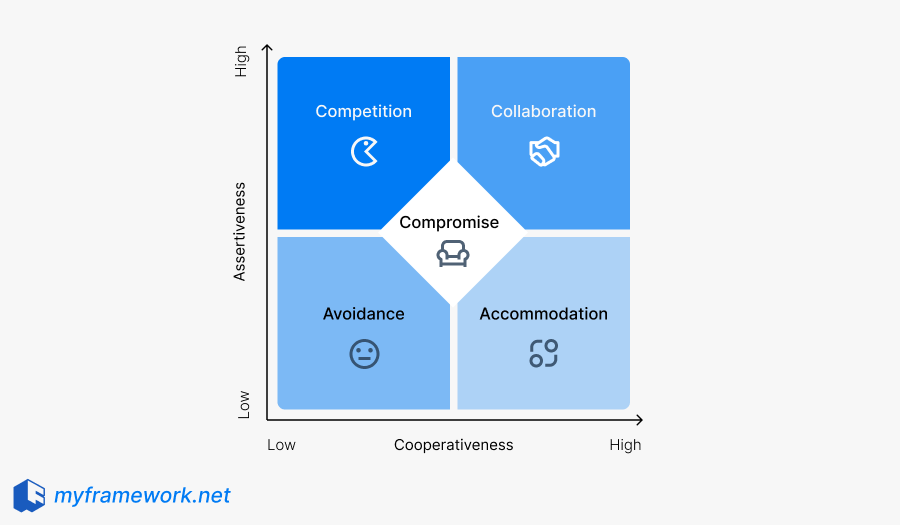
Developed by Kenneth Thomas and Ralph Kilmann, the TKI introduces five distinct conflict-handling styles based on two fundamental dimensions: assertiveness and cooperativeness.
By understanding these dimensions and styles, individuals can become more adaptable and strategic in addressing conflicts effectively.
Core Concept: The Assertiveness and Cooperativeness Framework
The TKI framework categorizes conflict management into five unique styles, which balance the dimensions of assertiveness (meeting one's own needs) and cooperativeness (considering others' needs):
Competition
This approach involves assertively pursuing one's own goals and needs, sometimes at the expense of others.
Individuals using this style prioritize winning the argument or conflict, which can be effective when a quick, decisive action is needed, such as in emergencies. However, overuse can strain relationships as others may feel unheard.
Accommodation
Here, individuals set aside their own concerns to satisfy the needs of others.
Accommodating is valuable in maintaining harmony or showing goodwill, especially when the issue is less important to the accommodating person. However, if relied on too heavily, it may lead to a sense of imbalance and unmet personal needs.
Avoidance
This style neither prioritizes one’s own needs nor those of others. Avoiding is useful for minor issues or when there’s a need to delay the conflict for a better time, but it risks allowing problems to escalate if used to avoid addressing meaningful conflicts.
Collaboration
Collaborating seeks a win-win solution, actively addressing the needs of both parties. Although this approach requires time and open communication, it often results in stronger, more sustainable solutions and positive relationships.
Compromise
A compromise seeks middle ground, with each party giving up something to reach a balanced solution. This style can be effective for time-sensitive situations and minor conflicts, though it may lead to only partially satisfying both parties.
By recognizing these styles, individuals can choose the most appropriate response to different conflicts, increasing the likelihood of positive outcomes.
The key insight of the TKI is not that one mode is better than another.
Each conflict mode is situationally useful. The real skill is not having a “preferred” style, but knowing when to switch modes deliberately instead of reacting on autopilot.