The Golden Circle
For understanding how great leaders and orgs inspire action by starting with a clear sense of purpose.
The Relationship Map
A simple way to evaluate your relationships.
Research Funnel Model
Understand users with clarity, even when resources are tight.
StoryBrand Framework
Focuses on the seven elements necessary for helping your customer.
The Hook Model
A four-step process that encourages user engagement and promotes habit formation.
Self-Us-Now Framework
Help individuals and groups connect personal stories to collective action.
The AIDMA Model
Classic framework in marketing, helping business understand and influence each stage of the customer journey.
AISAS Model
Adapts traditional marketing concept to the digital landscape.
AARRR Model
Amodel redefines digital marketing by focusing on measurable growth and customer retention.
AIPL Model
Optimize each stage of the customer journey, from brand awareness to loyalty.
Pixar Storytelling Formula
Turn complex ideas into clear cause-and-effect stories people remember.
5A Marketing Model
focusing on how brands can guide prospects from awareness to advocacy.
Hero's Journey Storytelling Framework
A storytelling framework that makes your message relatable, memorable, and impactful in any context.
The Innovation Story Framework
Narrate how an idea was born, built, and scaled to demonstrate its real-world impact.
4P Marketing Mix
A classic framework that provides a clear, structured approach to marketing.
ICARE Model
Build a service culture that turns everyday interactions into lasting customer loyalty.
4C Marketing Model
For building customer-focused marketing strategies.
TAM-SAM-SOM Analysis
Enhance your market segmentation and marketing strategy
9 Key Forces of Mobile Technology Reshape Customer Behavior
Understand how context, location, and environment shape mobile customer decisions.
Marketing Funnel 5 Stages To Boost Email Marketing
Align your marketing email with the proven customer journey strategy.
Product GTM Canvas
Brings clarity, reduces risk, and gives your product the best chance of success.
FABE Model
Highlight product value, connect with customer needs, and build long-term trust
SPIN Model
Uncover real customer pain through thoughtful, guided questioning.
6 Essential Marketing Campaigns Every Brand Needs
Better fomulate your brand’s marketing strategy.
Straight Line System
Gives sales people a clear roadmap to follow.
4P Model in Content Marketing
Build a clear system to improve content, ensuring long-term marketing impact.
ChatGPT5 P.R.O.M.P.T. Framework For Business Planning
Help you stay focused, filter noise, and improve output, which is deeply aligned with your intent.
POEMS Framework
Gives teams a clear way to observe, classify, and interpret user behavior.
5E Experience Model
Map user journeys from first attraction to lasting memory by structuring experiences across five critical stages.
CARE Framework
Design consistent customer service experiences through connection, support, resolution, and continuous improvement.
Freytag’s Pyramid
Helps communicators control emotional rhythm and attention over time.
Philip Kotler's 5 Product Levels
Analyze where your product creates value and identify the layers where real differentiation happens.
Philip Kotler's 5 Product Levels: A Model for Product Differentiation
Analyze where your product creates value and identify the layers where real differentiation happens.
Philip Kotler's 5 Product Levels
Why This Matters
Great products won't win if they rely solely on strong hardware or solid features. They win because they meet needs on multiple levels. Some needs are obvious. Others are emotional, social, or future-looking.
The Five Product Levels Model helps product teams see the full picture. It reveals the layers of value that shape user decisions. It also shows why basic features give you entry to the market, while advanced value shapes loyalty and long term success.
The Five Product Levels Model was proposed by marketing scholar Philip Kotler. It divides a product into five layers:
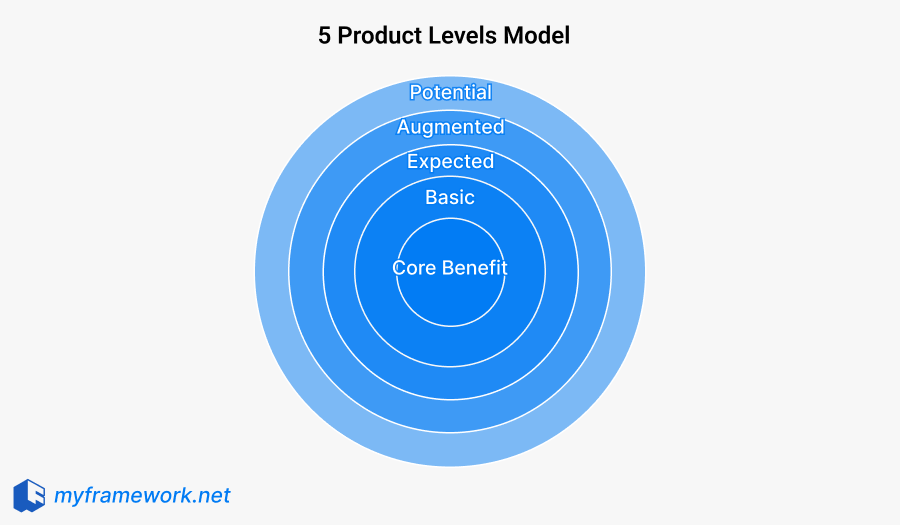
- Core Benefit
- Basic Product
- Expected Product
- Augmented Product
- Potential Product
Together, these layers show how customer value evolves from the basic function to future potential. This helps teams understand their competitive position and plan smart product development.
The Five Product Levels With Examples
Level 1 - Core Benefit
The core benefit is the fundamental value customers seek from the product. It is not the device they hold, but the problem they solve or the feeling they gain.
For a smartwatch, the core benefit is better health management and a more efficient lifestyle.
For an e-cigarette, the core benefit is a controlled and convenient alternative to traditional smoking, paired with a sense of relaxation or habit satisfaction.
For Notion, the core benefit is organizational clarity and a highly flexible "second brain." It isn't just about typing notes; it’s about the peace of mind that comes from having a chaotic work life structured in one place.
Understanding this layer helps product teams stay aligned with the emotional and practical reasons users buy in the first place.
Level 2 - Basic Product
The basic product is the tangible form that delivers the core benefit. It includes components, functions, and the minimum structure required for the product to exist.
For a smartwatch, this includes the screen, sensors, processor, and essential software that make the device functional.
For an e-cigarette, this includes the battery, heating element, cartridge, and airflow system.
For Notion, this includes the blank canvas interface, the block-based text editor, and the ability to create and nest pages. Without these fundamental technical components, the software simply doesn't function.
This layer sets the starting point for engineering and ensures the product can perform its most essential job.
Level 3 - Expected Product
The expected product reflects the features customers take for granted. These are not differentiators. They are minimum standards. If you fail here, users leave quickly.
Smartwatch users expect reliable notifications, stable connectivity, accurate sensors, and at least one day of battery life.
E-cigarette users expect consistent vapor output, safety, stable flavor, and a device that does not leak or malfunction.
SaaS users today expect real-time cross-device syncing, basic Markdown formatting, reliable search functionality, and standard data security. If Notion failed to sync between your phone and laptop, users would abandon it immediately regardless of its other features.
Delivering on expectations is how a product earns basic trust and avoids becoming a source of irritation.
Level 4 - Augmented Product
The augmented product includes features that exceed expectations and create delight. This layer differentiates brands, strengthens loyalty, and drives word of mouth.
For smartwatches, augmentation may include advanced workout coaching, fall detection, emergency alerts, rich watch face libraries, or seamless syncing with other ecosystem devices.
For e-cigarettes, augmentation may include smart temperature control, personalized flavor profiles, child safety locks, elegant industrial design, or apps that track usage patterns.
For Notion, augmentation includes relational databases that link pages like a website, the intuitive "/" command menu, and a vibrant community template ecosystem. These features turned a simple note-taking app into a powerful productivity OS that users love to customize.
Most competitive battles happen here because this is where brands create emotional value and memorable experiences.
Level 5 - Potential Product
The potential product is the vision for what the product could become. It includes future upgrades, radical improvements, and new directions that shape long-term competitiveness.
For smartwatches, this might involve non invasive glucose monitoring, full standalone communication, or integration into digital identity systems.
For e-cigarettes, this could include safer heating technologies, bio feedback systems to support smoking reduction, or regulatory approved health monitoring features.
This might involve fully autonomous AI agents that organize your messy notes for you, deep bi-directional integration with email and calendars, or becoming a complete no-code website builder. This level represents Notion's future evolution from a tool into a full operating system for work.
This level guides the roadmap and helps teams imagine where the next wave of value will emerge.
Competition no longer happens at the basic or expected levels. It now takes place in the augmented and potential levels where brands create emotional value and future advantage.
- When you meet the basic and expected layers, you earn the right to enter the market.
- When you excel in the augmented layer, you gain user preference and loyalty.
- When you understand the potential layer, you set the direction for how far your product can grow.
Together, these layers show that long-term success depends not only on what users need today, but also on what they will desire tomorrow.