The Golden Circle
For understanding how great leaders and orgs inspire action by starting with a clear sense of purpose.
The Relationship Map
A simple way to evaluate your relationships.
Research Funnel Model
Understand users with clarity, even when resources are tight.
StoryBrand Framework
Focuses on the seven elements necessary for helping your customer.
The Hook Model
A four-step process that encourages user engagement and promotes habit formation.
Self-Us-Now Framework
Help individuals and groups connect personal stories to collective action.
The AIDMA Model
Classic framework in marketing, helping business understand and influence each stage of the customer journey.
AISAS Model
Adapts traditional marketing concept to the digital landscape.
AARRR Model
Amodel redefines digital marketing by focusing on measurable growth and customer retention.
AIPL Model
Optimize each stage of the customer journey, from brand awareness to loyalty.
Pixar Storytelling Formula
Turn complex ideas into clear cause-and-effect stories people remember.
5A Marketing Model
focusing on how brands can guide prospects from awareness to advocacy.
Hero's Journey Storytelling Framework
A storytelling framework that makes your message relatable, memorable, and impactful in any context.
The Innovation Story Framework
Narrate how an idea was born, built, and scaled to demonstrate its real-world impact.
4P Marketing Mix
A classic framework that provides a clear, structured approach to marketing.
ICARE Model
Build a service culture that turns everyday interactions into lasting customer loyalty.
4C Marketing Model
For building customer-focused marketing strategies.
TAM-SAM-SOM Analysis
Enhance your market segmentation and marketing strategy
9 Key Forces of Mobile Technology Reshape Customer Behavior
Understand how context, location, and environment shape mobile customer decisions.
Marketing Funnel 5 Stages To Boost Email Marketing
Align your marketing email with the proven customer journey strategy.
Product GTM Canvas
Brings clarity, reduces risk, and gives your product the best chance of success.
FABE Model
Highlight product value, connect with customer needs, and build long-term trust
SPIN Model
Uncover real customer pain through thoughtful, guided questioning.
6 Essential Marketing Campaigns Every Brand Needs
Better fomulate your brand’s marketing strategy.
Straight Line System
Gives sales people a clear roadmap to follow.
4P Model in Content Marketing
Build a clear system to improve content, ensuring long-term marketing impact.
ChatGPT5 P.R.O.M.P.T. Framework For Business Planning
Help you stay focused, filter noise, and improve output, which is deeply aligned with your intent.
POEMS Framework
Gives teams a clear way to observe, classify, and interpret user behavior.
5E Experience Model
Map user journeys from first attraction to lasting memory by structuring experiences across five critical stages.
CARE Framework
Design consistent customer service experiences through connection, support, resolution, and continuous improvement.
Freytag’s Pyramid
Helps communicators control emotional rhythm and attention over time.
Philip Kotler's 5 Product Levels
Analyze where your product creates value and identify the layers where real differentiation happens.
Research Funnel Model: How to Conduct User Research on a Zero Budget
Understand users with clarity, even when resources are tight.
Research Funnel Model
Introduction
Struggling to Do User Research with Limited Resources? You are not alone. Many product managers, designers, and indie developers face this common challenge.
When you're not a professional researcher, it’s hard to know how deep to go, how to break the research into stages, and who the results are for. As a result, people often throw all research activities together—only to end up with no real insight or actionable decisions.
Jane Austin, a well-known design leader, introduced a simple but powerful model to solve this problem: the Research Funnel.
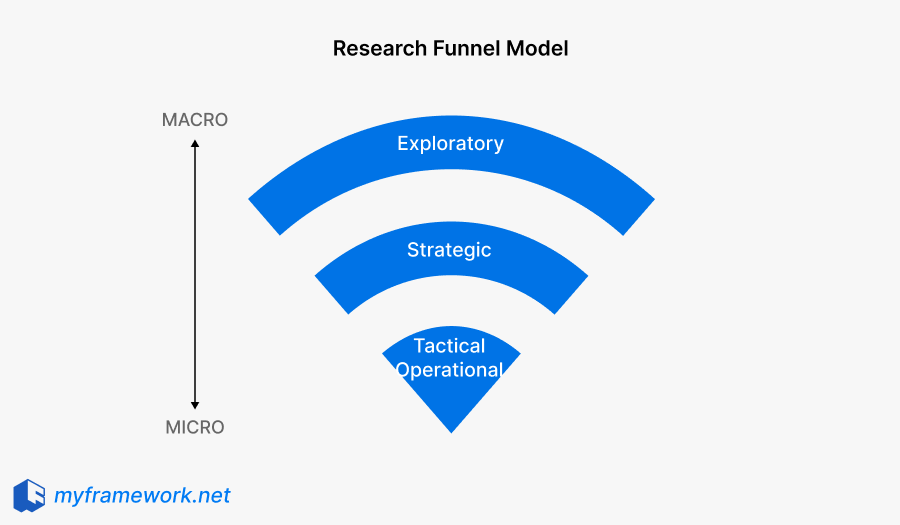
This model helps you structure your research based on how close you are to the problem, so you can make better use of your time, energy, and findings.
Three Levels of the Research Funnel
The Research Funnel breaks all user research into three categories, arranged from broad discovery to detailed validation. The idea is to match your research method to your current goal.
Exploratory Research: Find the Direction
When you only have a rough idea of the domain or user pain points, exploratory research helps you uncover what really matters.
This stage is about understanding the context.
- Methods: In-depth interviews, open-ended conversations, field observation.
- When to use: You have limited knowledge of your users and want to explore what problems exist.
- Example: A developer working on a children’s coding tool talked to 10 parents before building the product. He discovered the core issue was not the content itself but the parents’ lack of guidance skills. This changed his direction from building a question bank to focusing on parent-friendly support tools.
Strategic Research: Set the Direction
Once you’ve decided to build something, you need to define your priorities and target audience. Strategic research helps you make those choices.
- Methods: User personas, need clustering, pain point ranking.
- When to use: You know what product you want to build, but you're unclear on what features or users to focus on first.
- Example: A designer preparing to build an MVP for a SaaS tool interviewed startup founders. He learned that automation features were more important than visual chart design. So, he prioritized building auto-reports rather than dashboard beautification.
Tactical/Operational Research: Fine-Tune the Details
When your product is in development or already launched, research can help you improve the experience and validate ideas.
- Methods: Usability testing, A/B testing, heatmap analysis.
- When to use: You’re refining details or solving specific performance issues.
- Example: After launching a product, a developer noticed poor user conversion. He watched 10 new users use the app and saw most got stuck during registration. By simplifying the registration page, conversion increased by 40%.