The Golden Circle
For understanding how great leaders and orgs inspire action by starting with a clear sense of purpose.
The Relationship Map
A simple way to evaluate your relationships.
Research Funnel Model
Understand users with clarity, even when resources are tight.
StoryBrand Framework
Focuses on the seven elements necessary for helping your customer.
The Hook Model
A four-step process that encourages user engagement and promotes habit formation.
Self-Us-Now Framework
Help individuals and groups connect personal stories to collective action.
The AIDMA Model
Classic framework in marketing, helping business understand and influence each stage of the customer journey.
AISAS Model
Adapts traditional marketing concept to the digital landscape.
AARRR Model
Amodel redefines digital marketing by focusing on measurable growth and customer retention.
AIPL Model
Optimize each stage of the customer journey, from brand awareness to loyalty.
Pixar Storytelling Formula
Turn complex ideas into clear cause-and-effect stories people remember.
5A Marketing Model
focusing on how brands can guide prospects from awareness to advocacy.
Hero's Journey Storytelling Framework
A storytelling framework that makes your message relatable, memorable, and impactful in any context.
The Innovation Story Framework
Narrate how an idea was born, built, and scaled to demonstrate its real-world impact.
4P Marketing Mix
A classic framework that provides a clear, structured approach to marketing.
ICARE Model
Build a service culture that turns everyday interactions into lasting customer loyalty.
4C Marketing Model
For building customer-focused marketing strategies.
TAM-SAM-SOM Analysis
Enhance your market segmentation and marketing strategy
9 Key Forces of Mobile Technology Reshape Customer Behavior
Understand how context, location, and environment shape mobile customer decisions.
Marketing Funnel 5 Stages To Boost Email Marketing
Align your marketing email with the proven customer journey strategy.
Product GTM Canvas
Brings clarity, reduces risk, and gives your product the best chance of success.
FABE Model
Highlight product value, connect with customer needs, and build long-term trust
SPIN Model
Uncover real customer pain through thoughtful, guided questioning.
6 Essential Marketing Campaigns Every Brand Needs
Better fomulate your brand’s marketing strategy.
Straight Line System
Gives sales people a clear roadmap to follow.
4P Model in Content Marketing
Build a clear system to improve content, ensuring long-term marketing impact.
ChatGPT5 P.R.O.M.P.T. Framework For Business Planning
Help you stay focused, filter noise, and improve output, which is deeply aligned with your intent.
POEMS Framework
Gives teams a clear way to observe, classify, and interpret user behavior.
5E Experience Model
Map user journeys from first attraction to lasting memory by structuring experiences across five critical stages.
CARE Framework
Design consistent customer service experiences through connection, support, resolution, and continuous improvement.
Freytag’s Pyramid
Helps communicators control emotional rhythm and attention over time.
Philip Kotler's 5 Product Levels
Analyze where your product creates value and identify the layers where real differentiation happens.
Freytag’s Pyramid: Structure Compelling Business Narratives
Helps communicators control emotional rhythm and attention over time.
Freytag’s Pyramid
Why This Matters
Many stories fail not because the idea is weak, but because the structure is flat.
In business communication, presentations often start too slow, peak too late, or end without resolution. As a result, audiences lose attention, miss the key point, or forget what mattered most.
Freytag’s Pyramid solves this by giving you a clear narrative arc that builds tension, delivers impact, and lands with clarity.
Freytag’s Pyramid is a classic storytelling structure developed by German novelist and playwright Gustav Freytag.
It breaks a story into seven stages that move from setup to tension, reach a peak, and then resolve cleanly. While it originated in dramatic literature, it is widely used today in storytelling, presentations, speeches, and brand narratives.
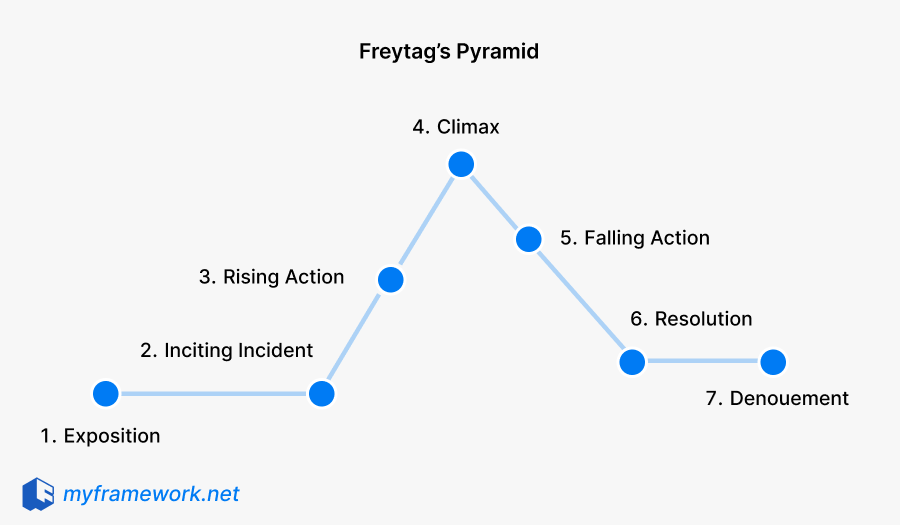
The model helps communicators control emotional rhythm and attention over time.
Core Concept of the Framework
Exposition
This is the introduction. You set the context, define the characters or stakeholders, and explain the situation.
In business, this could be the market context, the team, or the starting problem.
Inciting Incident
Something changes. A trigger appears that disrupts the status quo.
This could be a new challenge, a missed goal, a customer complaint, or a market shift.
Rising Action
Tension builds as actions are taken and obstacles appear. The audience starts to care because the outcome is uncertain.
In presentations, this is where complexity and stakes increase.
Climax
This is the turning point. The conflict reaches its peak.
A decision is made, a strategy is chosen, or a critical moment occurs. Everything before this leads here.
Falling Action
Tension begins to ease. The consequences of the decision unfold. You show what changed and how the situation starts to stabilize.
Resolution
The core conflict is resolved. The problem is addressed, the goal is reached, or a clear outcome is achieved.
Denouement
Loose ends are tied up.
You reflect, summarize lessons, and leave the audience with closure and meaning.