The Golden Circle
For understanding how great leaders and orgs inspire action by starting with a clear sense of purpose.
The Relationship Map
A simple way to evaluate your relationships.
Research Funnel Model
Understand users with clarity, even when resources are tight.
StoryBrand Framework
Focuses on the seven elements necessary for helping your customer.
The Hook Model
A four-step process that encourages user engagement and promotes habit formation.
Self-Us-Now Framework
Help individuals and groups connect personal stories to collective action.
The AIDMA Model
Classic framework in marketing, helping business understand and influence each stage of the customer journey.
AISAS Model
Adapts traditional marketing concept to the digital landscape.
AARRR Model
Amodel redefines digital marketing by focusing on measurable growth and customer retention.
AIPL Model
Optimize each stage of the customer journey, from brand awareness to loyalty.
Pixar Storytelling Formula
Turn complex ideas into clear cause-and-effect stories people remember.
5A Marketing Model
focusing on how brands can guide prospects from awareness to advocacy.
Hero's Journey Storytelling Framework
A storytelling framework that makes your message relatable, memorable, and impactful in any context.
The Innovation Story Framework
Narrate how an idea was born, built, and scaled to demonstrate its real-world impact.
4P Marketing Mix
A classic framework that provides a clear, structured approach to marketing.
ICARE Model
Build a service culture that turns everyday interactions into lasting customer loyalty.
4C Marketing Model
For building customer-focused marketing strategies.
TAM-SAM-SOM Analysis
Enhance your market segmentation and marketing strategy
9 Key Forces of Mobile Technology Reshape Customer Behavior
Understand how context, location, and environment shape mobile customer decisions.
Marketing Funnel 5 Stages To Boost Email Marketing
Align your marketing email with the proven customer journey strategy.
Product GTM Canvas
Brings clarity, reduces risk, and gives your product the best chance of success.
FABE Model
Highlight product value, connect with customer needs, and build long-term trust
SPIN Model
Uncover real customer pain through thoughtful, guided questioning.
6 Essential Marketing Campaigns Every Brand Needs
Better fomulate your brand’s marketing strategy.
Straight Line System
Gives sales people a clear roadmap to follow.
4P Model in Content Marketing
Build a clear system to improve content, ensuring long-term marketing impact.
ChatGPT5 P.R.O.M.P.T. Framework For Business Planning
Help you stay focused, filter noise, and improve output, which is deeply aligned with your intent.
POEMS Framework
Gives teams a clear way to observe, classify, and interpret user behavior.
5E Experience Model
Map user journeys from first attraction to lasting memory by structuring experiences across five critical stages.
CARE Framework
Design consistent customer service experiences through connection, support, resolution, and continuous improvement.
Freytag’s Pyramid
Helps communicators control emotional rhythm and attention over time.
Philip Kotler's 5 Product Levels
Analyze where your product creates value and identify the layers where real differentiation happens.
TAM-SAM-SOM Analysis: A Guide to Effective Market Segmentation
Enhance your market segmentation and marketing strategy
TAM-SAM-SOM Analysis
Introduction
Have you ever wondered how businesses identify the potential of a market and segment it effectively? The TAM-SAM-SOM model helps companies do just that.
Developed by marketing and business strategists, this framework allows organizations to better understand and measure the opportunity within a market.
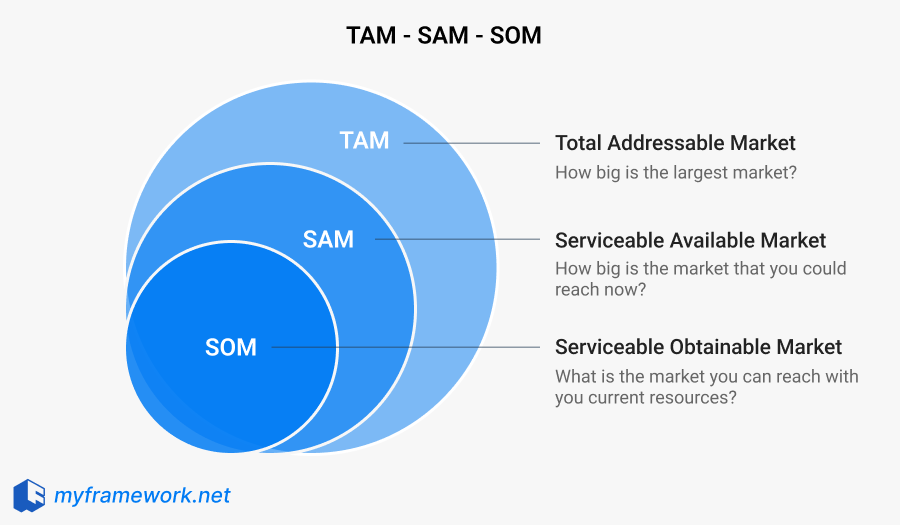
The model divides the market into three categories:
- Total Addressable Market (TAM)
- Serviceable Available Market (SAM)
- Serviceable Obtainable Market (SOM)
Each with a different level of market potential.
TAM (Total Addressable Market)
This is the broadest category and represents the total demand for a product or service within a market. It is the ideal scenario where a company has 100% market share and is serving every possible customer.
Key Questions for Defining TAM
What is the total size of the market globally or regionally?
What is the overall demand for this product or service?
How many potential customers exist, regardless of product availability?
What are the long-term trends driving the market’s growth?
SAM (Serviceable Available Market)
SAM is a more realistic view of the market. It narrows down the TAM to only those customers who are reachable based on geography, regulations, capabilities or resources.
Key Questions for Defining SAM:
Which geographic areas can I serve with my product or service?
What specific customer groups can I realistically target based on current capabilities?
What are the legal, regulatory, or cultural barriers preventing access to certain customers?
How does my offering meet the needs of this specific market?
SOM (Serviceable Obtainable Market)
SOM is the most specific category. It represents the portion of the SAM that your business can realistically capture, given your resources, competition, and market position.
Key Questions for Defining SOM:
What is the current competition in this segment, and what is their market share?
What portion of the market can I realistically reach in the next 6 to 12 months?
What resources (financial, human, or technological) do I have to capture this market?
How can I differentiate my offering to stand out in this specific segment?