Maslow's Hierarchy of Needs
Famous model in psychology and helps us understand what motivates people.
AVP Model
A simple practice to accept the anxiety, anger or sadness and start embracing them.
8+8+8 Rule
Make a good balance sheet of your life.
SQRRR (SQ3R) Method
A systematic approach to studying and comprehending reading material effectively.
Feynman Technique
Learning and understanding complex concepts by teaching them to someone else
STAR Method
Answer behavioral interview questions clearly.
Fogg Behavior Model
Identifies 3 elements for behavior change: Motivation, Ability, and Prompt.
Simon Learning Method
Effective strategies for rapid learning.
Mental Flow
A state of complete immersion and focused enjoyment in an activity.
Peak-End Rule
Explains how we remember experiences.
Freud’s Iceberg Theory
Developed from human psychology, it help us understand how the conscious and unconscious mind interacts.
Cornell Note-Taking System
Encourage active engagement with the material and reinforces memory with review.
COSTAR AI Prompt Framework
This AI prompt framework helps you receive higher-quality feedback, and it’s very simple and effective
CRISPE AI Prompt Framework
Define context, role, instruction, subject, preset, and exceptions to get high-quality AI feedback.
Current–Past–Future Interview Framework
An easy framework to answer "Tell Me About Yourself" in a job interview.
SOAR Self-Leadership Model
Built on four essential components that guide personal and professional development.
4-7-8 Breathing Technique
Simple approach to clam the nervous system.
4A Model
A valuable model to manage stress effectively.
5 Second Rule
A Simple Trick to overcome procrastination and anxiety.
Goleman Emotional Intelligence Model
Foundation for personal success and leadership.
BROKE AI Prompt Framework
Help you write better AI prompts.
ICIO AI Prompt Framework
A simple prompt that saves time and gets better result.
DIKW Model
Move beyond information overload and make truly wise decisions.
VITALS Method
Just take one small, meaningful step instead of a giant leap.
CBT Framework
It’s not the situation that causes your emotions — it’s how you think about it.
151515 Career Planning Model
Guiding you through three 15-year stages for your 45-year career.
ABC Model
A simple and practical way to break free from negative emotions.
PART Framework
Structure your answers and emphasize takeaways to show real growth.
ChatGPT5 P.R.O.M.P.T. Framework For Business Planning
Help you stay focused, filter noise, and improve output, which is deeply aligned with your intent.
Peak–Trough–Recovery Model
Knowing where you are helps you choose what to do next with intention instead of habit.
Three Zones of Learning
Helps you study and improve by giving you a clear way to plan your effort.
Deliberate Practice
Understand how to study with purpose, without wasted effort.
ISD Model
Creates a closed loop that ensures learning outcomes align with business objectives
ABC Model: How to Take Charge of Your Emotions
A simple and practical way to break free from negative emotions.
ABC Model
Why We Often Feel Stuck In Negative Emotions
Many people struggle with sudden frustration, anxiety, or even sadness that seems to appear out of nowhere.
We blame the event itself, like a harsh comment from a boss or a friend not replying to a message. But in reality, the root of our emotions is not the event. It is how we interpret it. If we can manage these interpretations, we can better manage our emotions and actions.
The ABC Model is part of Rational Emotive Behavior Therapy (REBT), created by psychologist Albert Ellis in the 1950s.
Ellis believed that people are not disturbed by events themselves, but by their beliefs about those events. He called this process the ABC Theory of Emotion.
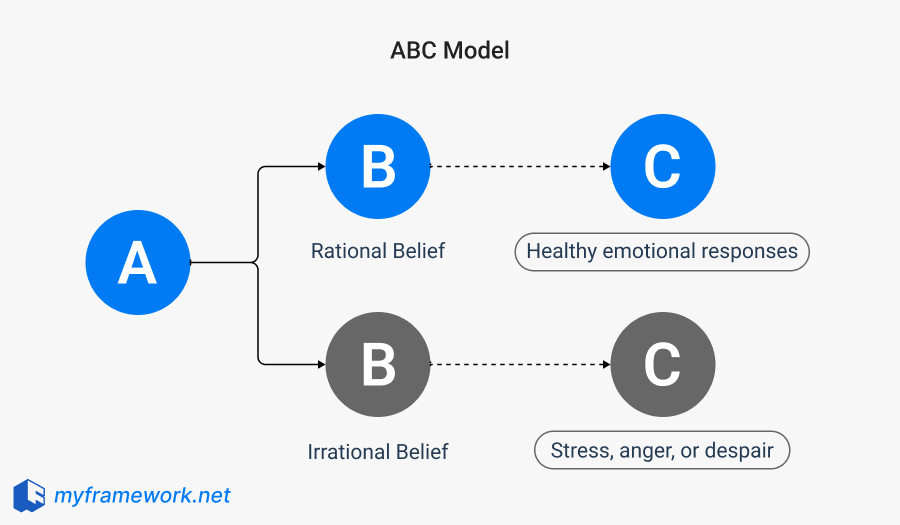
This model is now widely used in psychology, coaching, and personal improvement because it gives a practical tool to identify and change unhelpful thinking.
A - Activating Event
The situation that happens. It's only the trigger and it can be neutral or even random. Whatever the result is, one thing is obvious: it can not be changed.
B- Belief
The thoughts or assumptions we hold about the event.
It's the critical factor, because this is the only thing we can control.
A rational belief leads to healthy emotional responses, while an irrational belief creates stress, anger, or despair.
| Type | Definition | Example |
| Absolutism | Demanding that things must go our way | "I must win" or "Everyone must like me" |
| Overgeneralization | Judging yourself or others based on one event | "I failed once, so I am useless" |
| Catastrophizing | Assuming the worst possible outcome | "If I get criticized, I cannot survive it" |
C - Consequence
The consequenceis how we feel and act. Change the belief, and the consequence changes too.
By recognizing these patterns, we see that our emotions are not fixed. They are shaped by how we think.
So far, you can see that the ABC Model is a simple and practical way to break free from negative emotions. Still, I know it’s hard to follow any method when you feel really low.
If there’s only one thing to remember from this post, let it be this:
The real task is not managing emotions, but managing the irrational beliefs that drive them.