Maslow's Hierarchy of Needs
Famous model in psychology and helps us understand what motivates people.
AVP Model
A simple practice to accept the anxiety, anger or sadness and start embracing them.
8+8+8 Rule
Make a good balance sheet of your life.
SQRRR (SQ3R) Method
A systematic approach to studying and comprehending reading material effectively.
Feynman Technique
Learning and understanding complex concepts by teaching them to someone else
STAR Method
Answer behavioral interview questions clearly.
Fogg Behavior Model
Identifies 3 elements for behavior change: Motivation, Ability, and Prompt.
Simon Learning Method
Effective strategies for rapid learning.
Mental Flow
A state of complete immersion and focused enjoyment in an activity.
Peak-End Rule
Explains how we remember experiences.
Freud’s Iceberg Theory
Developed from human psychology, it help us understand how the conscious and unconscious mind interacts.
Cornell Note-Taking System
Encourage active engagement with the material and reinforces memory with review.
COSTAR AI Prompt Framework
This AI prompt framework helps you receive higher-quality feedback, and it’s very simple and effective
CRISPE AI Prompt Framework
Define context, role, instruction, subject, preset, and exceptions to get high-quality AI feedback.
Current–Past–Future Interview Framework
An easy framework to answer "Tell Me About Yourself" in a job interview.
SOAR Self-Leadership Model
Built on four essential components that guide personal and professional development.
4-7-8 Breathing Technique
Simple approach to clam the nervous system.
4A Model
A valuable model to manage stress effectively.
5 Second Rule
A Simple Trick to overcome procrastination and anxiety.
Goleman Emotional Intelligence Model
Foundation for personal success and leadership.
BROKE AI Prompt Framework
Help you write better AI prompts.
ICIO AI Prompt Framework
A simple prompt that saves time and gets better result.
DIKW Model
Move beyond information overload and make truly wise decisions.
VITALS Method
Just take one small, meaningful step instead of a giant leap.
CBT Framework
It’s not the situation that causes your emotions — it’s how you think about it.
151515 Career Planning Model
Guiding you through three 15-year stages for your 45-year career.
ABC Model
A simple and practical way to break free from negative emotions.
PART Framework
Structure your answers and emphasize takeaways to show real growth.
ChatGPT5 P.R.O.M.P.T. Framework For Business Planning
Help you stay focused, filter noise, and improve output, which is deeply aligned with your intent.
Peak–Trough–Recovery Model
Knowing where you are helps you choose what to do next with intention instead of habit.
Three Zones of Learning
Helps you study and improve by giving you a clear way to plan your effort.
Deliberate Practice
Understand how to study with purpose, without wasted effort.
ISD Model
Creates a closed loop that ensures learning outcomes align with business objectives
Three Zones of Learning: How to Grow Beyond Your Comfort Zone
Helps you study and improve by giving you a clear way to plan your effort.
Three Zones of Learning
Why This Matters
Many people want to improve, yet they feel stuck in routines that no longer help them grow. They stick to the same habits, repeat the same tasks, and wonder why their productivity doesn't change.
Noel Tichy, a professor at the University of Michigan, studied this problem and proposed a simple idea. Growth occurs when we understand our current position and then take one step beyond it. That is the heart of the Three Zones of Learning.
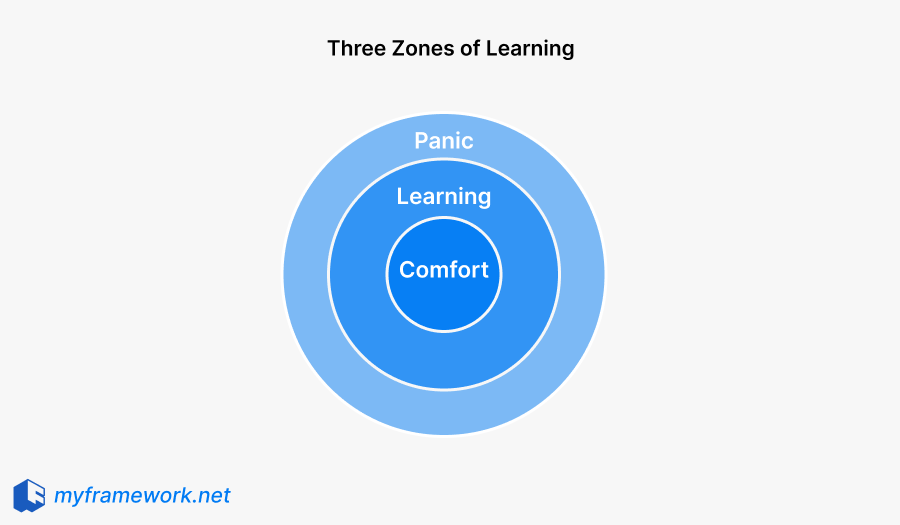
The Three Zones of Learning model describes three mental spaces that shape how we learn:
- Comfort zone
- Learning zone
- Panic zone
Each zone produces different emotions, different reactions, and different results. The key is to know when to stay, when to stretch, and when to pull back.
Comfort Zone
This is the space where everything feels familiar. Tasks are easy, skills are stable, and pressure is low.
People feel safe here, but the cost is slow improvement and productivity stays flat.
The comfort zone can become a trap when we stop noticing how the world changes around us. It feels warm, but it also limits how far we can go.
Learning Zone
This is where growth happens.
The learning zone creates enough challenge to activate curiosity without overwhelming the mind.
Research suggests that the ideal learning ratio is about 85 percent familiar and 15 percent unfamiliar. This mix keeps us engaged, stretches our thinking, and helps us learn faster. As we repeat these new skills, the unfamiliar becomes familiar, and the learning zone slowly transitions to the comfort zone.
Panic Zone
This is the space people usually won't want to touch. Tasks feel impossible, stress rises quickly, and focus disappears.
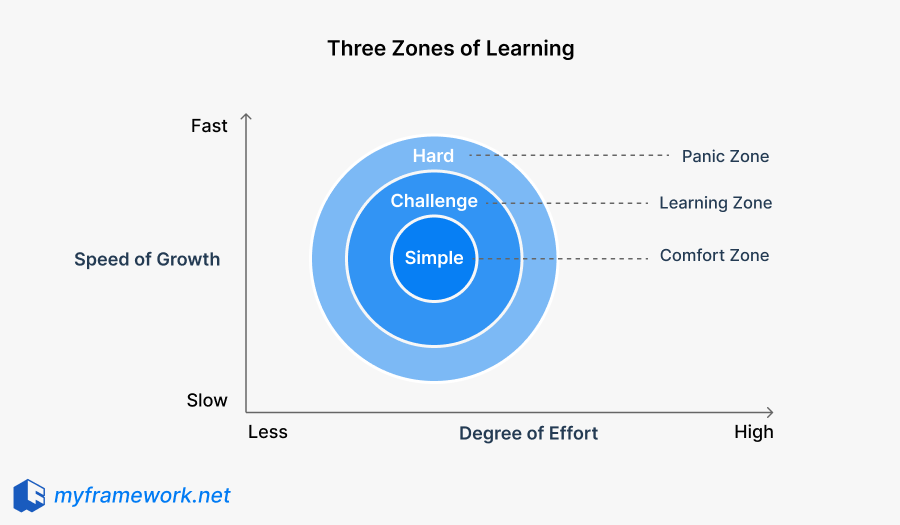
People sometimes quit because they believe they cannot succeed. In the panic zone, emotional overload replaces real learning. The goal is not to avoid this zone forever, but to move out of it fast and rebuild confidence inside the learning zone.