Maslow's Hierarchy of Needs
Famous model in psychology and helps us understand what motivates people.
AVP Model
A simple practice to accept the anxiety, anger or sadness and start embracing them.
8+8+8 Rule
Make a good balance sheet of your life.
SQRRR (SQ3R) Method
A systematic approach to studying and comprehending reading material effectively.
Feynman Technique
Learning and understanding complex concepts by teaching them to someone else
STAR Method
Answer behavioral interview questions clearly.
Fogg Behavior Model
Identifies 3 elements for behavior change: Motivation, Ability, and Prompt.
Simon Learning Method
Effective strategies for rapid learning.
Mental Flow
A state of complete immersion and focused enjoyment in an activity.
Peak-End Rule
Explains how we remember experiences.
Freud’s Iceberg Theory
Developed from human psychology, it help us understand how the conscious and unconscious mind interacts.
Cornell Note-Taking System
Encourage active engagement with the material and reinforces memory with review.
COSTAR AI Prompt Framework
This AI prompt framework helps you receive higher-quality feedback, and it’s very simple and effective
CRISPE AI Prompt Framework
Define context, role, instruction, subject, preset, and exceptions to get high-quality AI feedback.
Current–Past–Future Interview Framework
An easy framework to answer "Tell Me About Yourself" in a job interview.
SOAR Self-Leadership Model
Built on four essential components that guide personal and professional development.
4-7-8 Breathing Technique
Simple approach to clam the nervous system.
4A Model
A valuable model to manage stress effectively.
5 Second Rule
A Simple Trick to overcome procrastination and anxiety.
Goleman Emotional Intelligence Model
Foundation for personal success and leadership.
BROKE AI Prompt Framework
Help you write better AI prompts.
ICIO AI Prompt Framework
A simple prompt that saves time and gets better result.
DIKW Model
Move beyond information overload and make truly wise decisions.
VITALS Method
Just take one small, meaningful step instead of a giant leap.
CBT Framework
It’s not the situation that causes your emotions — it’s how you think about it.
151515 Career Planning Model
Guiding you through three 15-year stages for your 45-year career.
ABC Model
A simple and practical way to break free from negative emotions.
PART Framework
Structure your answers and emphasize takeaways to show real growth.
ChatGPT5 P.R.O.M.P.T. Framework For Business Planning
Help you stay focused, filter noise, and improve output, which is deeply aligned with your intent.
Peak–Trough–Recovery Model
Knowing where you are helps you choose what to do next with intention instead of habit.
Three Zones of Learning
Helps you study and improve by giving you a clear way to plan your effort.
Deliberate Practice
Understand how to study with purpose, without wasted effort.
ISD Model
Creates a closed loop that ensures learning outcomes align with business objectives
Maslow's Hierarchy of Needs: The 5 Levels of Human Motivation
Famous model in psychology and helps us understand what motivates people.
Maslow's Hierarchy of Needs
Check-in
Before you push for performance or growth, check if the basics are in place. Are fundamental needs being met, or are you expecting motivation without stability? When results feel stuck, the issue is often not capability, but unmet needs at a lower level.
The Maslow Demand Level Model, also known as Maslow's Hierarchy of Needs, is a psychological theory created by Abraham Maslow in 1943. It is one of the most famous models in psychology and helps us understand what motivates people.
Maslow created this model while working as a psychologist. He wanted to understand what drives people beyond just basic survival. He studied successful people like Albert Einstein and used ideas from humanistic psychology, which focuses on personal growth and reaching one's potential.
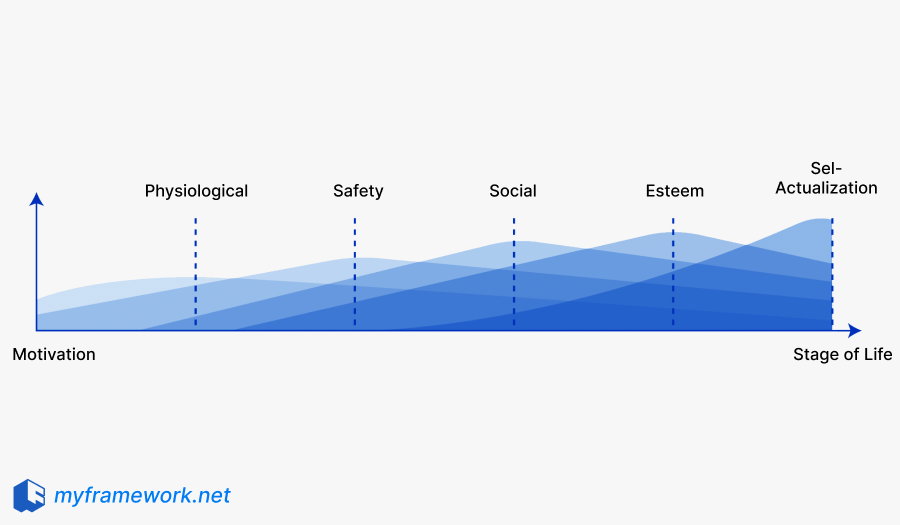
The model shows a pyramid of human needs, starting with the most basic needs and moving up to higher-level needs, ending with self-fulfillment.
Core Concept: The Hierarchy of Human Needs
The main idea of Maslow's model is that human needs are structured like a pyramid, with lower-level needs needing to be met before higher-level needs can be focused on. The hierarchy has five levels:
- Physiological Needs: Basic needs like food, water, sleep, and shelter.
- Safety Needs: Feeling safe, having financial security, and stability.
- Social Needs: The need for love, belonging, friendships, and social connections.
- Esteem Needs: Respect from others, self-esteem, recognition, and achievement.
- Self-Actualization Needs: The desire to reach one's full potential, personal growth, and fulfillment.