KISS Review Framework
An action-orientated review model to convert past experience into practice.
The Golden Circle
For understanding how great leaders and orgs inspire action by starting with a clear sense of purpose.
AVP Model
A simple practice to accept the anxiety, anger or sadness and start embracing them.
7-38-55 Rule
Your presence speaks louder than your words.
TOPS Framework
Make your pitch or message clear, logical, and action-oriented.
Winston’s Star
Apply five communication elements to make ideas memorable and repeatable.
2 Minute Rule
Change up the content every two minutes to keep people engaged.
The Rule of Suspense
Reveal your points step by step.
PREP Framework
Deliver clear, structured arguments by stating your point first, proving it, and closing with clarity.
FIRE Model
Separate facts from interpretations to respond to feedback calmly and solve the real problem.
Zoom-In and Zoom-Out Model
Allows you to handle challenges with clarity, whether you need to see the big picture or focus on the details.
Self-Us-Now Framework
Help individuals and groups connect personal stories to collective action.
7C Pyramid Communication Framework
Aim to eliminate confusion and miscommunication in both verbal and written forms
Pixar Storytelling Formula
Turn complex ideas into clear cause-and-effect stories people remember.
Hero's Journey Storytelling Framework
A storytelling framework that makes your message relatable, memorable, and impactful in any context.
The Innovation Story Framework
Narrate how an idea was born, built, and scaled to demonstrate its real-world impact.
COST Principle
Help people to deliver strong messages or express complex ideas.
Magic Loop Framework
Capture feedback, act on it, make changes stick, and report back with clarity.
RIDE Communication Framework
Help you persuade effectively, build trust, and gain support in any professional setting.
Freytag’s Pyramid
Helps communicators control emotional rhythm and attention over time.
SCR Framework
Resolve complications with concise, executive-ready solutions.
SCQA Framework
Structure complex messages into a clear narrative that leads the audience to your conclusion.
Pyramid Principle
Structured communication framework which is supporting your point with logically organized details and effective information delivery.
Magic Loop Framework: Close Feedback Gaps
Capture feedback, act on it, make changes stick, and report back with clarity.
Magic Loop Framework
Why Feedback Loops Break
Many teams struggle with broken feedback loops, where insights get stuck, action is delayed, and users or stakeholders feel unheard. These gaps weaken trust, lower engagement, and stall progress.
Magic Loop, a practical, cyclical communication framework designed to close the feedback loop efficiently and transparently. While its exact origin isn’t tied to a single creator, the model has been increasingly adopted in tech, service design, and product teams to enhance continuous learning and customer responsiveness.
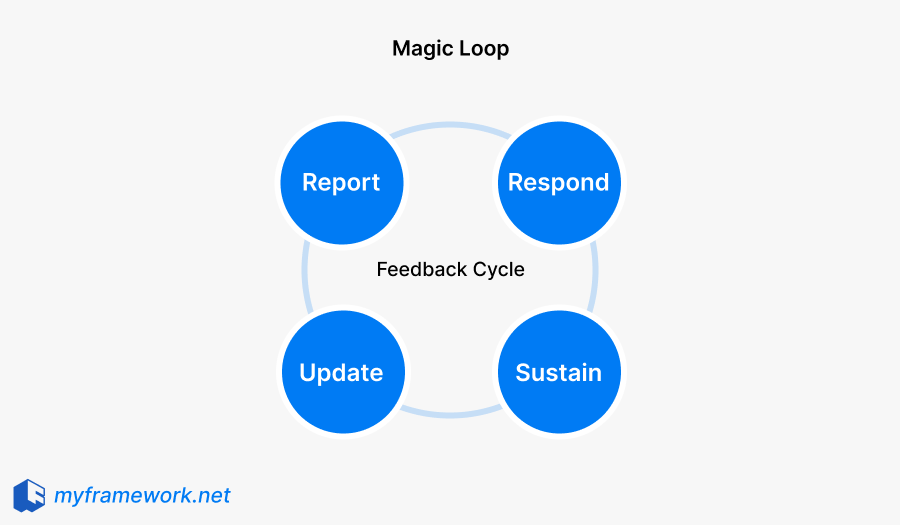
Core Concept of Magic Loop
Report
Capture and share what has been observed — be it a bug, user feedback, performance insight, or operational issue. The goal is to ensure the problem or input is clearly logged and acknowledged.
- Use accessible channels (support tickets, surveys, retrospectives).
- Structure the report: What happened? Who’s affected? What’s the evidence?
Respond
Take timely action.
This doesn’t always mean solving the issue immediately but showing that the input has been heard and addressed. A fast acknowledgment often matters more than an instant fix. Silence feels like rejection, even when the team is working on it.
- Acknowledge receipt and give an expected timeline.
- Prioritize and route to the right owner.
- Respond with empathy and clarity.
Sustain
Sustain is about ensuring that the solution or change is working and can be maintained over time.
- Introduce monitoring or documentation to lock in the change.
- Train teams or update procedures to prevent backsliding.
- Reinforce the impact of improvements.
A quick tip here: Don’t announce the fix until you’re sure it sticks. Let me give you an example:
- A bug is fixed — great.
- But to Sustain, you make sure it’s tested, won’t regress, and is supported by systems or policies.
Once the fix is stable and verified, you can move to the final stage: Update.
Update
Close the loop with the original reporter or broader community. Let them know what was done, what changed, or why it couldn’t be implemented (and what’s next).
- Share outcomes (even partial wins).
- Communicate clearly, even if the result isn’t perfect.
- Build trust by being transparent and consistent.
It’s called a “loop” for a reason — the process is ongoing and should repeat as new feedback or issues emerge.