KISS Review Framework
An action-orientated review model to convert past experience into practice.
The Golden Circle
For understanding how great leaders and orgs inspire action by starting with a clear sense of purpose.
AVP Model
A simple practice to accept the anxiety, anger or sadness and start embracing them.
7-38-55 Rule
Your presence speaks louder than your words.
TOPS Framework
Make your pitch or message clear, logical, and action-oriented.
Winston’s Star
Apply five communication elements to make ideas memorable and repeatable.
2 Minute Rule
Change up the content every two minutes to keep people engaged.
The Rule of Suspense
Reveal your points step by step.
PREP Framework
Deliver clear, structured arguments by stating your point first, proving it, and closing with clarity.
FIRE Model
Separate facts from interpretations to respond to feedback calmly and solve the real problem.
Zoom-In and Zoom-Out Model
Allows you to handle challenges with clarity, whether you need to see the big picture or focus on the details.
Self-Us-Now Framework
Help individuals and groups connect personal stories to collective action.
7C Pyramid Communication Framework
Aim to eliminate confusion and miscommunication in both verbal and written forms
Pixar Storytelling Formula
Turn complex ideas into clear cause-and-effect stories people remember.
Hero's Journey Storytelling Framework
A storytelling framework that makes your message relatable, memorable, and impactful in any context.
The Innovation Story Framework
Narrate how an idea was born, built, and scaled to demonstrate its real-world impact.
COST Principle
Help people to deliver strong messages or express complex ideas.
Magic Loop Framework
Capture feedback, act on it, make changes stick, and report back with clarity.
RIDE Communication Framework
Help you persuade effectively, build trust, and gain support in any professional setting.
Freytag’s Pyramid
Helps communicators control emotional rhythm and attention over time.
SCR Framework
Resolve complications with concise, executive-ready solutions.
SCQA Framework
Structure complex messages into a clear narrative that leads the audience to your conclusion.
Pyramid Principle
Structured communication framework which is supporting your point with logically organized details and effective information delivery.
2 Minute Rule: Keep People Engaged During Your Presentation
Change up the content every two minutes to keep people engaged.
2 Minute Rule
The Common Problem
While doing a presentation or public speaking, you may have seen many people losing the audience's attention, not due to unimportant content, but because the delivery is monotonous.
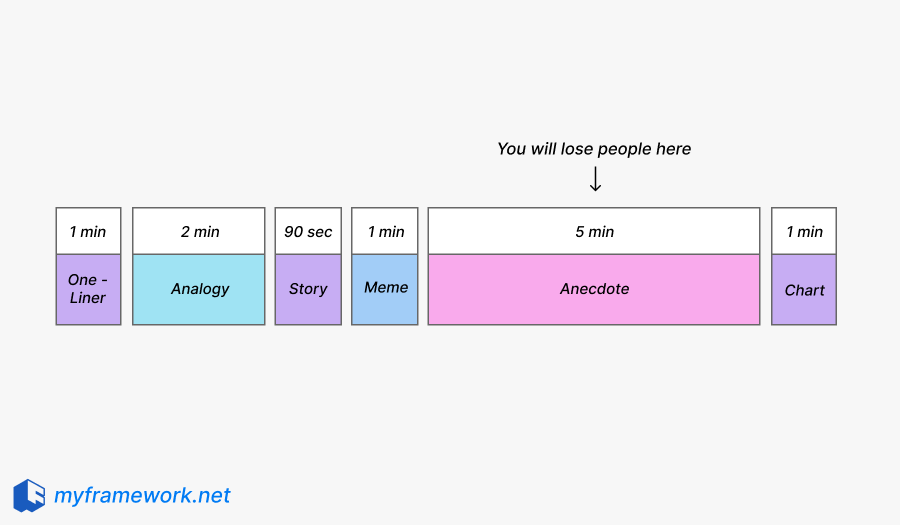
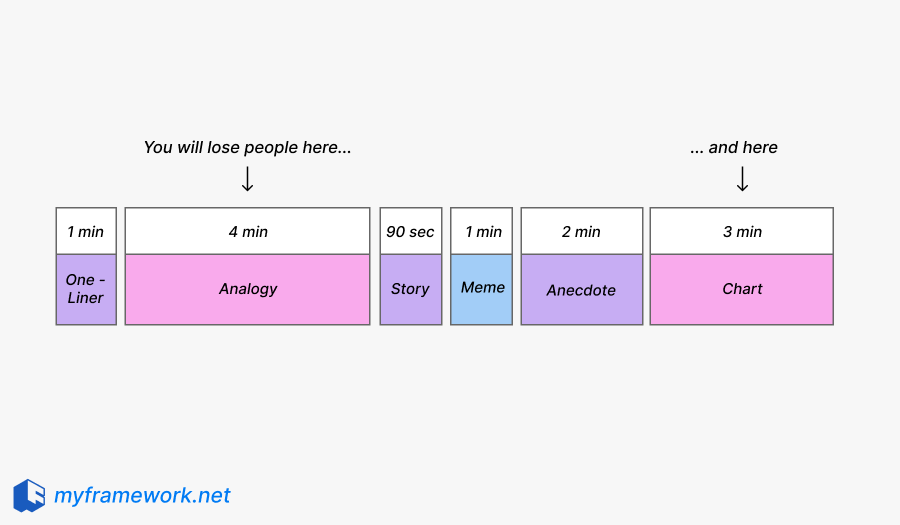
Research shows that adults can focus for about two minutes before their minds begin to wander if nothing changes. If your slides or speech keep the same tone for too long, even your best data will fade into background noise.
Why This Framework Works
The 2-Minute Rule is a communication strategy designed to keep audiences engaged by refreshing their attention every two minutes.
It stems from both cognitive science and practical presentation experience. Cognitive studies reveal that the human brain naturally craves novelty and contrast. This rule turns that insight into a simple, repeatable structure for meetings, speeches, and reports.
Detailed Explanation and Core Structure
The core idea is to change the format of your delivery at least once every two minutes so the audience’s brain gets a “fresh start.”
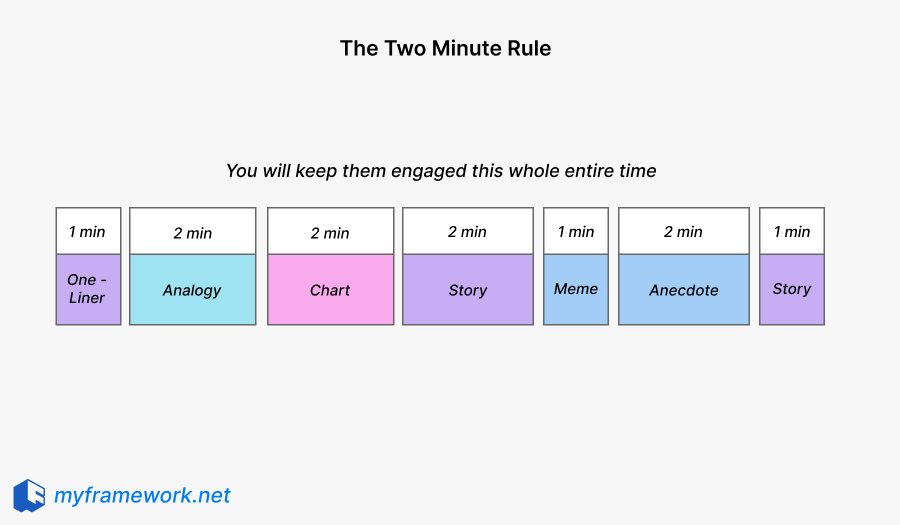
Each change is like flipping a page in a book—bringing new energy and focus.
Common switch methods include:
- One-liner (Punchline) – Start or transition with a short, memorable sentence. Example: “Data doesn’t lie, but storytellers can.”
- Analogy – Explain complex ideas with familiar comparisons. Example: “Upgrading our system is like replacing the engine of the entire supply chain.”
- Chart – Show data visually, not as a wall of numbers.
- Story – Share a real case that stirs emotion.
- Meme – Add a light, humorous image to reset attention.
- Anecdote – Insert a personal or relatable short story to make the content warm and human.
Arrange your slides to follow a pattern, for example: One-liner → Analogy → Chart → Story → Meme → Anecdote → Story.
Keep each segment under two minutes. Prepare transition cues like “This reminds me of…” or “Let’s go back to the data…” to signal a change.